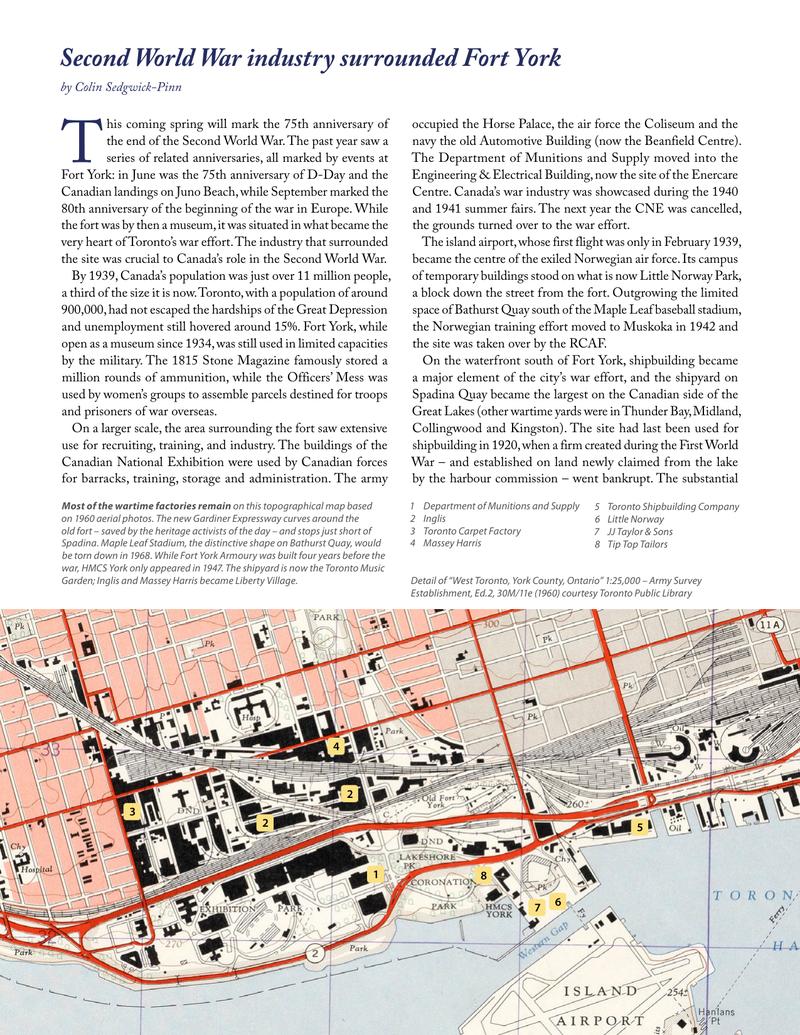
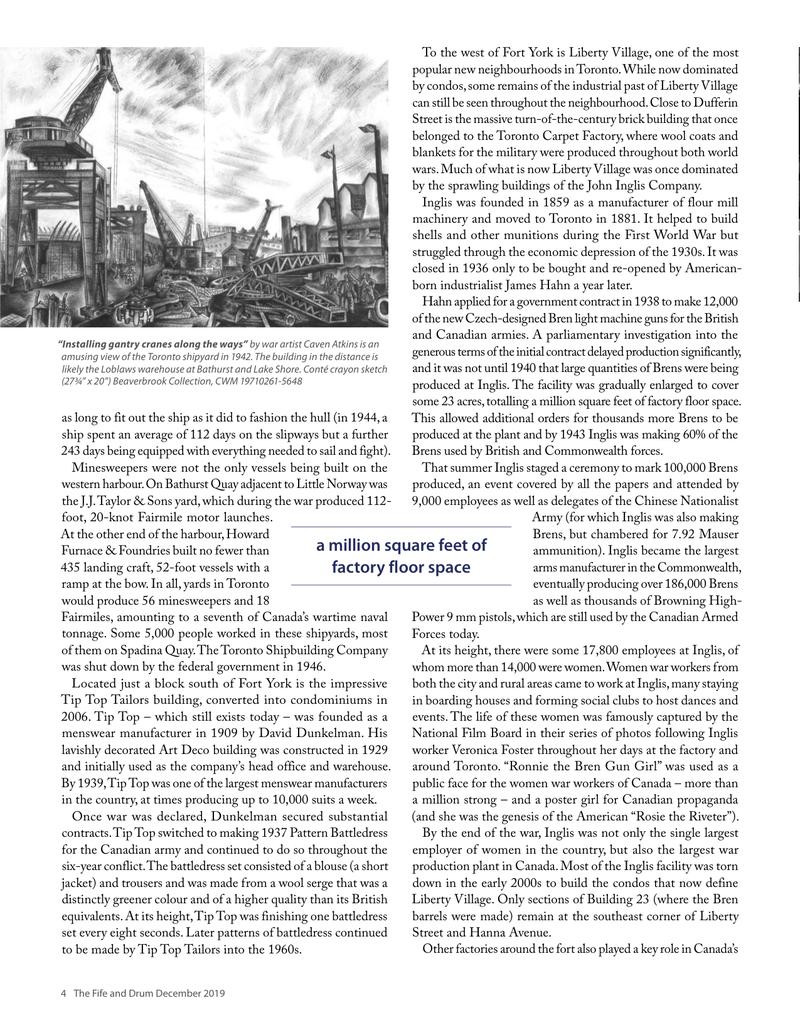
This coming spring will mark the 75th anniversary of the end of the Second World War. The past year saw a series of related anniversaries, all marked by events at Fort York: in June was the 75th anniversary of D-Day and the Canadian landings on Juno Beach, while September marked the 80th anniversary of the beginning of the war in Europe. While the fort was by then a museum, it was situated in what became the very heart of Toronto’s war effort. The industry that surrounded the site was crucial to Canada’s role in the Second World War.
By 1939, Canada’s population was just over 11 million people, a third of the size it is now. Toronto, with a population of around 900,000, had not escaped the hardships of the Great Depression and unemployment still hovered around 15%. Fort York, while open as a museum since 1934, was still used in limited capacities by the military. The 1815 Stone Magazine famously stored a million rounds of ammunition, while the Officers’ Mess was used by women’s groups to assemble parcels destined for troops and prisoners of war overseas.
On a larger scale, the area surrounding the fort saw extensive use for recruiting, training, and industry. The buildings of the Canadian National Exhibition were used by Canadian forces for barracks, training, storage and administration. The army occupied the Horse Palace, the air force the Coliseum and the navy the old Automotive Building (now the Beanfield Centre). The Department of Munitions and Supply moved into the Engineering & Electrical Building, now the site of the Enercare Centre. Canada’s war industry was showcased during the 1940 and 1941 summer fairs. The next year the CNE was cancelled, the grounds turned over to the war effort.
The island airport, whose first flight was only in February 1939, became the centre of the exiled Norwegian air force. Its campus of temporary buildings stood on what is now Little Norway Park, a block down the street from the fort. Outgrowing the limited space of Bathurst Quay south of the Maple Leaf baseball stadium, the Norwegian training effort moved to Muskoka in 1942 and the site was taken over by the RCAF.
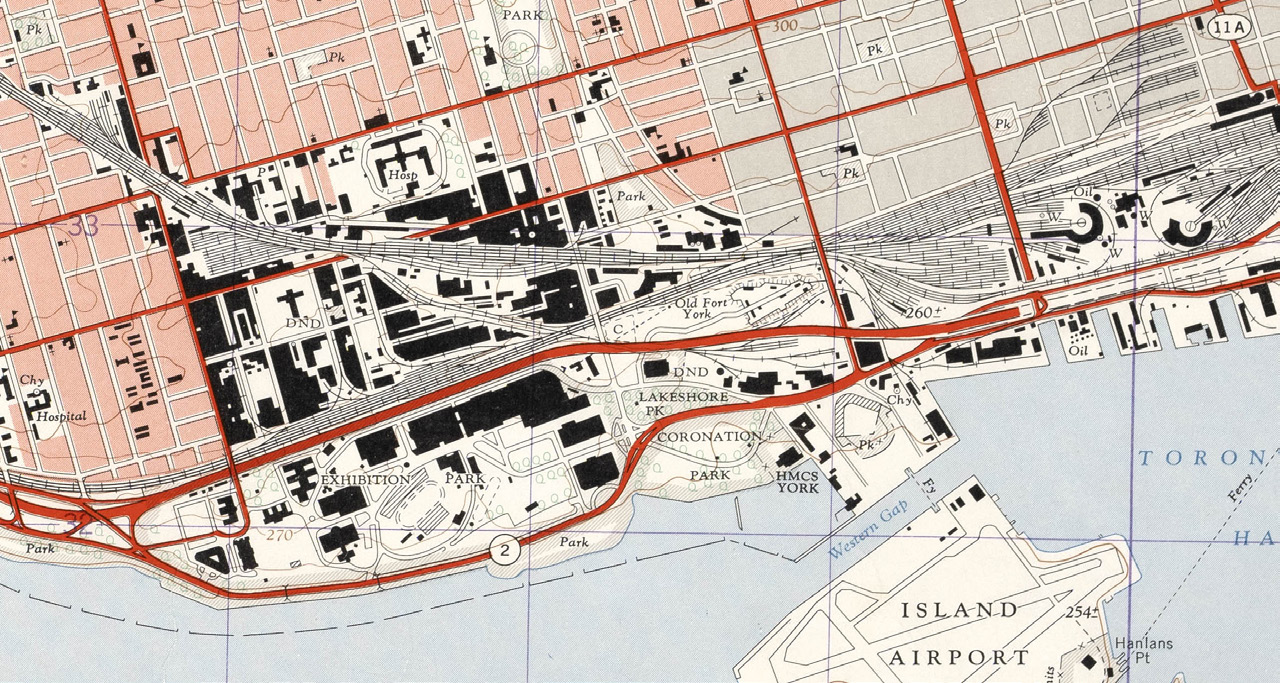
On the waterfront south of Fort York, shipbuilding became a major element of the city’s war effort, and the shipyard on Spadina Quay became the largest on the Canadian side of the Great Lakes (other wartime yards were in Thunder Bay, Midland, Collingwood and Kingston). The site had last been used for shipbuilding in 1920, when a firm created during the First World War – and established on land newly claimed from the lake by the harbour commission – went bankrupt. The substantial factory floor was revived during the Second World War to produce corvettes and minesweepers for the Royal Canadian Navy. By 1944, the yard employed over 3,000 people and covered some 23 acres, totalling a million square feet of factory floor space. This allowed additional orders for thousands more to be produced at the plant.
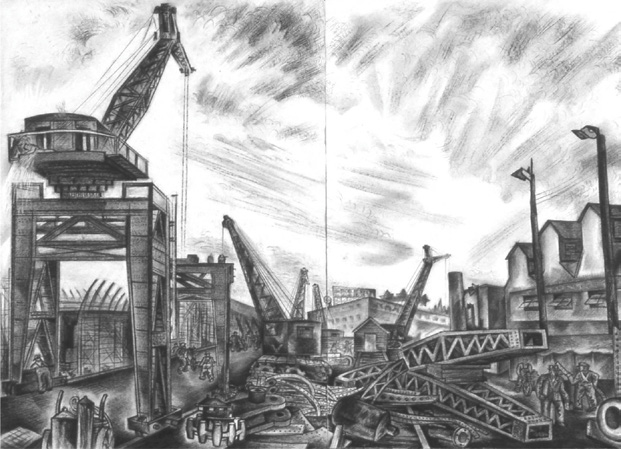
The work was meticulous and time-consuming: it took as long to fit out the ship as it did to fashion the hull (in 1944, a ship spent an average of 112 days on the slipways but a further 243 days being equipped with everything needed to sail and fight).
a million square feet of factory floor space
Minesweepers were not the only vessels being built on the western harbour. On Bathurst Quay adjacent to Little Norway was the J.J. Taylor & Sons yard, which during the war produced 112-foot, 20-knot Fairmile motor launches. At the other end of the harbour, Howard Furnace & Foundries built no fewer than 435 landing craft, 52-foot vessels with a ramp at the bow. In all, yards in Toronto would produce 56 minesweepers and 18 Fairmiles, amounting to a seventh of Canada’s wartime naval tonnage. Some 5,000 people worked in these shipyards, most of them on Spadina Quay. The Toronto Shipbuilding Company was shut down by the federal government in 1946.
Located just a block south of Fort York is the impressive Tip Top Tailors building, converted into condominiums in 2006. Tip Top – which still exists today – was founded as a menswear manufacturer in 1909 by David Dunkelman. His lavishly decorated Art Deco building was constructed in 1929 and initially used as the company’s head office and warehouse. By 1939, Tip Top was one of the largest menswear manufacturers in the country, at times producing up to 10,000 suits a week.
Once war was declared, Dunkelman secured substantial contracts. Tip Top switched to making 1937 Pattern Battledress for the Canadian army and continued to do so throughout the six-year conflict. The battledress set consisted of a blouse (a short jacket) and trousers and was made from a wool serge that was a distinctly greener colour and of a higher quality than its British equivalents. At its height, Tip Top was finishing one battledress set every eight seconds. Later patterns of battledress continued to be made by Tip Top Tailors into the 1960s.
To the west of Fort York is Liberty Village, one of the most popular new neighbourhoods in Toronto. While now dominated by condos, some remains of the industrial past of Liberty Village can still be seen throughout the neighbourhood. Close to Dufferin Street is the massive turn-of-the-century brick building that once belonged to the Toronto Carpet Factory, where wool coats and blankets for the military were produced throughout both world wars. Much of what is now Liberty Village was once dominated by the sprawling buildings of the John Inglis Company.
Inglis was founded in 1859 as a manufacturer of flour mill machinery and moved to Toronto in 1881. It helped to build shells and other munitions during the First World War but struggled through the economic depression of the 1930s. It was closed in 1936 only to be bought and re-opened by American-born industrialist James Hahn a year later.
Hahn applied for a government contract in 1938 to make 12,000 of the new Czech-designed Bren light machine guns for the British and Canadian armies. A parliamentary investigation into the generous terms of the initial contract delayed production significantly, and it was not until 1940 that large quantities of Brens were being produced at Inglis. The facility was gradually enlarged to cover some 23 acres, totalling a million square feet of factory floor space. This allowed additional orders for thousands more Brens to be produced at the plant and by 1943 Inglis was making 60% of the Brens used by British and Commonwealth forces.
That summer Inglis staged a ceremony to mark 100,000 Brens produced, an event covered by all the papers and attended by 9,000 employees as well as delegates of the Chinese Nationalist Army (for which Inglis was also making Brens, but chambered for 7.92 Mauser ammunition). Inglis became the largest arms manufacturer in the Commonwealth, eventually producing over 186,000 Brens as well as thousands of Browning High-Power 9 mm pistols, which are still used by the Canadian Armed Forces today.
At its height, there were some 17,800 employees at Inglis, of whom more than 14,000 were women. Women war workers from both the city and rural areas came to work at Inglis, many staying in boarding houses and forming social clubs to host dances and events. The life of these women was famously captured by the National Film Board in their series of photos following Inglis worker Veronica Foster through her days at the factory and around Toronto. “Ronnie the Bren Gun Girl” was used as a public face for the women war workers of Canada – more than a million strong – and a poster girl for Canadian propaganda (and she was the genesis of the American “Rosie the Riveter”).
By the end of the war, Inglis was not only the single largest employer of women in the country, but also the largest war production plant in Canada. Most of the Inglis facility was torn down in the early 2000s to build the condos that now define Liberty Village. Only sections of Building 23 (where the Bren barrels were made) remain at the southeast corner of Liberty Street and Hanna Avenue.
Other factories around the fort also played a key role in Canada’s
Original printed pages