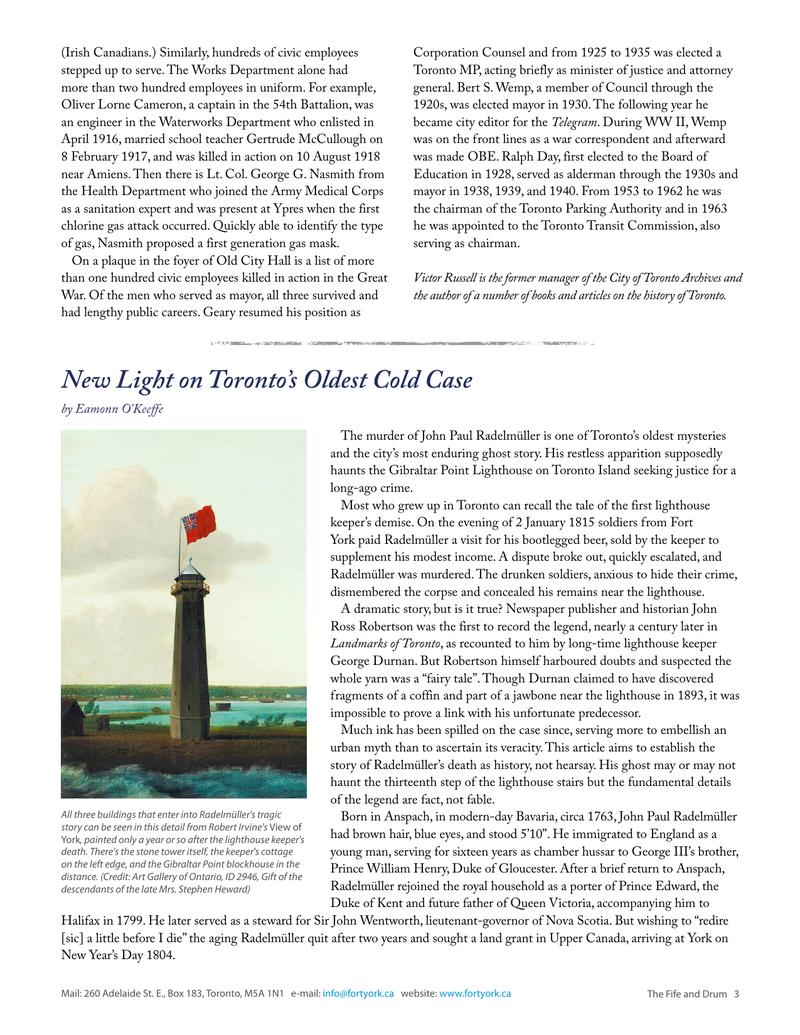
The murder of John Paul Radelmüller is one of Toronto’s oldest mysteries and the city’s most enduring ghost story. His restless apparition supposedly haunts the Gibraltar Point Lighthouse on Toronto Island seeking justice for a long-ago crime.
Most who grew up in Toronto can recall the tale of the first lighthouse keeper’s demise. On the evening of 2 January 1815 soldiers from Fort York paid Radelmüller a visit for his bootlegged beer, sold by the keeper to supplement his modest income. A dispute broke out, quickly escalated, and Radelmüller was murdered. The drunken soldiers, anxious to hide their crime, dismembered the corpse and concealed his remains near the lighthouse.
A dramatic story, but is it true? Newspaper publisher and historian John Ross Robertson was the first to record the legend, nearly a century later in Landmarks of Toronto, as recounted to him by long-time lighthouse keeper George Durnan. But Robertson himself harboured doubts and suspected the whole yarn was a “fairy tale”. Though Durnan claimed to have discovered fragments of a coffin and part of a jawbone near the lighthouse in 1893, it was impossible to prove a link with his unfortunate predecessor.
Much ink has been spilled on the case since, serving more to embellish an urban myth than to ascertain its veracity. This article aims to establish the story of Radelmüller’s death as history, not hearsay. His ghost may or may not haunt the thirteenth step of the lighthouse stairs but the fundamental details of the legend are fact, not fable.
Born in Anspach, in modern-day Bavaria, circa 1763, John Paul Radelmüller had brown hair, blue eyes, and stood 5’10”. He immigrated to England as a young man, serving for sixteen years as chamber hussar to George III’s brother, Prince William Henry, Duke of Gloucester. After a brief return to Anspach, Radelmüller rejoined the royal household as a porter of Prince Edward, the Duke of Kent and future father of Queen Victoria, accompanying him to Halifax in 1799. He later served as a steward for Sir John Wentworth, lieutenant-governor of Nova Scotia. But wishing to “retire after two years and sought a land grant in Upper Canada, arriving at York on New Year’s Day 1804.
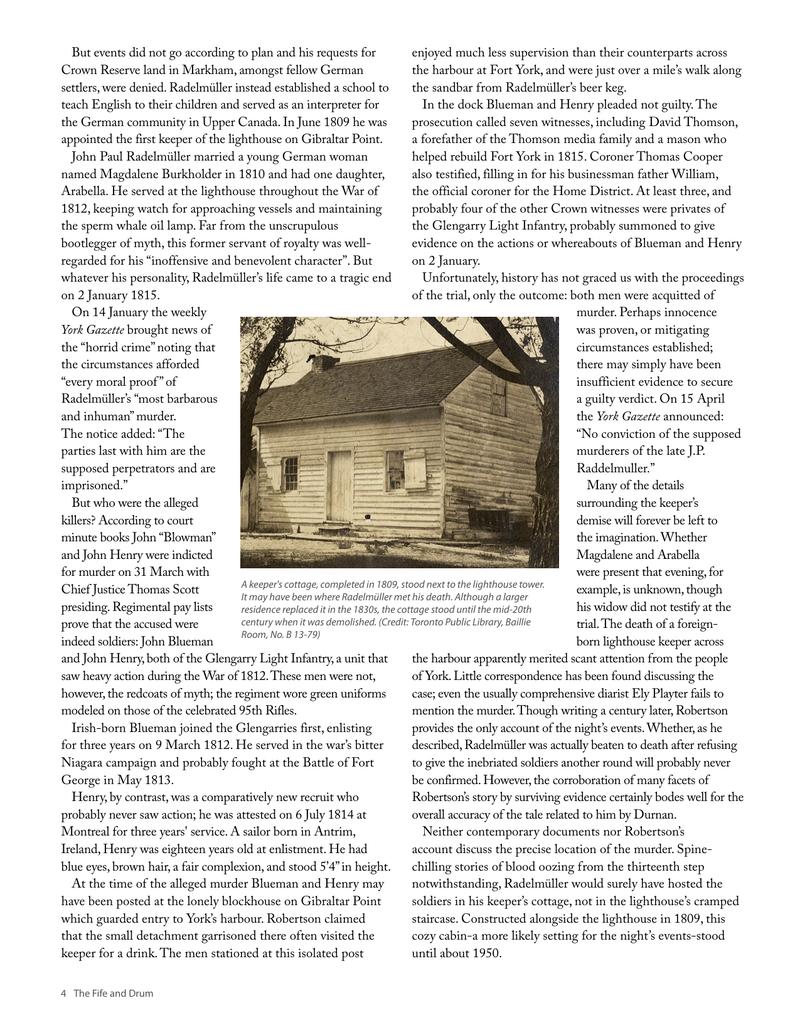
But events did not go according to plan and his requests for Crown Reserve land in Markham, amongst fellow German settlers, were denied. Radelmüller instead established a school to teach English to their children and served as an interpreter for the German community in Upper Canada. In June 1809 he was appointed the first keeper of the lighthouse on Gibraltar Point.
John Paul Radelmüller married a young German woman named Magdalene Burkholder in 1810 and had one daughter, Arabella. He served at the lighthouse throughout the War of 1812, keeping watch for approaching vessels and maintaining the sperm whale oil lamp. Far from the unscrupulous bootlegger of myth, this former servant of royalty was well-regarded for his “inoffensive and benevolent character”. But whatever his personality, Radelmüller’s life came to a tragic end on 2 January 1815.
On 14 January the weekly York Gazette brought news of the “horrid crime” noting that the circumstances afforded “every moral proof” of Radelmüller’s “most barbarous and inhuman” murder. The notice added: “The parties last with him are the supposed perpetrators and are imprisoned.”
But who were the alleged killers? According to court minute books John “Blowman” and John Henry were indicted for murder on 31 March with Chief Justice Thomas Scott presiding. Regimental pay lists prove that the accused were indeed soldiers: John Blueman and John Henry, both of the Glengarry Light Infantry, a unit that saw heavy action during the War of 1812. These men were not, however, the redcoats of myth; the regiment wore green uniforms modeled on those of the celebrated 95th Rifles.
Irish-born Blueman joined the Glengarries first, enlisting for three years on 9 March 1812. He served in the war’s bitter Niagara campaign and probably fought at the Battle of Fort George in May 1813.
Henry, by contrast, was a comparatively new recruit who probably never saw action; he was attested on 6 July 1814 at Montreal for three years’ service. A sailor born in Antrim, Ireland, Henry was eighteen years old at enlistment. He had blue eyes, brown hair, a fair complexion, and stood 5’4″ in height.
At the time of the alleged murder Blueman and Henry may have been posted at the lonely blockhouse on Gibraltar Point which guarded entry to York’s harbour. Robertson claimed that the small detachment garrisoned there often visited the keeper for a drink. The men stationed at this isolated post enjoyed much less supervision than their counterparts across the harbour at Fort York, and were just over a mile’s walk along the sandbar from Radelmüller’s beer keg.
In the dock Blueman and Henry pleaded not guilty. The prosecution called seven witnesses, including David Thomson, a forefather of the Thomson media family and a mason who helped rebuild Fort York in 1815. Coroner Thomas Cooper also testified, filling in for his businessman father William, the official coroner for the Home District. At least three, and probably four of the other Crown witnesses were privates of the Glengarry Light Infantry, probably summoned to give evidence on the actions or whereabouts of Blueman and Henry on 2 January.

Unfortunately, history has not graced us with the proceedings of the trial, only the outcome: both men were acquitted of murder. Perhaps innocence was proven, or mitigating circumstances established; there may simply have been insufficient evidence to secure a guilty verdict. On 15 April the York Gazette announced: “No conviction of the supposed murderers of the late J.P. Raddelmuller.”
Many of the details surrounding the keeper’s demise will forever be left to the imagination. Whether Magdalene and Arabella were present that evening, for example, is unknown, though his widow did not testify at the trial. The death of a foreign-born lighthouse keeper across the harbour apparently merited scant attention from the people of York. Little correspondence has been found discussing the case; even the usually comprehensive diarist Ely Playter fails to mention the murder. Though writing a century later, Robertson provides the only account of the night’s events. Whether, as he described, Radelmüller was actually beaten to death after refusing to give the inebriated soldiers another round will probably never be confirmed. However, the corroboration of many facets of Robertson’s story by surviving evidence certainly bodes well for the overall accuracy of the tale related to him by Durnan.
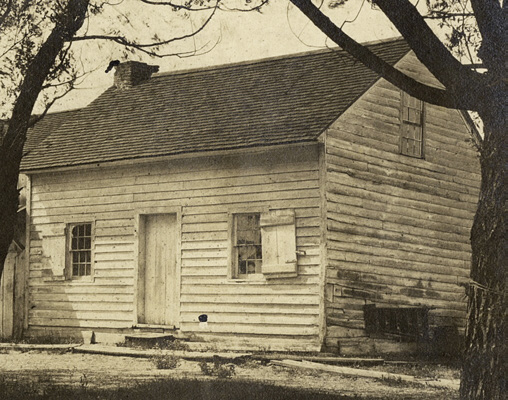
Neither contemporary documents nor Robertson’s account discuss the precise location of the murder. Spine-chilling stories of blood oozing from the thirteenth step notwithstanding, Radelmüller would surely have hosted the soldiers in his keeper’s cottage, not in the lighthouse’s cramped staircase. Constructed alongside the lighthouse in 1809, this cozy cabin-a more likely setting for the night’s events-stood until about 1950.
Although investigation has supported much of the traditional legend, rumours of the gruesome fate of Radelmüller’s corpse appear completely unfounded. While a missing body makes for a better ghost story, no sources describe the killers mutilating and concealing the keeper’s remains, or even claim that Radelmüller disappeared at all. In fact, contemporary reports note his “unfortunate death” without displaying any of the uncertainty that would inevitably arise in the absence of a body. A close reading of Robertson’s account provides the final nail in the coffin, so to speak, implying that Radelmüller’s corpse was respectfully buried, not hacked to pieces and scattered. The discovery of coffin fragments alongside a jawbone in 1893, if indeed linked to Radelmüller, would support such a conclusion, but does not tally with a hasty burial by fugitive killers. Contrary to oft-repeated claims that the keeper was “never seen again” all evidence suggests that Radelmüller’s body did not vanish in the first place, but was found, examined by the coroner, and laid to rest near the lighthouse.
Blueman and Henry had escaped the death penalty but neither remained in the army for long. Blueman, his term of enlistment complete, was discharged on 28 April 1815, while Henry deserted from the Glengarry Light Infantry on 30 June. Like many former soldiers Blueman received a location ticket in 1816 for 100 acres in Sophiasburgh, Prince Edward County, as a reward for his service. He never settled there permanently but later had second thoughts; his 1830 petition for another land grant was approved, though no lot was ever assigned to Blueman.
In 1816 John Radelmüller’s widow and brother-in-law, Michael Burkholder, secured title for 200 acres in Reach Township in trust for Arabella, in posthumous fulfillment of her father’s 1805 land petition. Just four or five years old at her father’s murder, Arabella grew up, married, and had seven children before her own death in 1844, aged 34.
The story of John Paul Radelmüller’s unfortunate demise has become one of Toronto’s most cherished myths. The tale has no doubt been “garnished in the telling” as Robertson warned, but nonetheless remains firmly rooted in fact. We may never know precisely how Radelmüller gave up the ghost on 2 January 1815, nor whether that ghost still haunts the Gibraltar Point lighthouse. But perhaps it does-if not in search of its dismembered corpse, then at least in pursuit of its pilfered jawbone!
Original printed pages