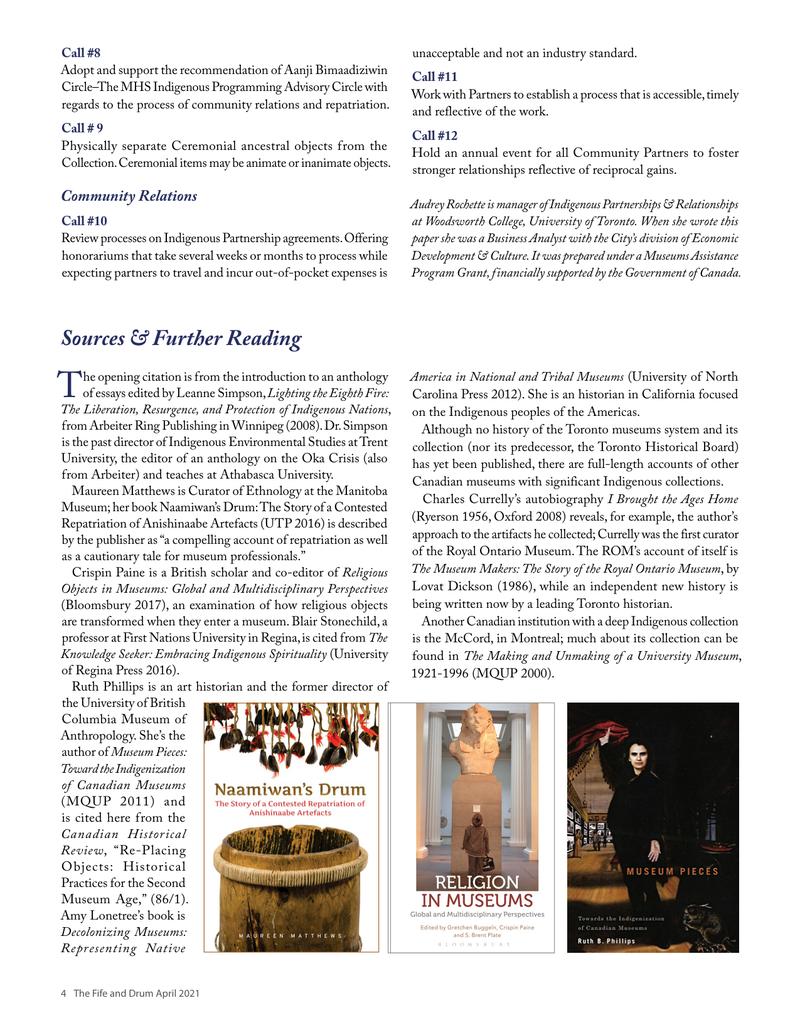
he opening citation is from the introduction to an anthology T of essays edited by Leanne Simpson, Lighting the Eighth Fire: The Liberation, Resurgence, and Protection of Indigenous Nations, from Arbeiter Ring Publishing in Winnipeg (2008). Dr. Simpson is the past director of Indigenous Environmental Studies at Trent University, the editor of an anthology on the Oka Crisis (also from Arbeiter) and teaches at Athabasca University. Maureen Matthews is Curator of Ethnology at the Manitoba Museum; her book Naamiwan’s Drum: The Story of a Contested Repatriation of Anishinaabe Artefacts (UTP 2016) is described by the publisher as “a compelling account of repatriation as well as a cautionary tale for museum professionals.” Crispin Paine is a British scholar and co-editor of Religious Objects in Museums: Global and Multidisciplinary Perspectives (Bloomsbury 2017), an examination of how religious objects are transformed when they enter a museum. Blair Stonechild, a professor at First Nations University in Regina, is cited from The Knowledge Seeker: Embracing Indigenous Spirituality (University of Regina Press 2016). Ruth Phillips is an art historian and the former director of the University of British Columbia Museum of Anthropology. She’s the author of Museum Pieces: Toward the Indigenization of Canadian Museums (MQUP 2011) and is cited here from the Canadian Historical Review, “Re-Placing Objects: Historical Practices for the Second Museum Age,” (86/1). Amy Lonetree’s book is Decolonizing Museums: Representing Native
America in National and Tribal Museums (University of North Carolina Press 2012). She is an historian in California focused on the Indigenous peoples of the Americas. Although no history of the Toronto museums system and its collection (nor its predecessor, the Toronto Historical Board) has yet been published, there are full-length accounts of other Canadian museums with significant Indigenous collections. Charles Currelly’s autobiography I Brought the Ages Home (Ryerson 1956, Oxford 2008) reveals, for example, the author’s approach to the artifacts he collected; Currelly was the first curator of the Royal Ontario Museum. The ROM’s account of itself is The Museum Makers: The Story of the Royal Ontario Museum, by Lovat Dickson (1986), while an independent new history is being written now by a leading Toronto historian. Another Canadian institution with a deep Indigenous collection is the McCord, in Montreal; much about its collection can be found in The Making and Unmaking of a University Museum, 1921-1996 (MQUP 2000).
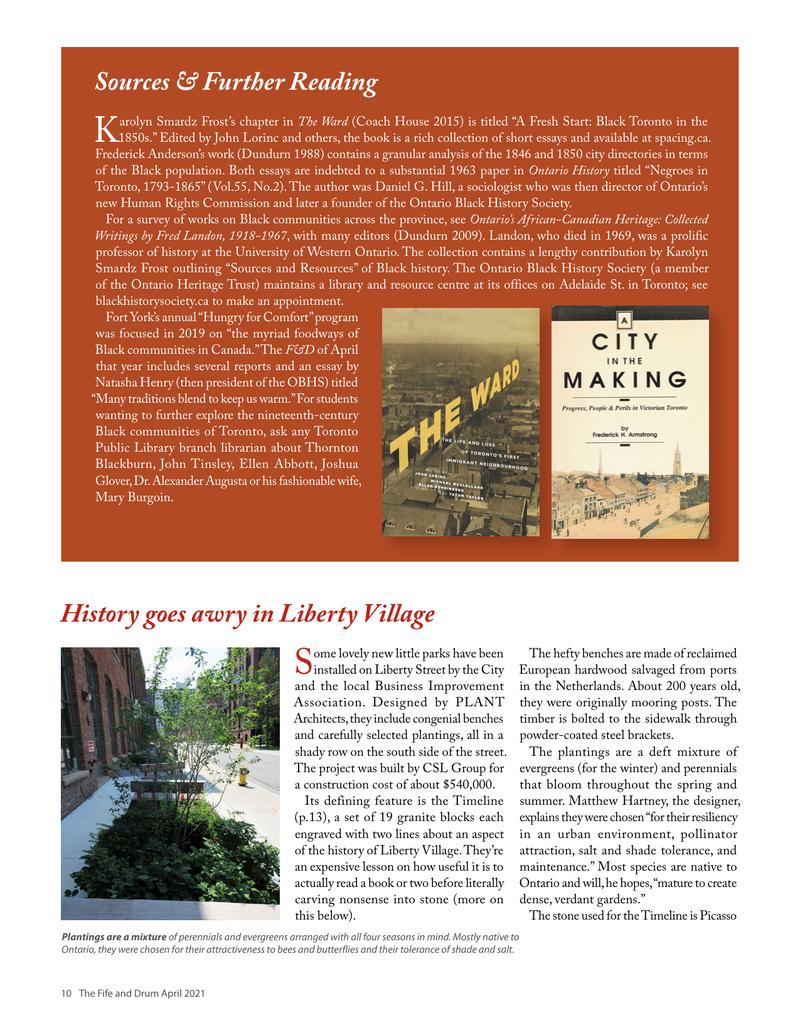
Sources & Further Reading arolyn Smardz Frost’s chapter in The Ward (Coach House 2015) is titled K 1850s.” Edited by John Lorinc and others, the book is a rich collection of short Frederick Anderson’s work (Dundurn 1988) contains a granular analysis of the 1846 of the Black population. Both essays are indebted to a substantial 1963 paper Toronto, 1793-1865” (Vol.55, No.2). The author was Daniel G. Hill, a sociologist new Human Rights Commission and later a founder of the Ontario Black History For a survey of works on Black communities across the province, see Ontario’s Writings by Fred Landon, 1918-1967, with many editors (Dundurn 2009). Landon, professor of history at the University of Western Ontario. The collection contains Smardz Frost outlining “Sources and Resources” of Black history. The Ontario of the Ontario Heritage Trust) maintains a library and resource centre at its offices blackhistorysociety.ca to make an appointment. Fort York’s annual “Hungry for Comfort” program was focused in 2019 on “the myriad foodways of Black communities in Canada.” The F&D of April that year includes several reports and an essay by Natasha Henry (then president of the OBHS) titled “Many traditions blend to keep us warm.” For students wanting to further explore the nineteenth-century Black communities of Toronto, ask any Toronto Public Library branch librarian about Thornton Blackburn, John Tinsley, Ellen Abbott, Joshua Glover, Dr. Alexander Augusta or his fashionable wife, Mary Burgoin.
Sources & Further Reading
Original printed pages