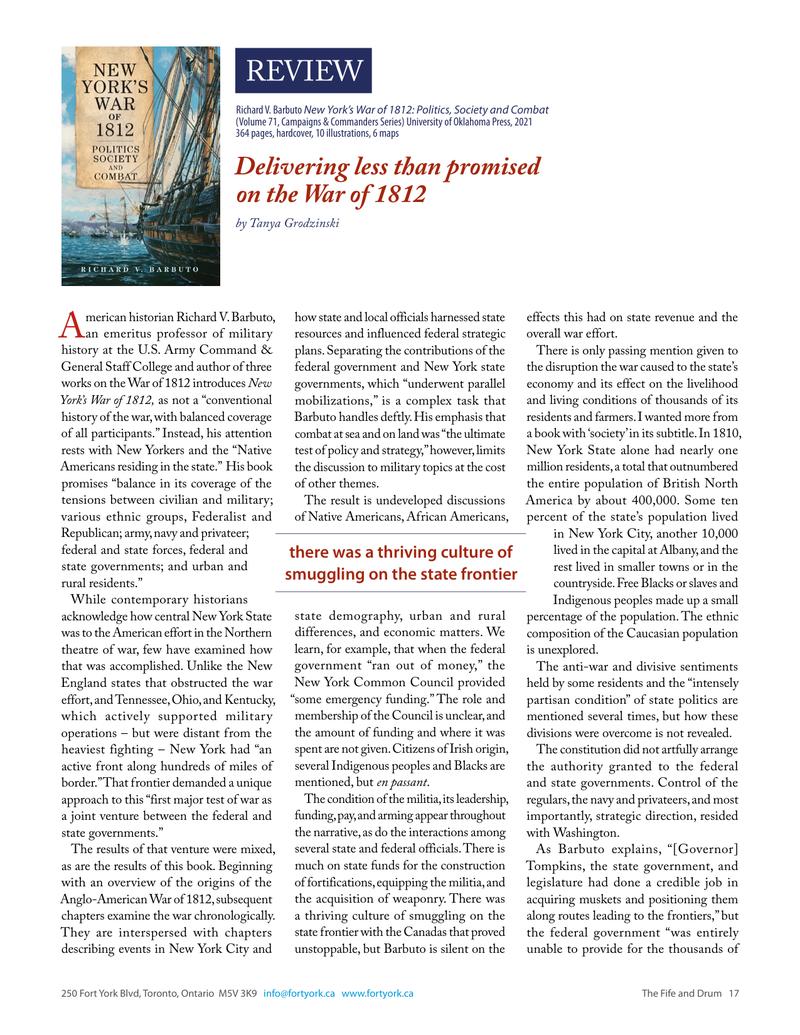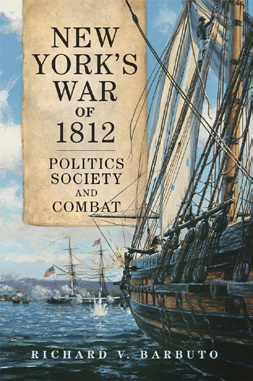
American historian Richard V. Barbuto, an emeritus professor of military history at the U.S. Army Command & General Staff College and author of three works on the War of 1812 introduces New York’s War of 1812, as not a “conventional history of the war, with balanced coverage of all participants.” Instead, his attention rests with New Yorkers and the “Native Americans residing in the state.” His book promises “balance in its coverage of the tensions between civilian and military; various ethnic groups, Federalist and Republican; army, navy and privateer; federal and state forces, federal and state governments; and urban and rural residents.”
While contemporary historians acknowledge how central New York State was to the American effort in the Northern theatre of war, few have examined how that was accomplished. Unlike the New England states that obstructed the war effort, and Tennessee, Ohio, and Kentucky, which actively supported military operations – but were distant from the heaviest fighting – New York had “an active front along hundreds of miles of border.” That frontier demanded a unique approach to this “first major test of war as a joint venture between the federal and state governments.”
The results of that venture were mixed, as are the results of this book. Beginning with an overview of the origins of the Anglo-American War of 1812, subsequent chapters examine the war chronologically. They are interspersed with chapters describing events in New York City and how state and local officials harnessed state resources and influenced federal strategic plans. Separating the contributions of the federal government and New York state governments, which “underwent parallel mobilizations,” is a complex task that Barbuto handles deftly. His emphasis that combat at sea and on land was “the ultimate test of policy and strategy,” however, limits the discussion to military topics at the cost of other themes.
The result is undeveloped discussions of Native Americans, African Americans, state demography, urban and rural differences, and economic matters. We learn, for example, that when the federal government “ran out of money,” the New York Common Council provided “some emergency funding.” The role and membership of the Council is unclear, and the amount of funding and where it was spent are not given. Citizens of Irish origin, several Indigenous peoples and Blacks are mentioned, but en passant.
there was a thriving culture of smuggling on the state frontier
The condition of the militia, its leadership, funding, pay, and arming appear throughout the narrative, as do the interactions among several state and federal officials. There is much on state funds for the construction of fortifications, equipping the militia, and the acquisition of weaponry. There was a thriving culture of smuggling on the state frontier with the Canadas that proved unstoppable, but Barbuto is silent on the effects this had on state revenue and the overall war effort.
There is only passing mention given to the disruption the war caused to the state’s economy and its effect on the livelihood and living conditions of thousands of its residents and farmers. I wanted more from a book with ‘society’ in its subtitle. In 1810, New York State alone had nearly one million residents, a total that outnumbered the entire population of British North America by about 400,000. Some ten percent of the state’s population lived in New York City, another 10,000 lived in the capital at Albany, and the rest lived in smaller towns or in the countryside. Free Blacks or slaves and Indigenous peoples made up a small percentage of the population. The ethnic composition of the Caucasian population is unexplored.
The anti-war and divisive sentiments held by some residents and the “intensely partisan condition” of state politics are mentioned several times, but how these divisions were overcome is not revealed.
The constitution did not artfully arrange the authority granted to the federal and state governments. Control of the regulars, the navy and privateers, and most importantly, strategic direction, resided with Washington.
As Barbuto explains, “[Governor] Tompkins, the state government, and legislature had done a credible job in acquiring muskets and positioning them along routes leading to the frontiers,” but the federal government “was entirely unable to provide for the thousands of detached militia brought into service,” leaving them unpaid and poorly equipped. Washington was “unprepared to wage war” and that led to “major shortcomings in manpower, money, warships, weaponry, skilled leadership, training, equipment, and transportation.” As Captain William Hawley wrote in 1813 of New York to write in an order: “we condemn the administration for their weakness and folly in plunging us unprepared into this Quisonic war.” (Hawley was cashiered after a superior officer overturned his acquittal by a court martial.)
With so comprehensive a list of shortfalls, one wonders how the federal leadership could seriously wage war, especially against an opponent who had been doing exactly that for 20 years.
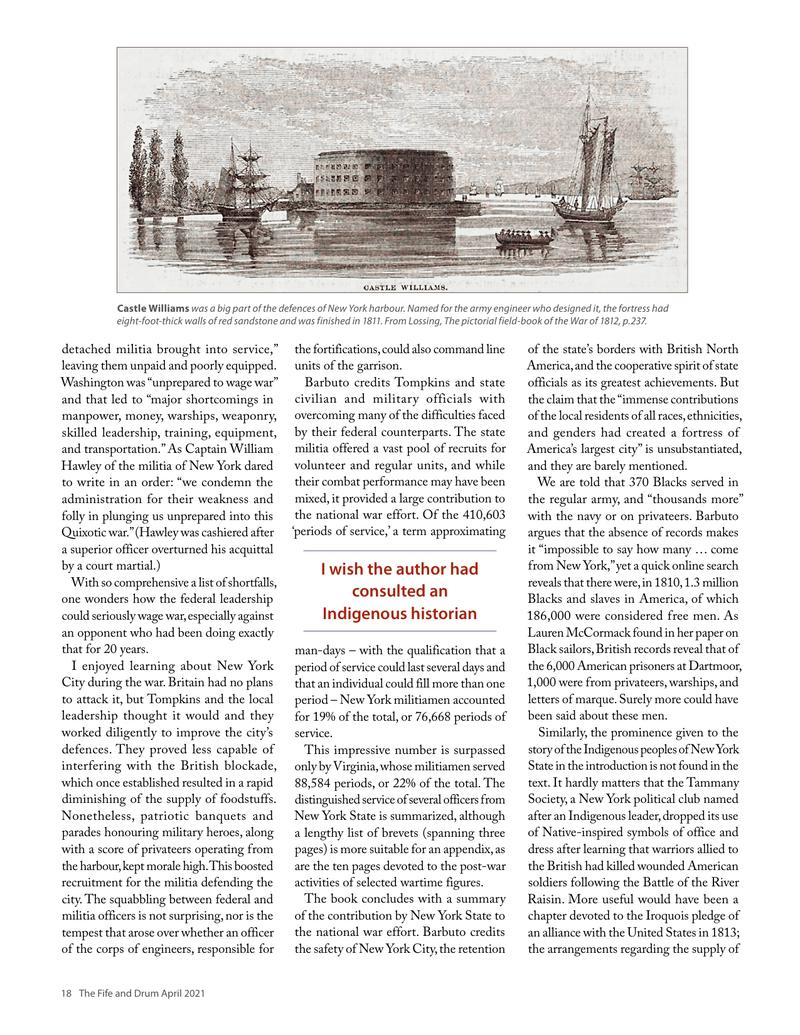
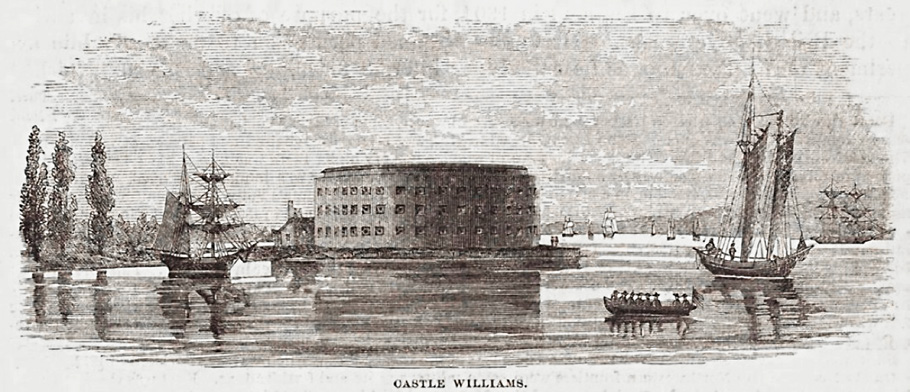
I enjoyed learning about New York City during the war. Britain had no plans to attack it, but Tompkins and the local leadership thought it would and they worked diligently to improve the city’s defences. They proved less capable of interfering with the British blockade, which once established resulted in a rapid diminishing of the supply of foodstuffs. Nonetheless, patriotic banquets and parades honouring military heroes, along with a score of privateers operating from the harbour, kept morale high. This boosted recruitment for the militia defending the city. The squabbling between federal and militia officers is not surprising, nor is the tempest that arose over whether an officer of the corps of engineers, responsible for the fortifications, could also command line units of the garrison.
I wish the author had consulted an Indigenous historian
Barbuto credits Tompkins and state civilian and military officials with overcoming many of the difficulties faced by their federal counterparts. The state militia offered a vast pool of recruits for volunteer and regular units, and while their combat performance may have been mixed, it provided a large contribution to the national war effort. Of the 410,603 ‘periods of service,’ a term approximating man-days – with the qualification that a period of service could last several days and that an individual could fill more than one period – New York militiamen accounted for 19% of the total, or six such ‘periods’ of service.
This impressive number is surpassed only by Virginia, whose militiamen served 88,584 periods, or 22% of the total. The distinguished service of several officers from New York State is summarized, although a lengthy list of brevets (spanning three pages) is more suitable for an appendix, as are the ten pages devoted to the post-war activities of selected wartime figures.
The book concludes with a summary of the contribution by New York State to the national war effort. Barbuto credits the safety of New York City, the retention of the state’s borders with British North America, and the cooperative spirit of state officials as its greatest achievements. But the claim that the “immense contributions of the host of residents of all races, ethnicities, and genders had created a fortress of America’s largest city” is unsubstantiated, and they are barely mentioned.
We are told that 370 Blacks served in the regular army, and “thousands more” with the navy or on privateers. Barbuto argues that the absence of records makes it “impossible to say how many … come from New York,” yet a quick online search reveals that there were, in 1810, 1.3 million Blacks and slaves in America, of which 186,000 were considered free men. As Lauren McCormack found in her paper on Black sailors, British records reveal that of the 6,000 American prisoners at Dartmoor, 1,000 were from privateers, warships, and letters of marque. Surely more could have been said about these men.
Similarly, the prominence given to the story of the Indigenous peoples of New York State in the introduction is not found in the text. It hardly matters that the Tammany Society, a New York political club named after an Indigenous leader, dropped its use of Native-inspired symbols of office and dress after learning that warriors allied to the British had killed wounded American soldiers following the Battle of the River Raisin. More useful would have been a chapter devoted to the Iroquois pledge of an alliance with the United States in 1813; the arrangements regarding the supply of money, provisions, clothing and weaponry to Indigenous groups; the workings of the transfer of prisoners of the Six Nations of Canada to the New York Iroquois; and their embargo of liquor.
I wish the author had consulted an Indigenous historian as readily as he did an authority on naval matters. There are summaries of warrior involvement in specific actions, and another of the work of Seneca Chief Red Jacket in 1815, but the conclusion that Native Americans ‘lost the war’ falls flat, it having been repeated in so many works.
Several general statements throughout the book do not stand up to scrutiny. For example, it’s simply inaccurate to claim that when Congress declared war in 1812, “British resources were focussed on defeating France.” During 1810 and 1811, France had imposed a peace in Europe. In Iberia, a British field army, supported by the Royal Navy, campaigned alongside Spanish and Portuguese allies against the occupying French army.
British fortunes there were aided by Napoleon’s siphoning off troops from Iberia during the assembly of his Grande Armée for the campaign against Russia. The French withdrawal from Russia – nearly coinciding with the American defeat at Queenston Heights – rekindled the European war as the allies pursued the French across Germany. During 1813, the British effort in Europe expanded as it sent 100,000 muskets and aid worth £4 million to Russia, even as it sent reinforcements to British North America.
Despite its shortfalls, New York’s War of 1812 is a welcome book. It contributes to our understanding of the important wartime interactions among federal and state governments. Barbuto also offers a valuable examination of state-related naval and military topics and the defence of New York City. Unfortunately, the promise of its sub-title – Politics, Society and Combat – is only partially kept.
Original printed pages