“We are currently living in the Seventh Fire, a time when, after a long period of colonialism and cultural loss, a new people, the Oshkimaadiziig, emerge. It is the Oshkimaadiziig whose responsibilities involve reviving our language, philosophies, political and economic traditions, our ways of knowing, and our culture. The foremost responsibility of the ‘new people’ is to pick up those things previous generations have left behind by nurturing relationships with Elders that have not ‘fallen asleep.’ Oshkimaadiziig are responsible for decolonizing, for rebuilding our nations, and for forging new relationships with other nations by returning to original Nishnaabeg visions of peace and justice.” Lighting the Eighth Fire – Leanne Simpson
Introduction
As a First Nations woman, my lived experience motivates me to enhance platforms for Indigenous voices, stories and history. As the daughter of a residential school survivor, Indigenous language, voices and ceremonies are the foundations of my worldview and the lens in which I conduct research and my professional work. Building on this foundation, this report and its recommendations will be presented through the work of the Truth and Reconciliation Commission of Canada’s Calls to Action.
In December 2015, the Truth and Reconciliation Commission released its Report and Calls to Action asserting that education is “key” to reconciliation. The TRC Report expressly endorses improving access to Indigenous worldviews. Calls 67 to 70 focus on Museums and Archives. Call 67 states:
We call upon the federal government to provide funding to the Canadian Museums Association to undertake, in collaboration with Aboriginal peoples, a national review of museum policies and best practices to determine the level of compliance with the United Nations Declaration on the Rights of Indigenous Peoples and to make recommendations.
To advance policy changes in City of Toronto Museums & Heritage Services, it is essential to understand that Indigenous Collections Management will require ongoing relationships with Indigenous communities that embody the principle of reciprocity. The outcomes of these relationships can foster an informed approach to the care of the collection and, more importantly, add a rich narrative to the voices of the ancestral objects.
As the TRC is the framework for this report, reconciliation can be embraced in the process. An essential foundation on the journey towards reconciliation is defined in the Mandate of the TRC: “Reconciliation is about establishing and maintaining a mutually respectful relationship between Aboriginal and nonAboriginal peoples in this country. In order for that to happen, there has to be awareness of the past, an acknowledgment of the harm that has been inflicted, atonement for the causes, and action to change behaviour.” This report can help facilitate that understanding through the themes and recommendations that follow.
Background Research
Museum Objects and Agency
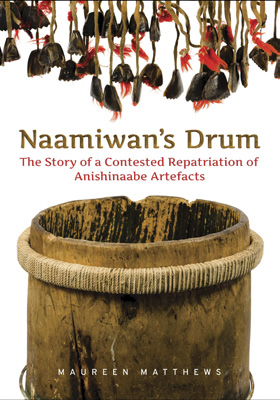
Material religion explores what objects do, how they are used and what impact they have. Crispin Paine explains that objects become religious if they are used in a ritual. He argues that these objects have duties and lives that stem from their agency. In her book Naamiwan’s Drum, Maureen Matthews uses Alfred Gell’s Art & Agency as a theoretical approach to repatriation. Matthews states that Gell’s agency theory “is a model that postulates personhood for objects” in a way that is parallel to Ojibwe metaphorical thinking of agency.
To further analyze an object’s agency, Matthews richly depicts the history of animacy linguistically, grammatically, and in museums through the story of a drum. Views on animacy can be a pivotal starting point for a decolonizing agenda within museums and for approaching works of reconciliation in accordance with the TRC.
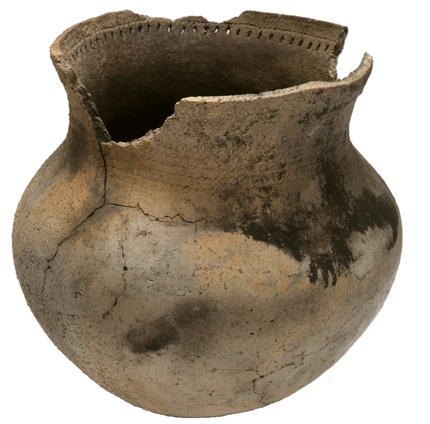
In the second museum age, curators must consider the role of the object and not just its physical properties. Through the lens of material religion, Paine argues that “objects have life stories as humans do” and they have duties to perform. Naamiwan’s Drum is a story that can be utilized by museum staff to approach the complexity and personhood of ancestral objects in their collections. The second museum age shows promise of restoring relationships with Indigenous communities by creating exhibitions that are a collaborative project between museum staff and Indigenous communities.
Ruth Phillips asserts that these new relationships “must modify the western ideals of open access to objects and information on which public museums were founded, in order to respect other systems of knowledge.” Collaboration will be essential as some artifacts are not meant for public knowledge or display. Communities can help museum staff determine the sacredness and purpose of ceremonial ancestral objects. Another aspect of the second museum age is that objects are being re-evaluated to determine their agency.
Collections management is another key aspect of developing a decolonizing agenda within museums. Storage rooms are filled with unique objects that have purpose and spiritual significance. To understand the concept of spirituality, I turn to Cree scholar Blair Stonechild, who states: “Spirituality involves direct engagement and connection with the mysteries of the transcendent.” Stonechild contrasts this definition with religion, which he believes is characterized by written texts that require a mediator to interpret. The potential for ancestral objects to be ‘viewed’ through an Indigenous worldview that embodies animacy can be a significant contribution to museum studies and practice.
Telling Hard Truths
Indigenous scholar Amy Lonetree, in her book Decolonizing Museums, considers some of the challenges museums face when embracing a decolonizing agenda. Most importantly, “a decolonizing museum practice must be in the service of speaking the hard truths of colonialism.” Over a ten-year research process, Lonetree developed a comparative analysis of the Mille Lacs Indian Museum, the Smithsonian’s National Museum of the American Indian, and the Ziibiwing Center of Anishinabe Culture & Lifeways, examining how these different museums revealed the violence of colonialism.
The hard truth can be uncomfortable and difficult, but as Lonetree reminds us, it can also be healing for Indigenous communities. This debwewin (truth) includes not only stories of genocide, colonization, and discriminatory legislation such as the Indian Act, but also stories of resistance, resurgence and resilience. The City of Toronto’s museums can be sites to facilitate these new narratives through collaborative projects and partnerships.
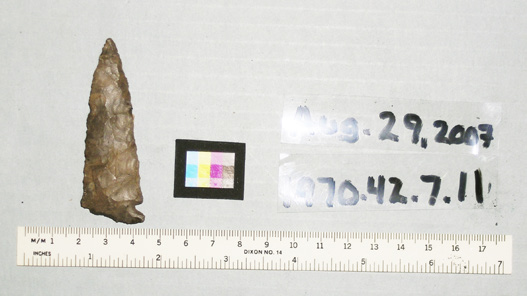
While these recommendations may appear to be unattainable in our current circumstances, time, research, resources and partnerships can make them achievable.
Animate/ Inanimate
Call #1
Conduct research on views of Animate and Inanimate objects in Museums Culture and within Indigenous Languages and worldviews.
Call #2
Solicit engagement from external partners such as Indigenous Language experts, Elders and Knowledge Keepers to grasp and embrace this complex worldview.
Call #3
Physically separate and store Indigenous-related artifacts and archaeological specimens (hereafter referred to as “the Collection”) according to two categories: Animate and Inanimate.
Spiritual Care
Call #4
Store for access the Four Sacred Medicines of the Anishinaabe (Sage, Sweetgrass, Cedar and Tobacco) at all Collection sites.
Call #5
Perform an annual Ceremony for the Collection with members of the Midewiwin Society or other Indigenous Spiritual Leaders or Elders.
Call #6
Open access to the Collection for Community Members to perform ceremonies such as smudging, songs, dances and visits as requested.
Repatriation
Call #7
Through the existing partnership with the Midewiwin Society, or with other Indigenous communities as appropriate, repatriate the human remains in the Collection.
Recommendations
Representing an important step forward in responding to the TRC’s Calls to Action, recommendations have been developed as a living document and roadmap towards decolonizing our sites and collections management. They are outlined here under four key themes: Animate/ Inanimate, Spiritual Care, Repatriation, and Community Relations. Each theme is supported by three recommendations. The implementation of these recommendations will be ongoing and will require further action notably with the Indigenous community.
Call #8
Adopt and support the recommendation of Aanji Bimaadiziwin Circle–The MHS Indigenous Programming Advisory Circle with regards to the process of community relations and repatriation.
Call #9
Physically separate Ceremonial ancestral objects from the Collection. Ceremonial items may be animate or inanimate objects.
Community Relations
Call #10
Review processes on Indigenous Partnership agreements. Offering honorariums that take several weeks or months to process while expecting partners to travel and incur out-of-pocket expenses is unacceptable and not an industry standard.
Call #11
Work with Partners to establish a process that is accessible, timely and reflective of the work.
Call #12
Hold an annual event for all Community Partners to foster stronger relationships reflective of reciprocal gains.
Sources & Further Reading
The opening citation is from the introduction to an anthology of essays edited by Leanne Simpson, Lighting the Eighth Fire: The Liberation, Resurgence, and Protection of Indigenous Nations, from Arbeiter Ring Publishing in Winnipeg (2008). Dr. Simpson is the past director of Indigenous Environmental Studies at Trent University, the editor of an anthology on the Oka Crisis (also from Arbeiter) and teaches at Athabasca University.
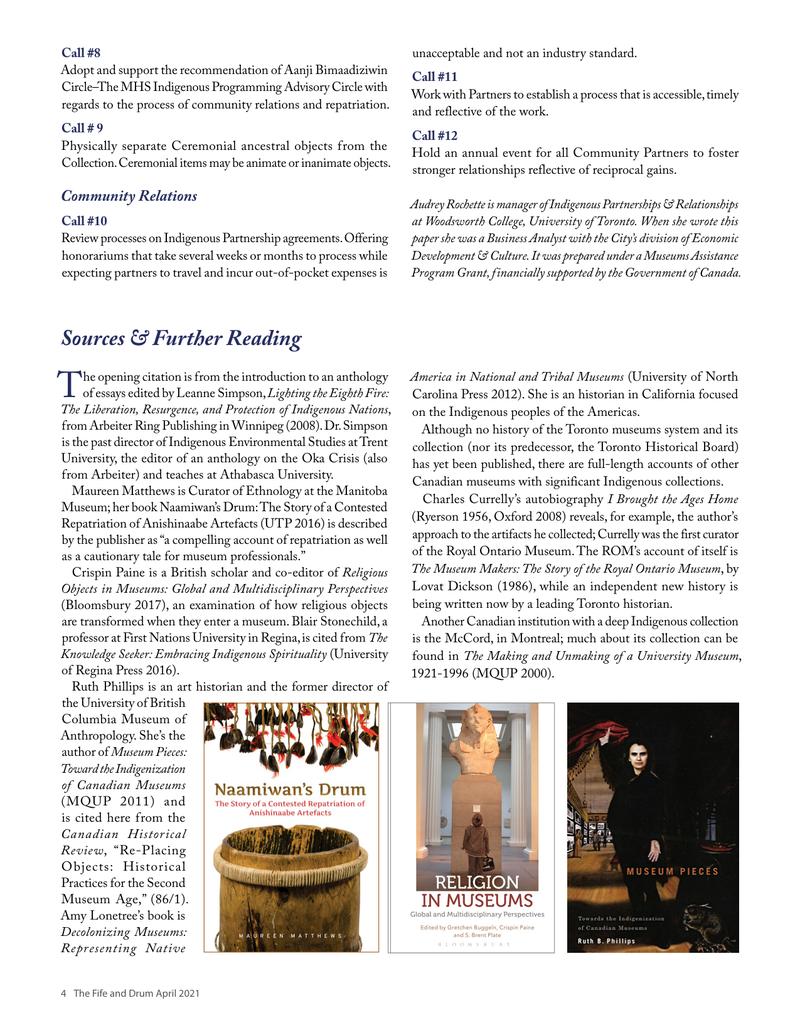
Maureen Matthews is Curator of Ethnology at the Manitoba Museum; her book Naamiwan’s Drum: The Story of a Contested Repatriation of Anishinaabe Artefacts (UTP 2016) is described by the publisher as “a compelling account of repatriation as well as a cautionary tale for the museum industry.”
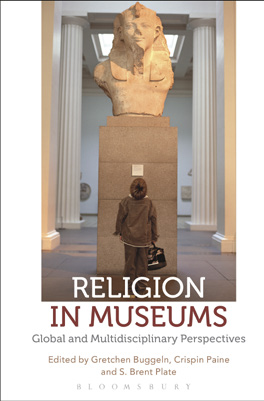
Crispin Paine is a British scholar and co-editor of Religious Objects in Museums: Global and Multidisciplinary Perspectives (Bloomsbury 2017), an examination of how religious objects are transformed when they enter a museum. Blair Stonechild, a professor at First Nations University of Regina is the McCord, in Montreal; much about its collection can be found in The Making and Unmaking of a University Museum, 1921-1996 (MQUP 2000).
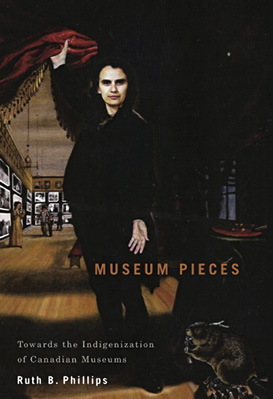
Ruth Phillips is an art historian and the former director of the University of British Columbia Museum of Anthropology. She’s the author of Museum Pieces: Toward the Indigenization of Canadian Museums (MQUP 2011) and is cited here from the Canadian Historical Review, “Re-Placing Objects: Historical Practices for the Second Museum Age,” (86/1). Amy Lonetree’s book is Decolonizing Museums: Representing Native America in National and Tribal Museums (University of North Carolina Press 2012). She is an historian in California focused on the Indigenous peoples of the Americas.
Although no history of the Toronto museums system and its collection (nor its predecessor, the Toronto Historical Board) has yet been published, there are full-length accounts of other Canadian museums with significant Indigenous collections.
Charles Currelly’s autobiography I Brought the Ages Home (Ryerson 1956, Oxford 2008) reveals, for example, the author’s approach to the artifacts he collected; Currelly was the first curator of the Royal Ontario Museum. The ROM’s account of itself is The Museum Makers: The Story of the Royal Ontario Museum, by Lovat Dickson (1986), while an independent new history is being written now by a leading Toronto historian.
Another Canadian institution with a deep Indigenous collection is the McCord, in Montreal; much about its collection can be found in The Making and Unmaking of a University Museum, 1921-1996 (MQUP 2000).
Original printed pages