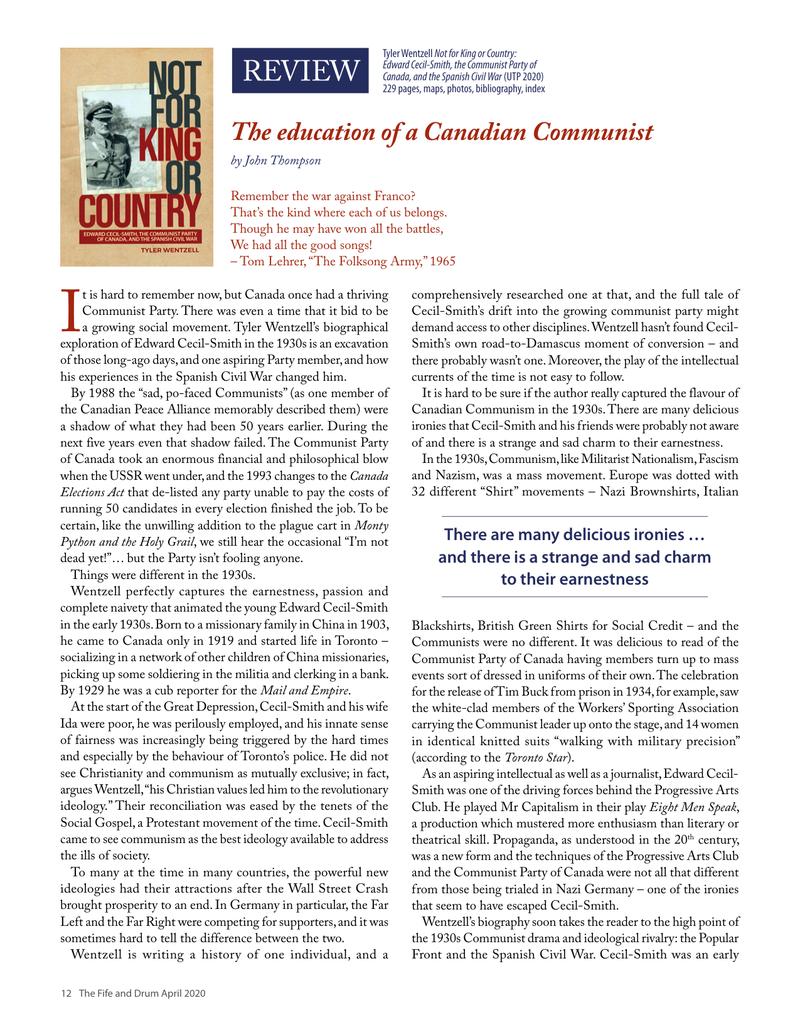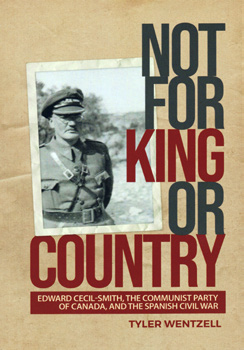
It is hard to remember now, but Canada once had a thriving Communist Party. There was even a time that it bid to be a growing social movement. Tyler Wentzell’s biographical exploration of Edward Cecil-Smith in the 1930s is an excavation of those long-ago days, and one aspiring Party member, and how his experiences in the Spanish Civil War changed him.
By 1988 the “sad, po-faced Communists” (as one member of the Canadian Peace Alliance memorably described them) were a shadow of what they had been 50 years earlier. During the next five years even that shadow failed. The Communist Party of Canada took an enormous financial and philosophical blow when the USSR went under, and the 1993 changes to the Canada Elections Act that de-listed any party unable to pay the costs of running 50 candidates in every election finished the job. To be certain, like the unwilling addition to the plague cart in Monty Python and the Holy Grail, we still hear the occasional “I’m not dead yet!”… but the Party isn’t fooling anyone.
Things were different in the 1930s.
Wentzell perfectly captures the earnestness, passion and complete naivety that animated the young Edward Cecil-Smith in the early 1930s. Born to a missionary family in China in 1903, he came to Canada only in 1919 and started life in Toronto – socializing in a network of other children of China missionaries, picking up some soldiering in the militia and clerking in a bank. By 1929 he was a cub reporter for the Mail and Empire.
At the start of the Great Depression, Cecil-Smith and his wife Ida were poor, he was perilously employed, and his innate sense of fairness was increasingly being triggered by the hard times and especially by the behaviour of Toronto’s police. He did not see Christianity and communism as mutually exclusive; in fact, argues Wentzell, “his Christian values led him to the revolutionary ideology.” Their reconciliation was eased by the tenets of the Social Gospel, a Protestant movement of the time. Cecil-Smith came to see communism as the best ideology available to address the ills of society.
To many at the time in many countries, the powerful new ideologies had their attractions after the Wall Street Crash brought prosperity to an end. In Germany in particular, the Far Left and the Far Right were competing for supporters, and it was sometimes hard to tell the difference between the two.
Wentzell is writing a history of one individual, and a comprehensively researched one at that, and the full tale of Cecil-Smith’s drift into the growing communist party might demand access to other disciplines. Wentzell hasn’t found Cecil-Smith’s own road-to-Damascus moment of conversion – and there probably wasn’t one. Moreover, the play of the intellectual currents of the time is not easy to follow.
It is hard to be sure if the author really captured the flavour of Canadian Communism in the 1930s. There are many delicious ironies that Cecil-Smith and his friends were probably not aware of and there is a strange and sad charm to their earnestness.
In the 1930s, Communism, like Militarist Nationalism, Fascism and Nazism, was a mass movement. Europe was dotted with 32 different “Shirt” movements – Nazi Brownshirts, Italian Blackshirts, British Green Shirts for Social Credit – and the Communists were no different. It was delicious to read of the Communist Party of Canada having members turn up to mass events sort of dressed in uniforms of their own. The celebration for the release of Tim Buck from prison in 1934, for example, saw the white-clad members of the Workers’ Sporting Association carrying the Communist leader up onto the stage, and 14 women in identical knitted suits “walking with military precision” (according to the Toronto Star).
There are many delicious ironies … and there is a strange and sad charm to their earnestness
As an aspiring intellectual as well as a journalist, Edward Cecil-Smith was one of the driving forces behind the Progressive Arts Club. He played Mr Capitalism in their play Eight Men Speak, a production which mustered more enthusiasm than literary or theatrical skill. Propaganda, as understood in the 20th century, was a new form and the techniques of the Progressive Arts Club and the Communist Party of Canada were not all that different from those being trialed in Nazi Germany – one of the ironies that seem to have escaped Cecil-Smith.
Wentzell’s biography soon takes the reader to the high point of the 1930s Communist drama and ideological rivalry: the Popular Front and the Spanish Civil War. Cecil-Smith was an early volunteer to the International Brigades, and Wentzell’s research readily depicts their enthusiasm, struggles with amateurism, scanty equipment, and appalling casualty rates. For all the romance appended to the XV International Brigade, their glorious legacy is mostly a series of catastrophic defeats for the Republican cause. The book covers these developments in fine detail, and the author has done an excellent piece of military history here. (As well as being a lawyer and an independent historian, Wentzell is a Canadian infantry officer – trained as a Regular, now in the Reserve – with the fighting in Afghanistan behind him.) The maps are also excellent.
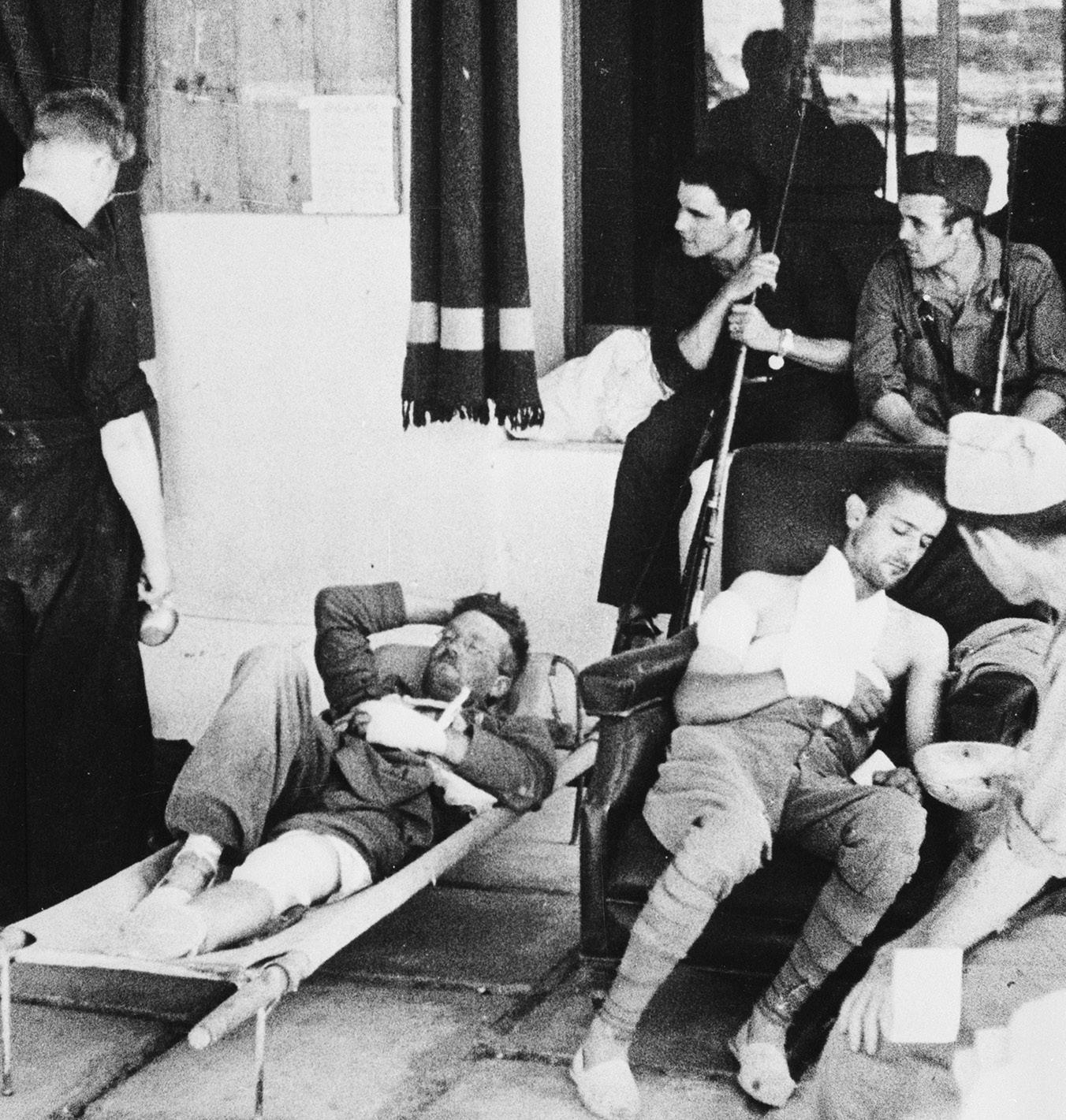
Cecil-Smith was at the birth of the Mackenzie-Papineau battalion, helping train and lead them, and it was clear that its International Brigade needed all the help it could get. It is also clear that Cecil-Smith was motivated and, if not loved, respected (which any soldier can tell you is a very satisfactory second prize). While his militia experience in Toronto wasn’t spectacular, it was enough to make a difference – particularly with the Canadian Communist Party screening out adventurers and unreliable types.
The Spanish Civil War has enjoyed decades of relatively uncritical analysis, often seeming as little more than a morality play. The Spanish Nationalists revolted against a democratic government, and accepted help from Hitler and Mussolini: bad guys, case closed, and so the International Brigades were on the side of the angels. More recent examinations suggest a less stark distinction. While Wentzell made use of some of Paul Preston’s work, the more balanced look at Franco in his 1994 biography of the Nationalist leader was not used, nor was Anthony Beevor’s more recent (and balanced) history The Battle for Spain.
The author has done an excellent piece of military history
Even so, Wentzell was not writing a history of the entire conflict, only one wandering Canadian’s part in it – and this is where things get interesting. Cecil-Smith departed for Spain as a relatively good Communist, but he doesn’t seem to have returned as one. In the years following that return, he and the party drifted apart, a decline well charted by the author.
Yet the searing paranoia generated by Stalin and his regime during the Great Terror of 1936-38 is impossible to grasp without an immersion in the Soviet experience. The works of Arthur Koestler and George Orwell only suggest the depth of the Terror’s insanity. Wentzell sees the start of the process in the growing Soviet influence among the Republicans, but doesn’t quite make the connection with how it worked out among the troops, even given the strong Communist influences on the International Brigades. I think Wentzell – like so many others – is too fundamentally decent to really understand it.
However, 1937 marked the transition from Moscow’s Popular Front ways of confronting Hitler and Mussolini to the Great Terror’s ruthless hunt for Trotskyites, wreckers and those comrades who were less than reliable. The International Brigades had their commissars, and some of them quickly guessed which way the wind was blowing. There were early signs that the Soviets were using the Spanish Civil War to purge the international Left of elements they regarded as unreliable.
Wentzell almost skips over the darker aspects of the commissars, although he addresses their suspicions about a self-inflicted injury when Cecil-Smith is withdrawn from the front line with a pistol bullet in his leg. Commissars’ reports evidently were sent to communist parties at home as well as to the Comintern. It could have been worse for Cecil-Smith: Anthony Beevor’s history mentions that André Marty (the paranoid French communist who was the chief political commissar for the International Brigades) was responsible for 500 executions.
Edward Cecil-Smith and the soldiers of the Mackenzie-Papineau Battalion who escaped Spain were lionized in early 1939, but events soon overtook them. He found himself separated from the party (he was dubiously “expelled” as a result of the reports of the commissars) and went his own way. The RCMP ceased actively watching him, and Cecil-Smith did little more in politics before his second and final stroke in 1963.
Fundamentally, Not for King or Country is a time machine and that makes it a really interesting read. Tyler Wentzell has done some very solid research that suggests he’s a talent to watch. The Spanish Civil War and a Canadian communist of the 1930s, however, is a truly daunting topic. He tells the story with meticulous detail, but does not, in my view, quite grasp all the nuance in the reality of international communism: for that, one needs a great deal more cynicism.
Original printed pages