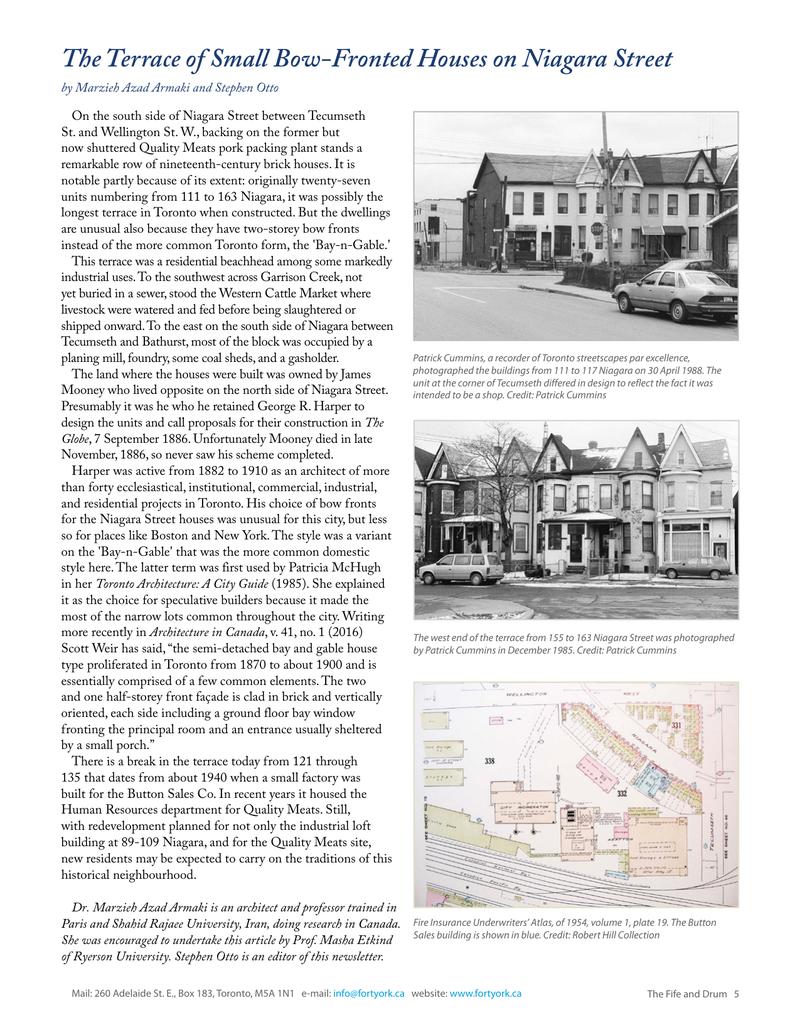
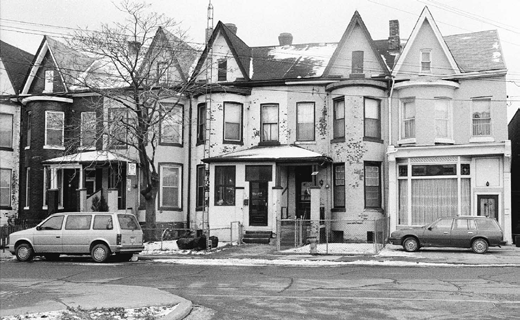
On the south side of Niagara Street between Tecumseth St. and Wellington St. W., backing on the former but now shuttered Quality Meats pork packing plant stands a remarkable row of nineteenth-century brick houses. It is notable partly because of its extent: originally twenty-seven units numbering from 111 to 163 Niagara, it was possibly the longest terrace in Toronto when constructed. But the dwellings are unusual also because they have two-storey bow fronts instead of the more common Toronto form, the ‘Bay-n-Gable.’

This terrace was a residential beachhead among some markedly industrial uses. To the southwest across Garrison Creek, not yet buried in a sewer, stood the Western Cattle Market where livestock were watered and fed before being slaughtered or shipped onward. To the east on the south side of Niagara between Tecumseth and Bathurst, most of the block was occupied by a planing mill, foundry, some coal sheds, and a gasholder.
The land where the houses were built was owned by James Mooney who lived opposite on the north side of Niagara Street. Presumably it was he who retained George R. Harper to design the units and call proposals for their construction in The Globe, 7 September 1886. Unfortunately Mooney died in late November, 1886, so never saw his scheme completed.
Harper was active from 1882 to 1910 as an architect of more than forty ecclesiastical, institutional, commercial, industrial, and residential projects in Toronto. His choice of bow fronts for the Niagara Street houses was unusual for this city, but less so for places like Boston and New York. The style was a variant on the ‘Bay-n-Gable’ that was the more common domestic style here. The latter term was first used by Patricia McHugh in her Toronto Architecture: A City Guide (1985). She explained it as the choice for speculative builders because it made the most of the narrow lots common throughout the city. Writing more recently in Architecture in Canada, v. 41, no. 1 (2016) Scott Weir has said, “the semi-detached bay and gable house type proliferated in Toronto from 1870 to about 1900 and is essentially comprised of a few common elements. The two and one half-storey front façade is clad in brick and vertically oriented, each side including a ground floor bay window fronting the principal room and an entrance usually sheltered by a small porch.”
There is a break in the terrace today from 121 through 135 that dates from about 1940 when a small factory was built for the Button Sales Co. In recent years it housed the Human Resources department for Quality Meats. Still, with redevelopment planned for not only the industrial loft building at 89-109 Niagara, and for the Quality Meats site, new residents may be expected to carry on the traditions of this historical neighbourhood.

Original printed pages