

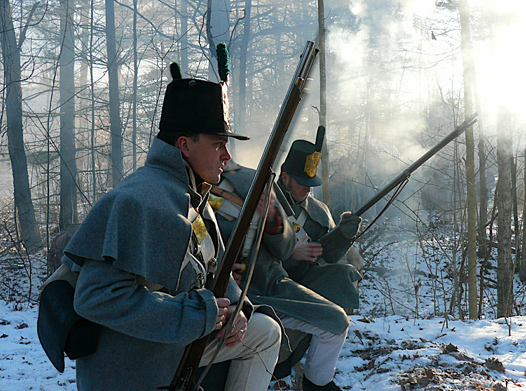
The War of 1812, a new full-length documentary produced by Buffalo’s PBS affiliate (WNED), will air at 9 p.m. on 10 October 2011. The filmmakers, Lawrence Hott and Diane Garey–who have two Oscars, two Emmys, a Peabody Award, and dozens of other awards and citations between them–have set out to provide a fair and balanced treatment of a war that is usually seen through a misty lens of national bias.
The resulting documentary provides a well-rounded view of the war and age by utilizing talking-head commentary from a diverse range of American, Canadian, British, and First Nations historians to provide multiple perspectives on the precursors of war and internal political debates, blundering military campaigns on land and sea, and the long-term cultural consequences of the conflict.
Among these interviewed experts is Peter Twist of Military Heritage (the military uniform and supply company), a veteran of a number of film projects undertaken on both sides of the border, and a former director of the Friends of Fort York. He spoke to Fife and Drum about his involvement with The War of 1812.
In addition to his onscreen commentary, Twist also acted as Production Designer. He was on set for each day of filming to advise about period costume, military behaviour, and any other expertise the filmmakers required.
Save for naval scenes, the documentary was filmed almost entirely in Canada at Upper Canada Village and Westfield Village in Rockton. In additional to local Ontario military re-enactment groups, about twenty Americans from as far away as Texas (already in Morrisburg for a major re-enactor event) were cast to stage military battles for the film. Far from the sweeping battlefield view of a Hollywood film, The War of 1812 treats battles impressionistically–emphasizing small details and close-ups.
Twist has also worked as historical and technical advisor for the Pirates of the Caribbean movies, where actors need to be trained in period military techniques, and filmed scenes require a good deal of hands-on coordination. In contrast, the documentary’s re-enactment enthusiasts, most of whom arrived with their own US and British uniforms and props, were already well-drilled and knowledgeable in the subject matter. On set, Twist told us, he was able to give orders like an actual military commander and see them executed faithfully for the camera with minimal direction.
Compared to a Hollywood blockbuster–where each member of an enormous crew is highly specialized–Twist also noted that the smaller scale of The War of 1812, with a crew of fewer than a dozen, allowed a great deal of personal input into, and impact on, the finished product.
Beyond this examination of the military tactics, the documentary personalizes the campaigns with recitations of excerpts from letters from well-known military leaders, unfamiliar common soldiers, and women who were eyewitness to events. While Châteauguay and Crysler’s Farm loom large in the documentary’s narrative as crucial Canadian battles, the burning of York merits only brief mention. Twist explained that the de-emphasis on York is common in 1812 documentaries because the event had minimal impact on the overall war. But the film does make the case that the burning of York and Newark (and the retaliatory burning of American towns by the British) were early instances where the scope of warfare expanded to target a civilian populace. There was sometimes a fine line, the film argues, between victory and atrocities.
Striving for a fair and balanced approach, the filmmakers ensure that single events are seen from multiple perspectives. For example, First Lady Dolley Madison’s experience when abandoned by her honour guard as British troops marched towards Washington is counterbalanced by discussion of the public outrage in London newspapers that British soldiers had burned down the White House.
The War of 1812 also strives to deconstruct the war’s progeny of nationalist mythology. The filmmakers examine how events and personages have grown into foundational narratives and heroes in Canada and the United States, as historical facts have evolved into popular memory. An explanation of Andrew Jackson’s victory at New Orleans, for example, prompts a fact-checking of Johnny Horton’s hit country song, “The Battle of New Orleans.”
The documentary, then, is not just about what actually happened in the war but also about how Canadians, Americans, the British, and First Nations have each remembered and forgotten it.
Original printed pages


