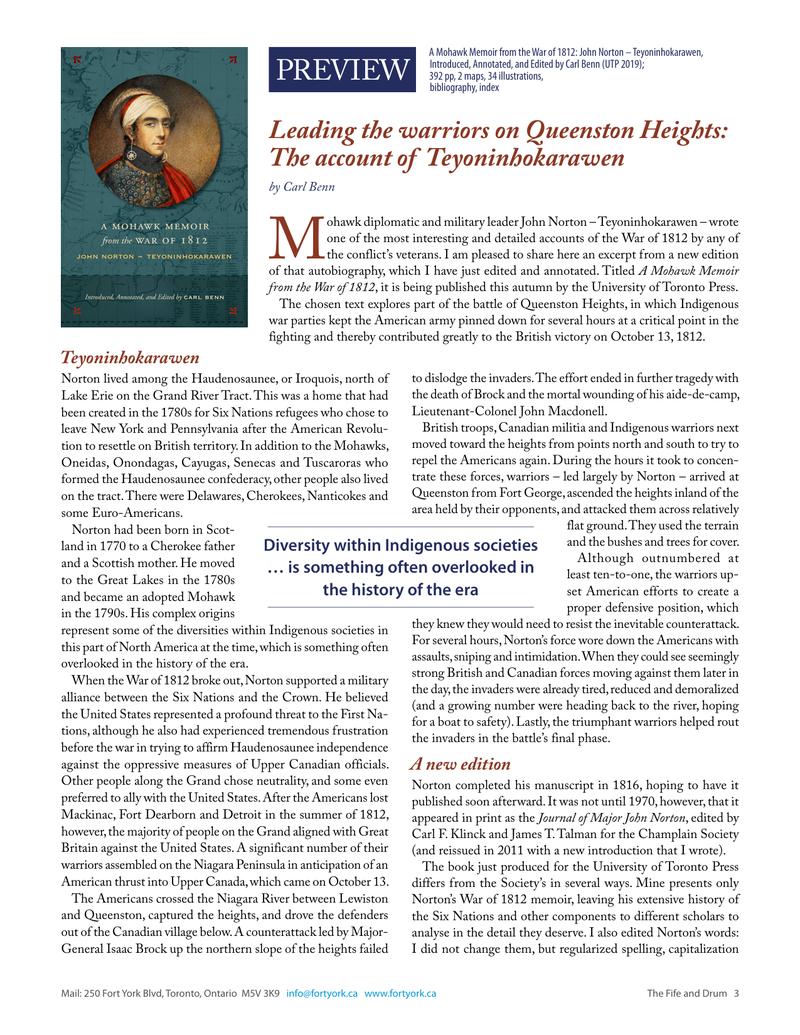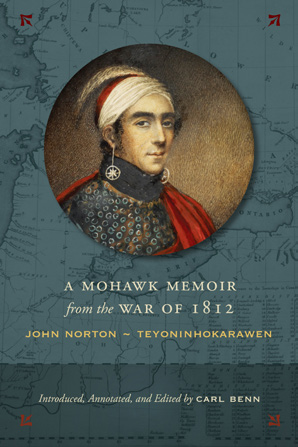
Mohawk diplomatic and military leader John Norton – Teyoninhokarawen – wrote one of the most interesting and detailed accounts of the War of 1812 by any of the conflict’s veterans. I am pleased to share here an excerpt from a new edition of that autobiography, which I have just edited and annotated. Titled A Mohawk Memoir from the War of 1812, it is being published this autumn by the University of Toronto Press. The chosen text explores part of the battle of Queenston Heights, in which Indigenous war parties kept the American army pinned down for several hours at a critical point in the fighting and thereby contributed greatly to the British victory on October 13, 1812.
Teyoninhokarawen
Norton lived among the Haudenosaunee, or Iroquois, north of Lake Erie on the Grand River Tract. This was a home that had been created in the 1780s for Six Nations refugees who chose to leave New York and Pennsylvania after the American Revolution to resettle on British territory. In addition to the Mohawks, Oneidas, Onondagas, Cayugas, Senecas and Tuscaroras who formed the Haudenosaunee confederacy, other people also lived on the tract. There were Delawares, Cherokees, Nanticokes and some Euro-Americans.
Norton had been born in Scotland in 1770 to a Cherokee father and a Scottish mother. He moved to the Great Lakes in the 1780s and became an adopted Mohawk in the 1790s. His complex origins represent some of the diversities within Indigenous societies in this part of North America at the time, which is something often overlooked in the history of the era.
Diversity within Indigenous societies … is something often overlooked in the history of the era
When the War of 1812 broke out, Norton supported a military alliance between the Six Nations and the Crown. He believed the United States represented a profound threat to the First Nations, although he also had experienced tremendous frustration before the war in trying to affirm Haudenosaunee independence against the oppressive measures of Upper Canadian officials. Other people along the Grand chose neutrality, and some even preferred to ally with the United States. After the Americans lost Mackinac, Fort Dearborn and Detroit in the summer of 1812, however, the majority of people on the Grand aligned with Great Britain against the United States. A significant number of their warriors assembled on the Niagara Peninsula in anticipation of an American thrust into Upper Canada, which came on October 13.
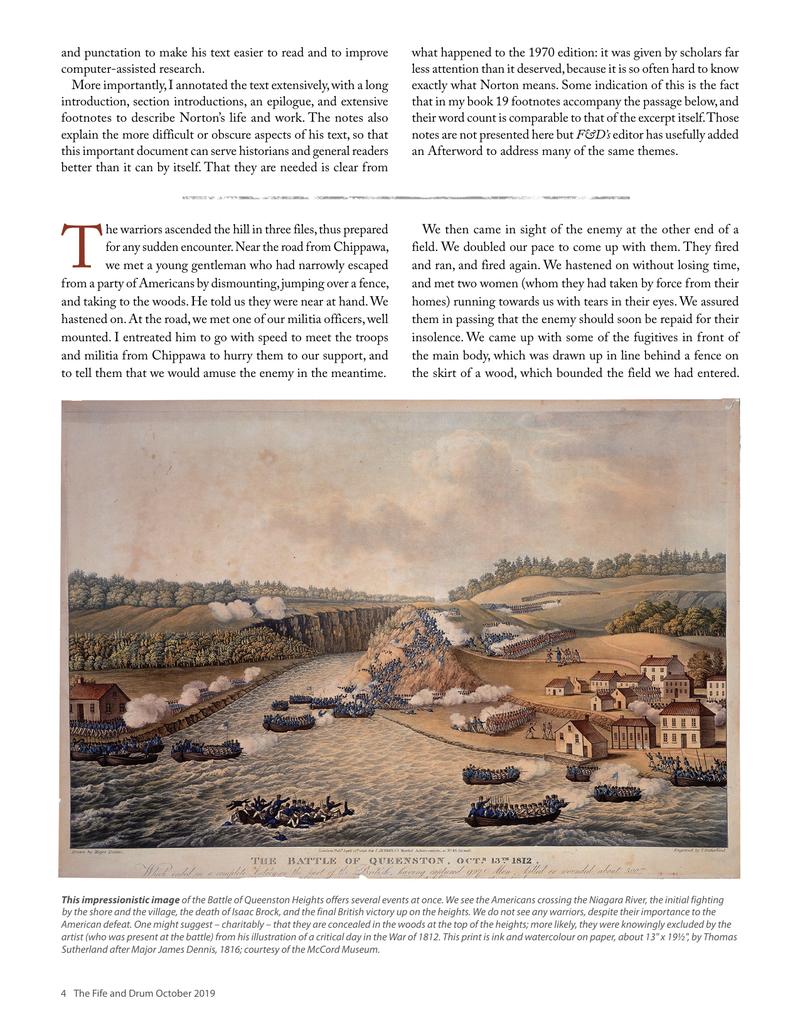
The Americans crossed the Niagara River between Lewiston and Queenston, captured the heights, and drove the defenders out of the Canadian village below. A counterattack led by Major-General Isaac Brock up the northern slope of the heights failed to dislodge the invaders. The effort ended in further tragedy with the death of Brock and the mortal wounding of his aide-de-camp, Lieutenant-Colonel John Macdonell.
British troops, Canadian militia and Indigenous warriors next moved toward the heights from points north and south to try to repel the Americans again. During the hours it took to concentrate these forces, warriors – led largely by Norton – arrived at Queenston from Fort George, ascended the heights inland of the area held by their opponents, and attacked them across relatively flat ground. They used the terrain and the bushes and trees for cover.
Although outnumbered at least ten-to-one, the warriors upset American efforts to create a proper defensive position, which they knew they would need to resist the inevitable counterattack. For several hours, Norton’s force wore down the Americans with assaults, sniping and intimidation. When they could see seemingly strong British and Canadian forces moving against them later in the day, the invaders were already tired, reduced and demoralized (and a growing number were heading back to the river, hoping for a boat to safety). Lastly, the triumphant warriors helped rout the invaders in the battle’s final phase.
A new edition
Norton completed his manuscript in 1816, hoping to have it published soon afterward. It was not until 1970, however, that it appeared in print as the Journal of Major John Norton, edited by Carl F. Klinck and James T. Talman for the Champlain Society (and reissued in 2011 with a new introduction that I wrote).
The book just produced for the University of Toronto Press differs from the Society’s in several ways. Mine presents only Norton’s War of 1812 memoir, leaving his extensive history of the Six Nations and other components to different scholars to analyse in the detail they deserve. I also edited Norton’s words: I did not change them, but regularized spelling, capitalization and punctuation to make his text easier to read and to improve computer-assisted research.
More importantly, I annotated the text extensively, with a long introduction, section introductions, an epilogue, and extensive footnotes to describe Norton’s life and work. The notes also explain the more difficult or obscure aspects of his text, so that this important document can serve historians and general readers better than it can by itself. That they are needed is clear from what happened to the 1970 edition: it was given by scholars far less attention than it deserved, because it is so often hard to know exactly what Norton means. Some indication of this is the fact that in my book 19 footnotes accompany the passage below, and their word count is comparable to that of the excerpt itself. Those notes are not presented here but F&D‘s editor has usefully added an Afterword to address many of the same themes.
The warriors ascended the hill in three files, thus prepared for any sudden encounter. Near the road from Chippawa, we met a young gentleman who had narrowly escaped from a party of Americans by dismounting, jumping over a fence, and taking to the woods. He told us they were near at hand. We hastened on. At the road, we met one of our militia officers, well mounted. I entreated him to go with speed to meet the troops and militia from Chippawa to hurry them to our support, and to tell them that we would amuse the enemy in the meantime.

We then came in sight of the enemy at the other end of a field. We doubled our pace to come up with them. They fired and ran, and fired again. We hastened on without losing time, and met two women (whom they had taken by force from their homes) running towards us with tears in their eyes. We assured them in passing that the enemy should soon be repaid for their insolence. We came up with some of the fugitives in front of the main body, which was drawn up in line behind a fence on the skirt of a wood, which bounded the field we had entered.
On our left, they advanced into the field. We inclined in that direction to attack them, flanking the most assailable part to assail with our small party. The whole line opened fire on us, but without any effect of the Grand kind we were favouring us. The warriors returned the fire of the enemy with coolness and deliberate aim. The fire exercise made the greatest noise (from the number of muskets), yet I believe ours did the most execution. The enemy retired behind the fence, from whence they kept up a heavy fire. We inclined imperceptibly to the extremity on the mountain’s brow. From thence, we rushed on with impetuosity, and some were stretched upon the ground. They rallied among sheds that had been erected there by the troops and militia formerly encamped on that ground.
At this time, we heard some report approaching to that of platoons [firing musket volleys] proceeding from the shrapnel shells fired from a field piece under the direction of Captain Holcroft, Royal Artillery, and with which he continued to annoy the enemy with the greatest skill and gallantry.
I never will fail to lead where any warrior can follow
This led us to suppose that the troops were advancing in front of the enemy, which caused us to push with more forwardness than our small number should otherwise have authorized, in order to favour them by distracting the attention of the enemy in giving them a furious onset from our quarter at the same time.
Now undeceived, and seeing the enemy rally in great numbers, the warrior stands meditating how to range with greatest advantage his gallant men (three Seneca and one Oneida warrior called out, “Why stand so mute? Now here is the foe before us.” He then replied, “Come on, I never will fail to lead where any warrior can follow,” and darting forward, and swiftly, they stand within a javelin’s throw of the crowded ranks, when, levelling sure, they discharged the hidden deaths among them (the slight foliage of some slender oak concealed them from hostile view). Those, who with more distant annoyed the enemy, attracted his attention until the fusil’s flash and near report discovered the friends. Then the foe raged like a hive of bees disturbed. Volleys of bullets flew towards them [i.e., the warriors], but all passed harmless over. Viewing each other with a smile, they acknowledged it rather too hot, and retired towards the more numerous body….
Having returned to those in the rear who lurked secure in a deep ravine, Norton endeavoured to arouse them: “Where are now those fierce spirits that at the village feast were wont to boast of their prowess? How, now so calm? Come forward whoever holds a manly heart!” Some Delaware warriors from the summit of the hill met the advancing enemy. The guns cracked, the bullets whistled through the air, the warriors rushed forward, closed, and drove back the foe.
At this time a heavy fire commenced on our right. Supposing it to proceed from those of our people [i.e., the warriors] who were bringing up the rear having fallen upon the centre of the enemy, we began to extricate them from the difficulty in which they might have got involved from the great superiority of the foe. We found them retiring, and carrying away some wounded men, with a party of the enemy following, which we compelled to retire upon the main body. There had been only about twenty of them that had imprudently fallen upon the centre instead of joining us in a more advantageous position. They behaved with much gallantry, but were entirely put to flight with a severe loss: two chiefs and a warrior killed, and many wounded.
In regaining our position on the flank of the enemy, we found numbers [of warriors] gone to the rear to a place that had been named as a rendezvous. A message was immediately sent after them, expressing that no place of rendezvous was acknowledged for that day unless it should be within sight of the enemy, and that wherever the cracking of guns was greatest, there they might be assured of finding us. We came in time to repulse the enemy, who had again advanced as far as the bakehouse, from which we had driven them at the first onset.
We now saw with joyful hearts the troops and militia passing obliquely through the fields at the foot of the mountain to ascend it by the path where we had passed. The enemy again sounded the charge, but they advanced towards us with reluctant pace. They stopped and fired their cannon, loaded with grape, which rattled around. We returned the fire with more effect. They soon retired; and now, although the enemy left the ground on which we first assailed them with many of their fallen friends lying around, they also had to lament the loss of some brave warriors, which served to whet the warriors’ rage to renew the combat. We now awaited with impatience the arrival of the troops to fill the space on our right, that we might then push the enemy to the precipice without being enveloped.
The ground on which we had fought was well adapted to favour a small number against a stronger force. On our left, the steep descent of Queenston Mountain, along which, and [across] the meadows beneath, we had an uninterrupted view; on our right, an extensive field that reached to the Niagara River, which exposed to our sight any body of the enemy that might advance in that direction to pass our flank….
General Sheaffe and the troops having now ascended the hill, I sent [someone] to inform him of our position. (The advantage I expected to derive from it in making the attack on myself.) The general sent to me Lieutenant Kerr of the Glengarry [Light Infantry Fencibles] to enquire particularly into our situation and the strength of the enemy. I told him that we were ready to rush on as soon as the troops should form on our right, so as to draw some men of their centre and to be of them in readiness to support us. He said that the general awaited the arrival of the Chippawa troops and militia from below, who were expected every minute. As soon as he had rejoined the general, a reinforcement of Brock’s flank company and two under Lieutenant McIntyre of the 41st were sent to us. They were accompanied by Mr. Clench and Mr. Willcocks as volunteers. At the same time, we were also strengthened by a number of Cayuga warriors who had been detained at Niagara from the apprehension of its being also attacked. We were thus more than doubly strengthened.
The enemy fired. We closed, and they ran.
We arranged ourselves on the extremity of the left, the light infantry taking post on our right, next to the main body. When we saw the right wing enter the field, we rushed forward. The enemy fired. We closed, and they ran. From the side of a hill where they lay, they fired again. We came in upon them swiftly. They left their cannon, and we raised the shout of victory. Whilst our cannon fired on the ridge, the right cut them off in rear (which was in front of the field through which our right wing was advancing). It fell into confusion. They [i.e., the Americans] ran in disorder, many falling on the way. They then took post behind the bank whence they fired, as well-covered as from behind a breastwork. We rushed forward, and saw the grenadiers led by Lieutenant Bullock coming from the right along the bank of the river. The enemy disappeared under the bank, many plunging into the river. The inconsiderate still continued to fire at them until checked by repeated commands of “Stop fire!” The white flag from the American general was gallant, General Sheaffe, proposing to surrender at discretion the remainder of those who had invaded us.
Afterword
There were about 80 warriors with Norton when they went into action at about 11:00 a.m. In the village below, Captain William Holcroft’s artillery – two 6-pounders and a 5.5″ howitzer – with soldiers of the 41st Regiment began forcing the enemy out of Queenston village. Up on the heights, Norton could not be sure of what was happening below.
Some episodes of Norton’s account indicate there were several distinct war parties in the field. We see one group distracting the enemy while another approaches their line; the Delaware warriors, who may have been part of the Six Nations contingent; and the group of 20 or so that Norton’s men ran forward to help. Each had their own leader but all were supporting one another and being generally directed by Norton.
The warrior challenged to lead by the impatient Seneca could only have been Norton himself. On an individual level, Indigenous societies tolerated decisions by men to leave a battle because of bad omens, ordinary fear, or their own individual assessments of the risks and rewards involved. In his battle oration, Norton himself left open the possibility – even while a few warriors, discovered later, are ridiculed for making themselves scarce: “Where are now those fierce spirits that at the village feast were wont to boast?” he asks.
In the early afternoon, the fighting on the heights ebbed and flowed. Years later, a Canadian militia officer recalled watching this phase of the battle. “It was most interesting,” wrote James Crooks, “to see Norton, young Brant and [William Johnson] Kerr, with about 50 Indians, driving in the outposts of the enemy on the heights above us. They being reinforced, obliged the Indians to retire. This happened several times, and as there was a clear sky beyond, it became quite a picture to witness the evolutions.” The “grape” that Norton mentions is an artillery round filled mostly with balls that functions like a shotgun blast.
The light infantry sent to reinforce Norton and to fill in the gap between the warriors and Sheaffe’s main body were specialists in scouting, skirmishing, covering a formation’s flanks and, in general, fighting with more independence than the companies formed up in line to volley. They fought, in short, much like warriors. Sheaffe’s emissary Lieutenant Walter Kerr of the Glengarry light infantry – a unit raised in Canada – was a grandson of Sir William Johnson.


Original printed pages