Earlier this year, the Montreal-based CSL Group completed Tecumseh—a 228.5-metre, 71,405-tonne Trillium-class self-unloader. The cargo ship, among the most advanced in the world, enters service for CSL’s Americas division just in time for the two hundredth anniversary of the Battle of the Thames, and the death of its famed namesake.
Tecumseh joins a centuries’ long tradition of letters, song, and material culture that purports to honour the nineteenth-century Shawnee leader while simultaneously evacuating his name of meaningful historical significance or culturally specific agency. This tradition operates like an empty ship: a vessel that governments and private concerns, in Canada and the United States, can fill at their discretion with partisan interpretations of the past and propaganda for the present. The Shawnee Confederacy and Tecumseh’s role in the War of 1812 become mere containers, the contents of which are determined by colonial powers.

This ongoing process of mythmaking began shortly after Tecumseh’s death on 5 October 1813. Even before John Richardson—who later recalled shaking Tecumseh’s hand that day in Moraviantown, Upper Canada—published his poem Tecumseh: Or the Warrior of the West (1828), the British navy had commemorated the fallen warrior with a 124-foot schooner, HMS Tecumseth (1814). Today a replica is the flagship of Discovery Harbour, in Penetanguishene, Ontario, and HMCS Tecumseh is a Canadian Naval Reserve base in Calgary. The US military has likewise paid tribute to its former adversary with USS Tecumseh, a Canonicus-class monitor launched in 1863 and sunk in 1864. Two tugboats of the same name followed in 1898 and 1943; the navy launched a nuclear submarine as the fourth USS Tecumseh in 1963.
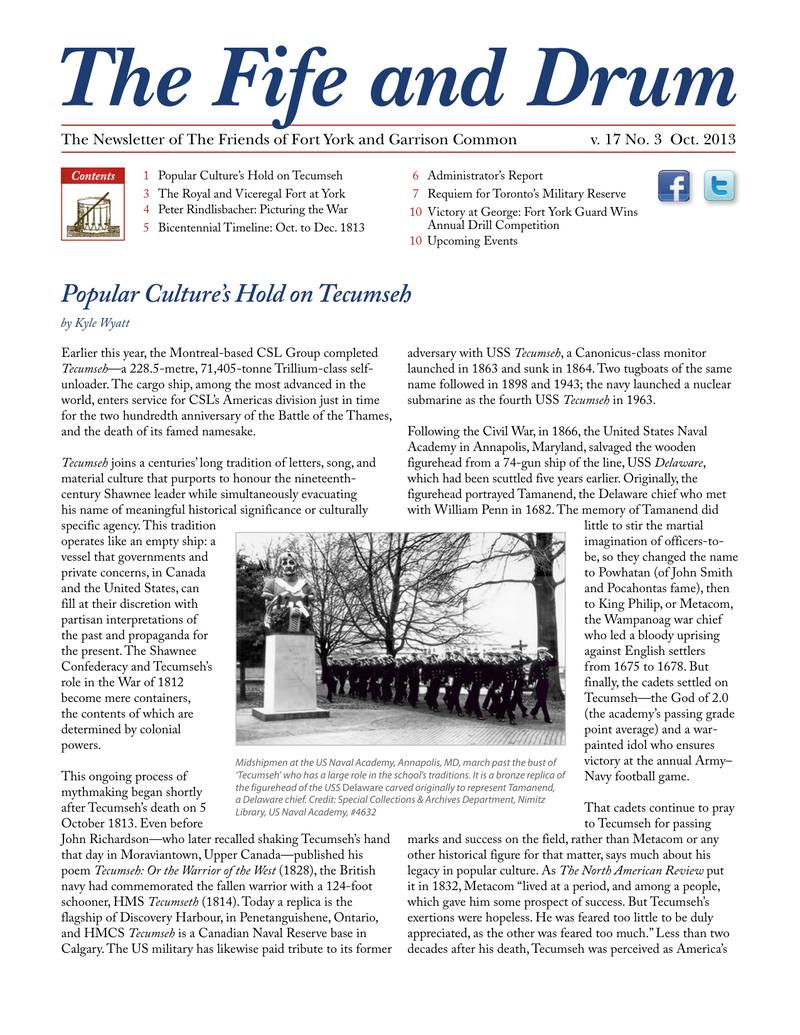
Following the Civil War, in 1866, the United States Naval Academy in Annapolis, Maryland, salvaged the wooden figurehead from a 74-gun ship of the line, USS Delaware, which had been scuttled five years earlier. Originally, the figurehead portrayed Tamanend, the Delaware chief who met with William Penn in 1682. The memory of Tamanend did little to stir the martial imagination of officers-to-be, so they changed the name to Powhatan (of John Smith and Pocahontas fame), then to King Philip, or Metacom, the Wampanoag war chief who led a bloody uprising against English settlers from 1675 to 1678. But finally, the cadets settled on Tecumseh—the God of 2.0 (the academy’s passing grade point average) and a war-painted idol who ensures victory at the annual Army–Navy football game.
That cadets continue to pray to Tecumseh for passing marks and success on the field, rather than Metacom or any other historical figure for that matter, says much about his legacy in popular culture. As The North American Review put it in 1832, Metacom “lived at a period, and among a people, which gave him some prospect of success. But Tecumseh’s exertions were hopeless. He was feared too little to be duly appreciated, as the other was feared too much.” Less than two decades after his death, Tecumseh was perceived as America’s “less obnoxious enemy,” who was “contemned” rather than “hated.” A “patriot” for “wild lands and for wild liberty,” his failed confederacy—his 2.0 of statesmanship—posed no real threat, historical or contemporary, to US expansion. As his aims were hopeless, his quixotic nobility could be refashioned as a malleable building block of nineteenth-century US nationalism. In the words of historian and biographer John Sugden, “The historical facts about Tecumseh were soon forgotten.”
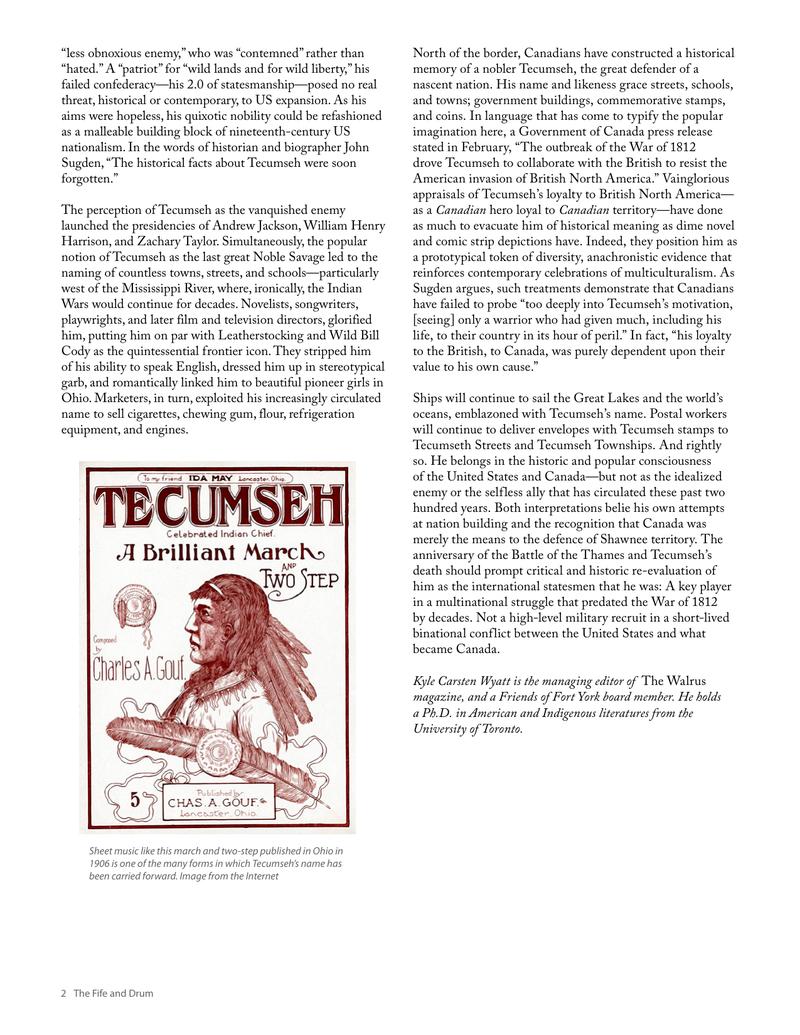
The perception of Tecumseh as the vanquished enemy launched the presidencies of Andrew Jackson, William Henry Harrison, and Zachary Taylor. Simultaneously, the popular notion of Tecumseh as the last great Noble Savage led to the naming of countless towns, streets, and schools—particularly west of the Mississippi River, where, ironically, the Indian Wars would continue for decades. Novelists, songwriters, playwrights, and later film and television directors, glorified him, putting him on par with Leatherstocking and Wild Bill Cody as the quintessential frontier icon. They stripped him of his ability to speak English, dressed him up in stereotypical garb, and romantically linked him to beautiful pioneer girls in Ohio. Marketers, in turn, exploited his increasingly circulated name to sell cigarettes, chewing gum, flour, refrigeration equipment, and engines.

North of the border, Canadians have constructed a historical memory of a nobler Tecumseh, the great defender of a nascent nation. His name and likeness grace streets, schools, and towns; government buildings, commemorative stamps, and coins. In language that has come to typify the popular imagination here, a Government of Canada press release stated in February, “The outbreak of the War of 1812 drove Tecumseh to collaborate with the British to resist the American invasion of British North America.” Vainglorious appraisals of Tecumseh’s loyalty to British North America—as a Canadian hero loyal to Canadian territory—have done as much to evacuate him of historical meaning as dime novel and comic strip depictions have. Indeed, they position him as a prototypical token of diversity, anachronistic evidence that reinforces contemporary celebrations of multiculturalism. As Sugden argues, such treatments demonstrate that Canadians have failed to probe “too deeply into Tecumseh’s motivation, [seeing] only a warrior who had given much, including his life, to their country in its hour of peril.” In fact, “his loyalty to the British, to Canada, was purely dependent upon their value to his own cause.”
Ships will continue to sail the Great Lakes and the world’s oceans, emblazoned with Tecumseh’s name. Postal workers will continue to deliver envelopes with Tecumseh stamps to Tecumseh Streets and Tecumseh Townships. And rightly so. He belongs in the historic and popular consciousness of the United States and Canada—but not as the idealized enemy or the selfless ally that has circulated these past two hundred years. Both interpretations belie his own attempts at nation building and the recognition that Canada was merely the means to the defence of Shawnee territory. The anniversary of the Battle of the Thames and Tecumseh’s death should prompt critical and historic re-evaluation of him as the international statesman that he was: A key player in a multinational struggle that predated the War of 1812 by decades. Not a high-level military recruit in a short-lived binational conflict between the United States and what became Canada.
Original printed pages