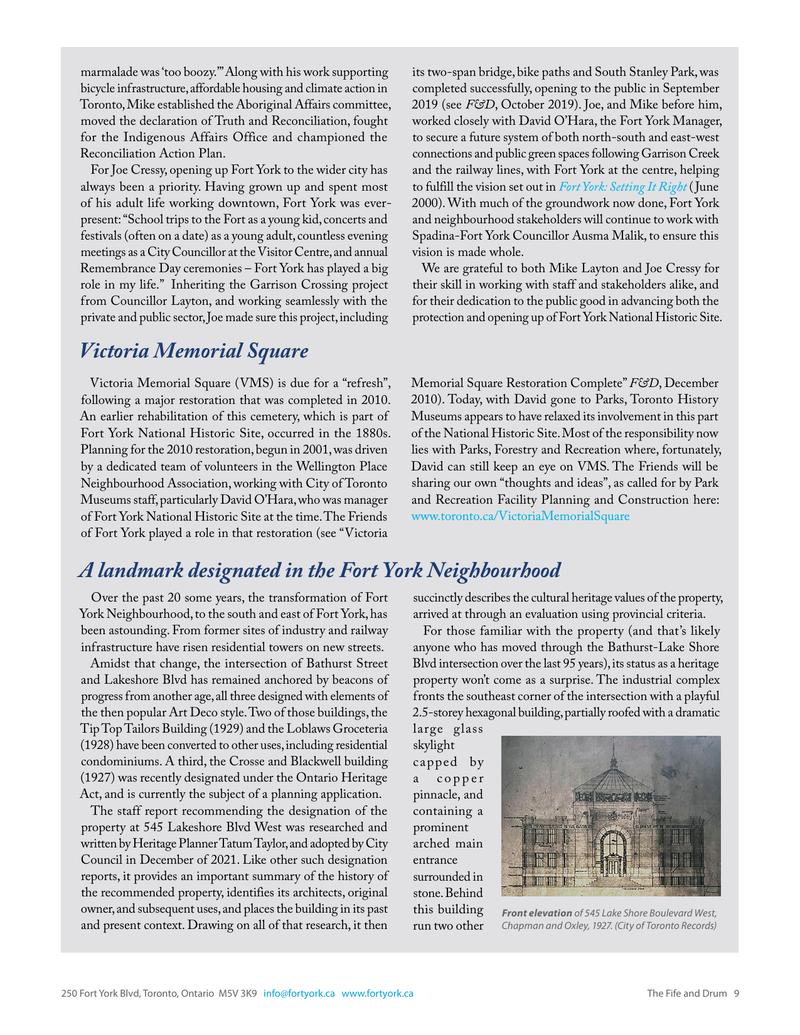
Over the past 20 some years, the transformation of Fort York Neighbourhood, to the south and east of Fort York, has been astounding. From former sites of industry and railway infrastructure have risen residential towers on new streets. Amidst that change, the intersection of Bathurst Street and Lakeshore Blvd has remained anchored by beacons of progress from another age, all three designed with elements of the then popular Art Deco style. Two of those buildings, the Tip Top Tailors Building (1929) and the Loblaws Groceteria (1928) have been converted to other uses, including residential condominiums. A third, the Crosse and Blackwell building (1927) was recently designated under the Ontario Heritage Act, and is currently the subject of a planning application.
The staff report recommending the designation of the property at 545 Lakeshore Blvd West was researched and written by Heritage Planner Tatum Taylor, and adopted by City Council in December of 2021. Like other such designation reports, it provides an important summary of the history of the recommended property, identifies its architects, original owner, and subsequent uses, and places the building in its past and present context. Drawing on all of that research, it then succinctly describes the cultural heritage values of the property, arrived at through an evaluation using provincial criteria.
For those familiar with the property (and that’s likely anyone who has moved through the Bathurst–Lake Shore Blvd intersection over the last 95 years), its status as a heritage property won’t come as a surprise. The industrial complex fronts the southeast corner of the intersection with a playful 2.5-storey hexagonal building, partially roofed with a dramatic large glass skylight capped by a copper pinnacle, and containing a prominent arched main entrance surrounded in stone. Behind this building run two other more typical three storey industrial buildings.
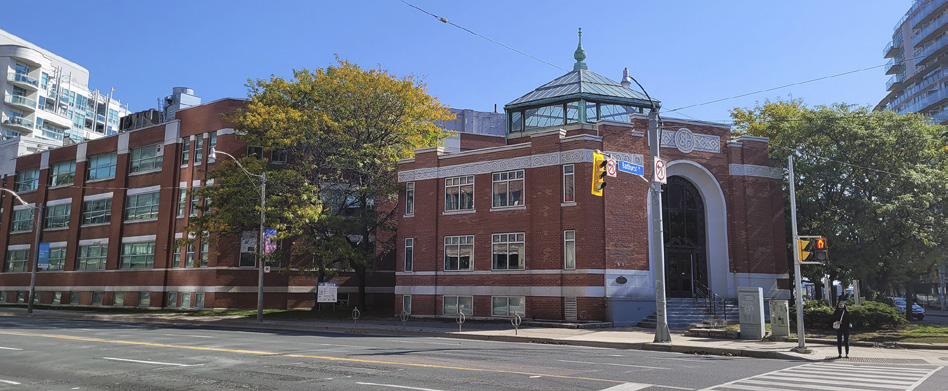
The entrance building fronting the corner looks like it should be on Exhibition Place, or further west on Lake Shore Blvd. Not coincidentally perhaps, it was designed by prominent architects Chapman and Oxley, who also designed the nearby Princes’ Gates and the Sunnyside Pavilion.
The building is valued for more than its design, however. The designation report notes that the building was one of the first to be constructed on new lands created directly south of the Fort through landfilling operations in the early 1920s. Its intriguing design and prominent corner location was purposefully created to contribute to the identity of Lake Shore Boulevard West (then Fleet Street) as a quite new waterfront thoroughfare across Toronto.
Finally, the report points to the value of the building related to its history and past use. It was constructed for Crosse & Blackwell, a centuries-old British foodstuffs company, that was then prized in a very British Toronto. More intriguing to the Toronto of today, perhaps, the property was adapted into a media centre for CFMT-TV, Canada’s first multilingual, multicultural TV station, headed by Dan Iannuzzi. And that makes a final link to the Friends of Fort York. When the new streets in the Fort York neighbourhood were being named, the Friends contributed to the street naming process (see “Names chosen for streets and park in FY neighbourhood” in F&D, May 2005). Today, running parallel to Grand Magazine Street and intersecting with Sloping Sky Mews, is Iannuzzi Street.
Original printed pages