While the Dictionary of Canadian Biography described Thomas J. Sutherland (1801-1852) as a “Patriot filibuster and author” http://www.biographi.ca/en/bio/sutherland_thomas_jefferson_8E.html, his detractors called him many disparaging things—a pirate, borderer, brigand, intense ruffian, rapscallion rabble, blustering Bobadil, and plumed popinjay.
Americans referred to the civil rebellions in Upper and Lower Canada in 1837-38 as the “Patriot War.” Sutherland first came to prominent notice as a Patriot activist in December 1837 when he addressed two of the largest public meetings ever held in Buffalo, announcing that the Patriots were intending to invade Canada immediately. In a direct violation of American neutrality laws, he called for volunteers and contributions of arms and supplies to the cause. On December 13, “Colonel” Sutherland (as he was now styled), William Lyon Mackenzie, “General” Rensselaer Van Rensselaer, and 25 to 50 followers invaded Canada when they set up camp on Navy Island in the Niagara River. Within a week the Patriot ranks there had swelled to 500 men. At the end of December, Van Rensselaer sent newly promoted “Brigadier-General” Sutherland to Detroit to co-ordinate Patriot plans to invade Upper Canada’s Western District. Two weeks later Sutherland was arrested for violating US neutrality laws. Found not guilty, he was released but also relinquished his command in the Patriot army.
On March 4 while on route back to Buffalo, Sutherland and his aide-de-camp Captain Patrick Spencer were captured by Lieutenant-Colonel John Prince on the ice of Lake Erie, west of Colchester. As Prince recorded in his diary: “About 8 miles below Malden I had the good fortune to capture General Sutherland & Capt Spencer of The Patriot (or Rebel) Army! Conveyed the Prisoners to Malden.” His military colleague, Lieutenant Henry Rudyerd, also noted the seizure of the two men: “Brig Genl. Sutherland and Captn Spencer were captured by Lt. Col’l Prince they were observed by him on the ice 2 miles from our shore … we escorted them to Amherstburg.”
At Fort Malden the next day Sutherland and Spencer were examined by the magistrates. The military authorities there were of the opinion, “… it is not safe that [the prisoners] should remain here long,” and believed they should be sent immediately “under a strong escort to Toronto, in charge of Captain Rudyer [sic], of the loyal Essex Volunteers.” Rudyerd and the prisoners reached Toronto on March 12. Sutherland was taken to Government House where he met Lieutenant-Governor Sir Francis Bond Head who assured him that the intention of the government was to conduct a speedy trial. Sutherland would have the dubious honour of being the first captured Patriot to be tried under the Lawless Aggression Act, passed in January 1838 giving the civil authorities the power to try enemy aliens by court martial. The two prisoners were then moved to “the garrison” and incarcerated. On March 13, Spencer was transferred to the Toronto Gaol, and the Militia General Court Martial of Sutherland began. Officials served Sutherland with a copy of the charges preferred against him, and then adjourned to allow the prisoner to prepare his defence. Sutherland was delivered into the custody of Major George Gurnett at Fort York.
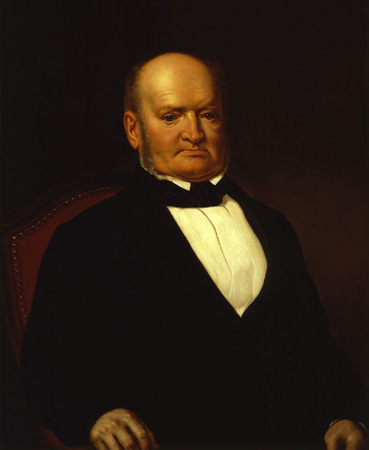
Gurnett, a Toronto city alderman chosen by his peers on council to serve as mayor for 1837, was later appointed as an unattached major in the militia. He was a magistrate of the Home District and a clerk of the peace besides. His responsibility for running certain aspects of Fort York was probably a consequence of the departure of most of the regular soldiers and their officers for Lower Canada to deal with the Patriote rebellion there.
Sutherland described his situation at Fort York: “I was conveyed to the garrison … [and] confined in a room of a magazine whose walls were four or five feet thick, with treble-locked doors and massive grates at the windows. This of itself would have forbidden all idea of getting out, if I had been left there alone; but the security against my escape was made doubly so by a chain of five sentinels posted on the outside of the building, with another who walked by the side of my bed. Then to these there were added three Irish Orangemen sworn in as special constables, who remained in the room near my person to ensure the fidelity of the soldiers, who are always distrusted by their officers.”
The next morning, Major Gurnett was called to Sutherland’s quarters where, “He found him in a state of great exhaustion, from loss of blood. Sutherland had opened veins in both his arms and his feet, evidently with the intention of destroying himself.” Dr. Lennie, assistant surgeon of the 24th Regiment, was called to attend. In consequence of the attempted suicide, the court adjourned until Sutherland had recovered sufficiently to stand trial.
Lieutenant Charles Allan Parker, a Royal Marine stationed at Kingston who had fought at the Battle of the Windmill in Prescott, recorded his thoughts about Sutherland: “The deportment of Sutherland is said to have been calm and collected. On his trial he stated himself to be a lawyer. He was furnished with a copy of the charges against him, and allowed to consult counsel [Mr. Ridout] who were not however allowed to plead for him … The second day of the trial was interrupted in consequence of the prisoner having during the night, attempted to bleed himself to death … An end worthy of a bandit. Suicide may have been considered in the days of Brutus a manly virtue. In the days of Victoria it betrays a coward heart!”
On March 19, Dr. Lennie stated that Sutherland had sufficiently regained his health and was ready to be brought before the court. The proceedings continued until March 29, when Sutherland presented his defence, abandoned using counter evidence, and trusted his case wholly to points of law. For his detailed account of the trial see T.J. Sutherland, A Letter to Her Majesty the British Queen (Albany, NY: C. Van Benthuysen, 1841). The trial was brought to a close and Sutherland remained locked up at Fort York for nearly a month, awaiting the verdict.
In the [Kingston] British Whig of March 31, it was suggested why a verdict had not been reached: “There is some difficulty in deciding on his case, arising from a technicality in the statute, which applies only to foreigners taken in arms with subjects of Her Majesty.” The May 19 issue of the [London] Spectator opined that “Sutherland it was said, would be transported for life, as no act of violence was proven against him.” Subsequently, he was found guilty and he was sentenced to transportation for life. Sutherland was then transferred to the Toronto Gaol. In June, he was sent to the Citadel in Quebec “for the sole purpose of safe custody,” and there awaited his fate.
Serious doubts and questions were brought forward as to the legality of Sutherland’s conviction. The matter was referred to Law Officers of the Crown in England. After their deliberations, a decision was made proclaiming that the conviction was clearly illegal. Lord Durham set aside the guilty verdict, and put in motion actions that led to Lieutenant-Governor Sir George Arthur signing a pardon. Sutherland was then repatriated to the United States. One of Fort York’s most infamous prisoners would never return there again, and was set free to live out the rest of his life in relative obscurity in his homeland.
Original printed pages