

Q) How long have you known Douglas?
A) Since high school in 1974, at Sentinel Senior Secondary in West Vancouver. We were in the same art classes.
Q) Was it a school that specialized in the arts?
A) No way. Sentinel had an award for metal shop but not for art. After Sentinel, Doug arrived in the Emily Carr College of Art & Design in 1980 [now called the Emily Carr University] when I was there in my second year until I dropped out. Even then you could tell Doug was destined for great things. We’ve always kept in touch.
Q) How long have you been studying things military?
A) My father was an historian but also part of my fascination with things military stems from the fact that British Columbia has never had a big battle, major campaign or much of a military presence at all. Growing up I felt ripped off! Like many younger people of my era I thought Canadian history was boring—only later have I realized that peace was actually a good thing.
Q) What was your pathway to where you are now?
A) Comics to start with—Joe Kubert and John Severin being favourites—but I was a late starter reading books as I’m dyslexic. The first real book I ever read was on the European campaigns of WW2.
Q) What about figures?
A) I collected Airfix plastic soldiers (we called them “50 Men”) and model kits—mostly aircraft as putting on model tank treads was so hard.
Q) Dioramas?
A) Yes. They involved lots of Polyfilla.
Q) What about metal figures?
A) Soon enough I discovered metal wargame figures, Hinchcliffe mostly. I painted and collected them. Then, in my early teens I discovered the Trumpeter Wargames Club in Vancouver’s suburb of Burnaby.
Q) What was your first army?
A) The Brunswick army at the battle of Waterloo; I liked the black uniforms. Since then I’ve painted many thousands of figures as I paint for hire. I’ve got figures for Colonials (Zulu, First Boer and Darkest Africa,) the French and Indian War, War of 1812, and the entire 4th Corps of the Prussian army in 1813-1814.
Q) Do you have any theories about where the art world meets the military world?
A) It isn’t easy being an artist who’s into military history. People automatically assume I’m pro-war. I don’t try to hide my wargamer interests. It’s become an important part of my identity and a badge of honour.
Q) Have you visited Fort York?
A) No, sadly, I’ve never been to Toronto. I’ve been to Fort Henry, Crysler’s Farm, old Quebec City, Louisbourg, Port Beauséjour and the Halifax Citadel, but never Toronto.
Q) Was it weird when Douglas came to you for help on such a super-specific task?
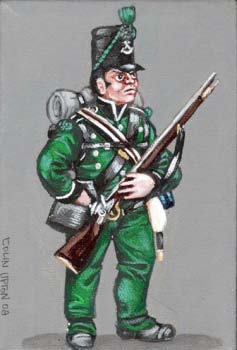
A) At first I wasn’t sure what the drawings were for, but when Doug explained what was needed, it all seemed perfectly natural. Doug knows about my interest in military history, but, I mean, how many people would anybody know who understood the difference between a “Stovepipe” and a “Barretina” shako? Doug’s knowing me was a happy coincidence.
Q) “Barretina” shako?
A) The “Barretina” is the original Portuguese false-fronted shako (itself I suspect influenced by the false-fronted but peakless Austro-Hungarian “Kaskett”) that inspired the British “Waterloo” or “Belgic” shako (both inaccurate names as the “1812” shako was seen in limited numbers in the Peninsular War before the 100 Days Campaign) and the American “Tombstone,” meanwhile, ironically, the Portuguese had adopted the “Stovepipe” shako and …as you can see, I like details.
Q) Can you describe your collections to us?

A) I have a large collection of military history books covering all periods for reference, but I concentrate on the 18th to 20th centuries. As for wargaming painted pieces, I have 25mm French and Indian War, 15mm War of 1812, 25mm Zulu and 1st Boer War, an extensive collection of “Darkest Africa” figures and the 4th Corps of the Prussian Army, 1813-1815 in 15mm.
Q) What’s your most cherished figure?
A) Oh, gosh, I dunno, I’ve painted so many. The Copplestone Darkest Africa figures are lovely sculpts (and have been a joy to paint 28mm after all those 15mm!) I have a couple 15mm conversions, Tecumseh and the Glengarry Light Infantry Fencibles for example, that I’m quite proud of. I don’t paint spectacular individual “show” figures, instead I am able to paint large numbers of figures to a reasonably high standard. I have a lot of affection for my Copplestone “not-Corto Maltese” figure.
Q) You’ve seen photos of the finished 1812 piece in Toronto. Your thoughts?
A) It’s so damn cool every time I look at it I just start to giggle. They’re so BIG! I love the gentle poke at those Americans who still delude themselves into thinking that the War of 1812 was some sort of victory for them. I love how it reminds me of the plastic toy soldiers of my youth (complete with mold lines and flash!) and that unlike so much modern art it is instantly understandable. I love the fact that I was small a part of this and that historical accuracy mattered enough to Doug to make sure somebody like me was there to get it right. Okay, some of the proportions were off but that’s consistent with the “toy soldier” aesthetic. But mostly I’m relieved that so far the figures have passed muster (even with some hardcore historical recreationists) with no glaring mistakes on my part. I was holding my breath for a long time before they were unveiled.
Oh, right, well, the dark green guy is from the “Glengarry Light Infantry Fencibles, 1812” And the guy in the light green fringed hunting shirt is “1st U.S. Rifle Regiment, 1812”
Original printed pages


