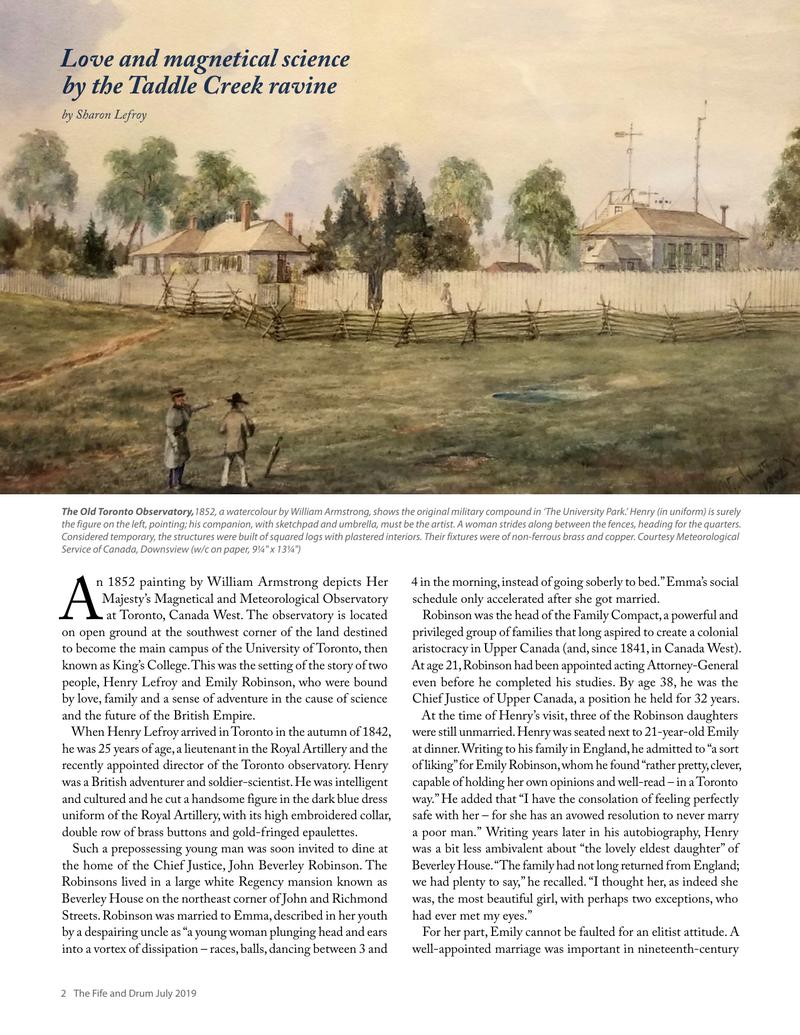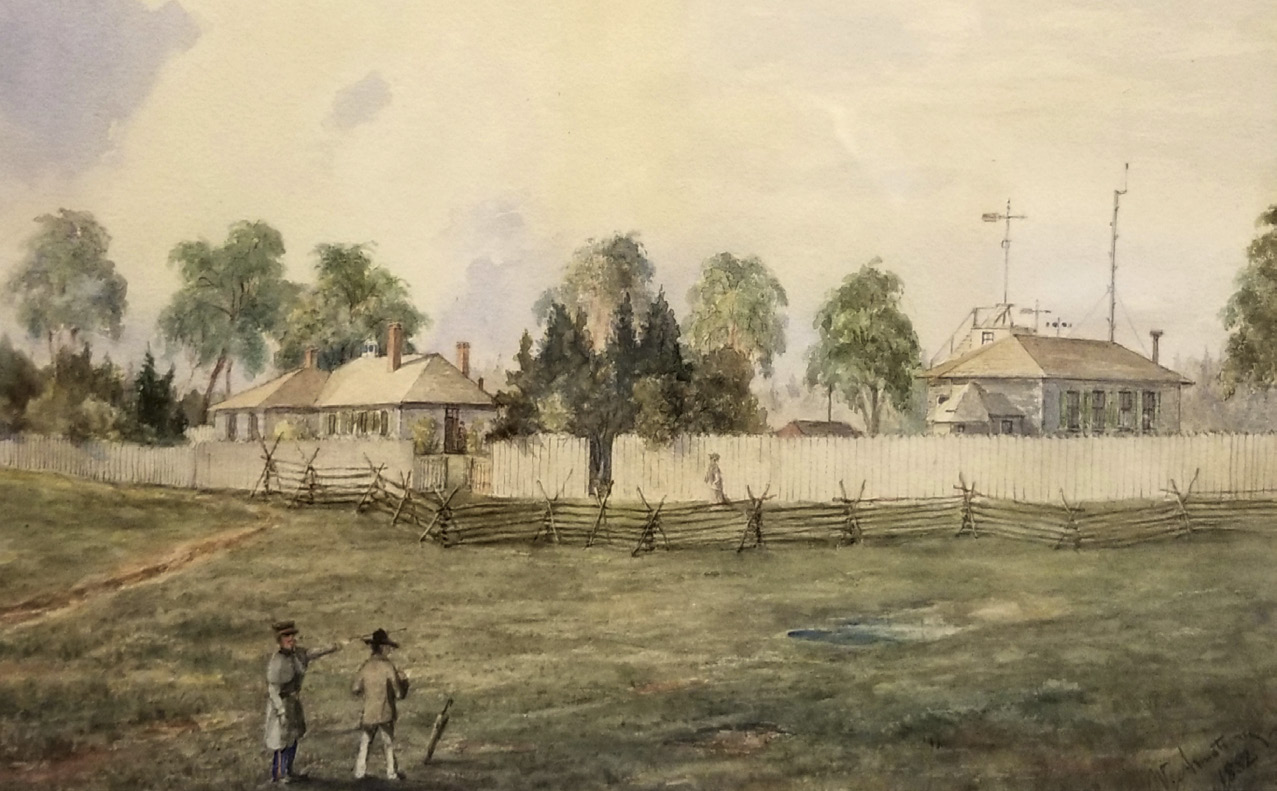
An 1852 painting by William Armstrong depicts Her Majesty’s Magnetical and Meteorological Observatory at Toronto, Canada West. The observatory is located on open ground at the southwest corner of the land destined to become the main campus of the University of Toronto, then known as King’s College. This was the setting of the story of two people, Henry Lefroy and Emily Robinson, who were bound by love, family and a sense of adventure in the cause of science and the future of the British Empire.
When Henry Lefroy arrived in Toronto in the autumn of 1842, he was 25 years of age, a lieutenant in the Royal Artillery and the recently appointed director of the Toronto observatory. Henry was a British adventurer and soldier-scientist. He was intelligent and cultured and he cut a handsome figure in the dark blue dress uniform of the Royal Artillery, with its high embroidered collar, double row of brass buttons and gold-fringed epaulettes.
Such a prepossessing young man was soon invited to dine at the home of the Chief Justice, John Beverley Robinson. The Robinsons lived in a large white Regency mansion known as Beverley House on the northeast corner of John and Richmond Streets. Robinson was married to Emma, described in her youth by a despairing uncle as “a young woman plunging head and ears into a vortex of dissipation – races, balls, dancing between 3 and 4 in the morning, instead of going soberly to bed.” Emma’s social schedule only accelerated after she got married.
Robinson was the head of the Family Compact, a powerful and privileged group of families that long aspired to create a colonial aristocracy in Upper Canada (and, since 1841, in Canada West). At age 21, Robinson had been appointed acting Attorney-General even before he completed his studies. By age 38, he was the Chief Justice of Upper Canada, a position he held for 32 years.
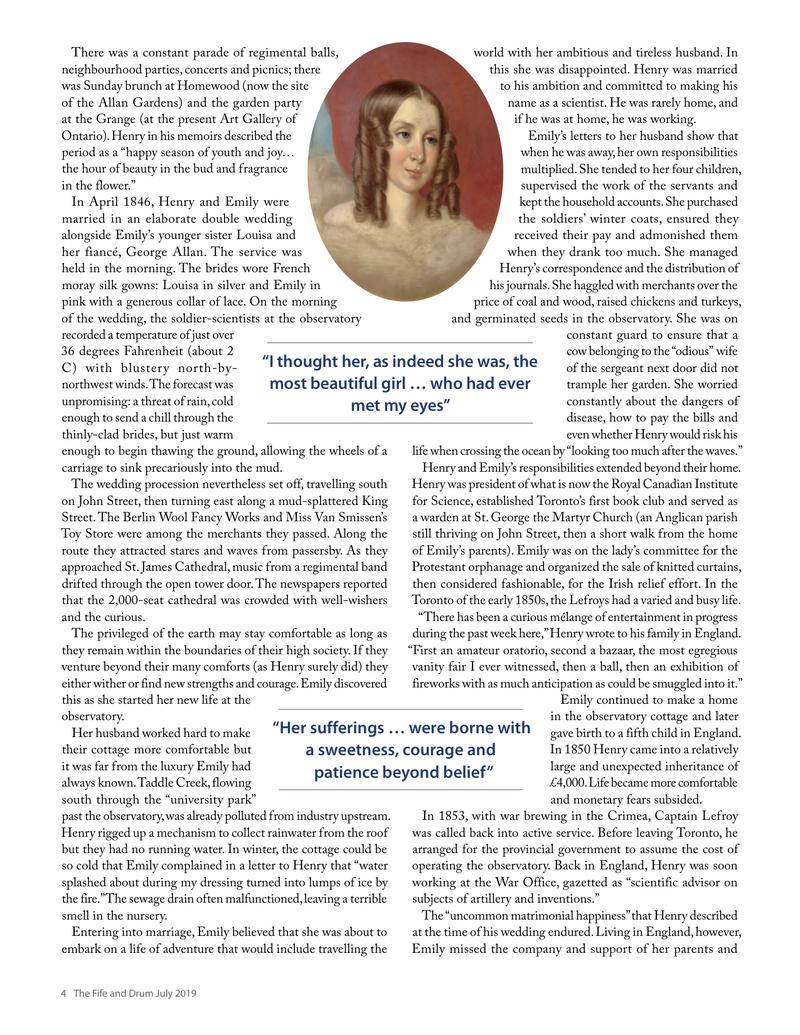
At the time of Henry’s visit, three of the Robinson daughters were still unmarried. Henry was seated next to 21-year-old Emily at dinner. Writing to his family in England, he admitted to “a sort of liking” for Emily Robinson, whom he found “rather pretty, clever, capable of holding her own opinions and well-read – in a Toronto way.” He added that “I have the consolation of feeling perfectly safe with her – for she has an avowed resolution to never marry a poor man.” Writing years later in his autobiography, Henry was a bit less ambivalent about “the lovely eldest daughter” of Beverley House. “The family had not long returned from England; we had plenty to say,” he recalled. “I thought her, as indeed she was, the most beautiful girl, with perhaps two exceptions, who had ever met my eyes.”
For her part, Emily cannot be faulted for an elitist attitude. A well-appointed marriage was important in nineteenth-century
There was a constant parade of regimental balls, neighbourhood parties, concerts and picnics; there was Sunday brunch at Homewood (now the site of the Allan Gardens) and the garden party at the Grange (at the present Art Gallery of Ontario). Henry in his memoirs described the period as a “happy season of youth and joy… the hour of beauty in the bud and fragrance in the flower.”
In April 1846, Henry and Emily were married in an elaborate double wedding alongside Emily’s younger sister Louisa and her fiancé, George Allan. The service was held in the morning. The brides wore French moray silk gowns: Louisa in silver and Emily in pink with a generous collar of lace. On the morning of the wedding, the soldier-scientists at the observatory recorded a temperature of just over 36 degrees Fahrenheit (about 2 C) with blustery north-by-northwest winds. The forecast was unpromising: a threat of rain, cold enough to send a chill through the thinly-clad brides, but just warm enough to begin thawing the ground, allowing the wheels of a carriage to sink precariously into the mud.
“I thought her, as indeed she was, the most beautiful girl … who had ever met my eyes”
The wedding procession nevertheless set off, travelling south on John Street, then turning east along a mud-splattered King Street. The Berlin Wool Fancy Works and Miss Van Smissen’s Toy Store were among the merchants they passed. Along the route they attracted stares and waves from passersby. As they approached St. James Cathedral, music from a regimental band drifted through the open tower door. The newspapers reported that the 2,000-seat cathedral was crowded with well-wishers and the curious.
The privileged of the earth may stay comfortable as long as they remain within the boundaries of their high society. If they venture beyond their many comforts (as Henry surely did) they either wither or find new strengths and courage. Emily discovered this as she started her new life at the observatory.
Her husband worked hard to make their cottage more comfortable but it was far from the luxury Emily had always known. Taddle Creek, flowing south through the “university park” past the observatory, was already polluted from industry upstream. Henry rigged up a mechanism to collect rainwater from the roof but they had no running water. In winter, the cottage could be so cold that Emily complained in a letter to Henry that “water splashed about during my dressing turned into lumps of ice by the fire.” The sewage drain often malfunctioned, leaving a terrible smell in the nursery.
“Her sufferings … were borne with a sweetness, courage and patience beyond belief”
Entering into marriage, Emily believed that she was about to embark on a life of adventure that would include travelling the world with her ambitious and tireless husband. In this she was disappointed. Henry was married to his ambition and committed to making his name as a scientist. He was rarely home, and if he was at home, he was working.
Emily’s letters to her husband show that when he was away, her own responsibilities multiplied. She tended to her four children, supervised the work of the servants and kept the household accounts. She purchased the soldiers’ winter coats, ensured they received their pay and admonished them when they drank too much. She managed Henry’s correspondence and the distribution of his journals. She haggled with merchants over the price of coal and wood, raised chickens and turkeys, and germinated seeds in the observatory. She was on constant guard to ensure that a cow belonging to the “odious” wife of the sergeant next door did not trample her garden. She worried constantly about the dangers of disease, how to pay the bills and even whether Henry would risk his life when crossing the ocean by “looking too much after the waves.”
Henry and Emily’s responsibilities extended beyond their home. Henry was president of what is now the Royal Canadian Institute for Science, established Toronto’s first book club and served as a warden at St. George the Martyr Church (an Anglican parish still thriving on John Street, then a short walk from the home of Emily’s parents). Emily was on the lady’s committee for the Protestant orphanage and organized the sale of knitted curtains, then considered fashionable, for the Irish relief effort. In the Toronto of the early 1850s, the Lefroys had a varied and busy life.
“There has been a curious mélange of entertainment in progress during the past week here,” Henry wrote to his family in England. “First an amateur oratorio, second a bazaar, the most egregious vanity fair I ever witnessed, then a ball, then an exhibition of fireworks with as much anticipation as could be smuggled into it.”
Emily continued to make a home in the observatory cottage and later gave birth to a fifth child in England. In 1850 Henry came into a relatively large and unexpected inheritance of £4,000. Life became more comfortable and monetary fears subsided.
In 1853, with war brewing in the Crimea, Captain Lefroy was called back into active service. Before leaving Toronto, he arranged for the provincial government to assume the cost of operating the observatory. Back in England, Henry was soon working at the War Office, gazetted as “scientific advisor on subjects of artillery and inventions.”
The “uncommon matrimonial happiness” that Henry described at the time of his wedding endured. Living in England, however, Emily missed the company and support of her parents and
Original printed pages