Emily was well schooled in the feminine skills essential in her milieu: sewing and embroidery, piano, French, drawing and polite conversation. She found most of these terribly tedious. Like her mother, Emily preferred to attend dances, socialize and share an occasional good morsel of gossip. On a trip to England and France with her family as a young adult, she sat in the peeress’s gallery of the House of Lords to witness Queen Victoria announce her engagement to Prince Albert. She attended balls and banquets and was introduced to members of the British royalty. “I would rather go to the continent just now than return to Canada most decidedly,” she wrote in her diary. Once in France, “I played and copied some of Musard’s quadrilles. We amused ourselves dancing to Lanner’s Waltzes. We went to the Cirque Olympique.”
Although Henry’s financial situation was quite different from Emily’s, he was equally strategic in marriage. “I will never marry a woman whose character and influence will ever be unfavourable,” Henry wrote to his superior officer, the scientist Colonel Edward Sabine, in England. A problem was that Henry earned only £200 annually as a junior officer, plus a £180 supplement for his scientific work. In contrast, the Chief Justice earned the highest salary in the province next to the lieutenant governor, close to ten times Henry’s base salary.
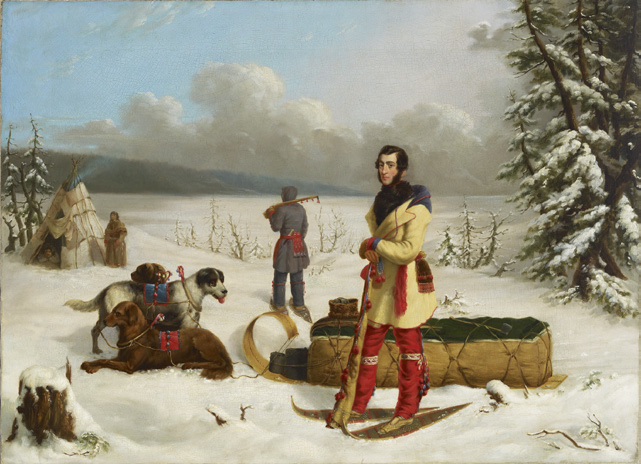
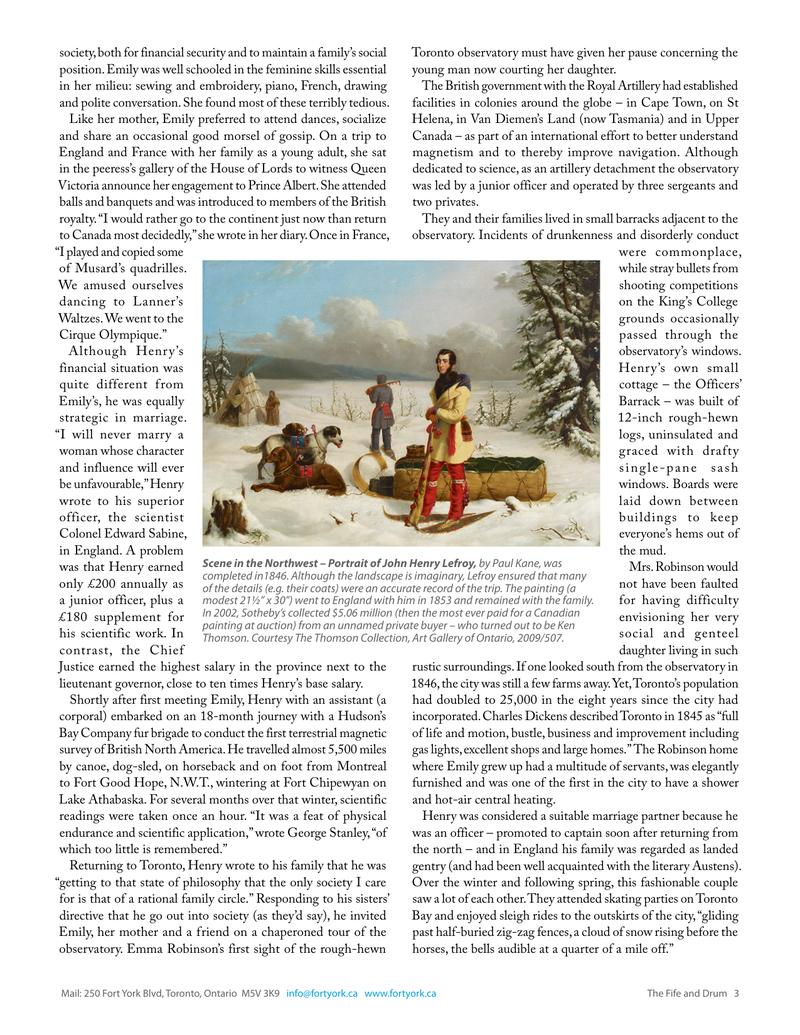
Shortly after first meeting Emily, Henry with an assistant (a corporal) embarked on an 18-month journey with a Hudson’s Bay Company fur brigade to conduct the first terrestrial magnetic survey of British North America. He travelled almost 5,500 miles by canoe, dog-sled, on horseback and on foot from Montreal to Fort Good Hope, N.W.T., wintering at Fort Chipewyan on Lake Athabaska. For several months over that winter, scientific readings were taken once an hour. “It was a feat of physical endurance and scientific application,” wrote George Stanley, “of which too little is remembered.”
Returning to Toronto, Henry wrote to his family that he was “getting to that state of philosophy that the only society I care for is that of a rational family circle.” Responding to his sisters’ directive that he go out into society (as they’d say), he invited Emily, her mother and a friend on a chaperoned tour of the observatory. Emma Robinson’s first sight of the rough-hewn Toronto observatory must have given her pause concerning the young man now courting her daughter.
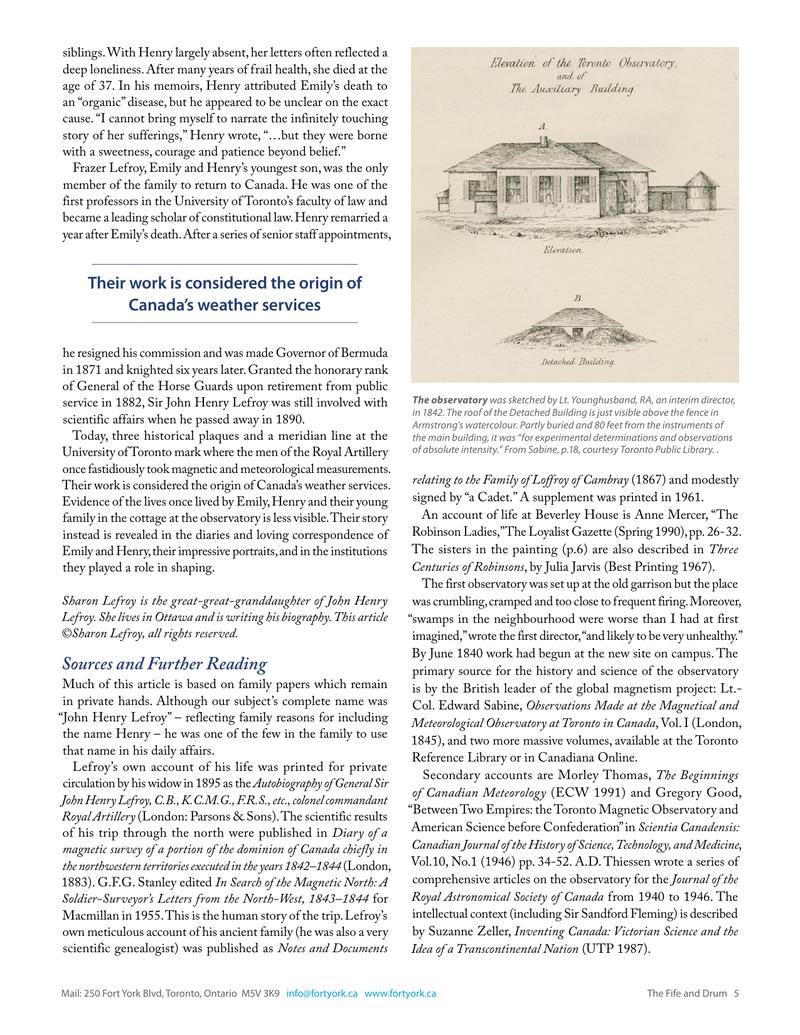
The British government with the Royal Artillery had established facilities in colonies around the globe – in Cape Town, on St Helena, in Van Diemen’s Land (now Tasmania) and in Upper Canada – as part of an international effort to better understand magnetism and to thereby improve navigation. Although dedicated to science, as an artillery detachment the observatory was led by a junior officer and operated by three sergeants and two privates.
They and their families lived in small barracks adjacent to the observatory. Incidents of drunkenness and disorderly conduct were commonplace, while stray bullets from shooting competitions on the King’s College grounds occasionally passed through the observatory’s windows. Henry’s own small cottage – the Officers’ Barrack – was built of 12-inch rough-hewn logs, uninsulated and graced with drafty single-pane sash windows. Boards were laid down between buildings to keep everyone’s hems out of the mud.
Mrs. Robinson would not have been faulted for having difficulty envisioning her very social and genteel daughter living in such rustic surroundings.
If one looked south from the observatory in 1846, the city was still a few farms away. Yet, Toronto’s population had doubled to 25,000 in the eight years since the city had incorporated. Charles Dickens described Toronto in 1845 as “full of life and motion, bustle, business and improvement including gas lights, excellent shops and large homes.” The Robinson home where Emily grew up had a multitude of servants, was elegantly furnished and was one of the first in the city to have a shower and hot-air central heating.
Henry was considered a suitable marriage partner because he was an officer – promoted to captain soon after returning from the north – and in England his family was regarded as landed gentry (and had been well acquainted with the literary Austens). Over the winter and following spring, this fashionable couple saw a lot of each other. They attended skating parties on Toronto Bay and enjoyed sleigh rides to the outskirts of the city, “gliding past half-buried zig-zag fences, a cloud of snow rising before the horses, the bells audible at a quarter of a mile off.”
Original printed pages