

Much is made today of the death of our soldiers in Afghanistan. Solemn ceremonies are held with flag draped coffins, the strains of bagpipes are often heard, prayers are said and a tribute to the fallen may be paid by a firing party. But formalities like this were rarely seen when Canada was fighting for its very survival during the war of 1812. Often soldiers were buried where they fell, their graves unmarked, their names unknown.
On the day following the Battle of York of 27 April 1813 the American victors buried scores of casualties, British as well as their own, who died either in the conflict or from their wounds soon after. Counting war casualties is difficult, since reports are often incomplete and conflicting. The Battle of York is no exception. Likely the most reliable estimates of how many were killed, wounded or missing are ones made recently by Robert Malcomson for his forthcoming book on the Battle of York. Addressing only those who were killed on the field or expired soon after, he calculates that 75 men were lost by the British while about 57 U.S. army and navy personnel perished. When deaths among British artificers, their Native allies and the local militia are added, the total number who perished on both sides at York rises to near 140. While other men may have succumbed elsewhere or had lingering deaths, they are not included in this total. Casualties including the dead and wounded were 168 on the British side and about 305 on the American.
Because the magnitude of the job of burying the dead was enormous, most men were laid in mass graves on the battlefield rather than in the Garrison Burying Ground near the fort, now part of Victoria Memorial Square at Portland and Niagara streets. There were some interesting exceptions. The body of Brigadier-General Zebulon Pike was placed in a barrel of spirits and taken back to Sackets Harbor, NY, for burial, while the remains of a Native ally of the British were laid in a grave said by Scadding to be within sight of Yonge Street at Clover Hill, just above Wellesley. Maybe too the bodies of some of the four members of the local militia who fell were recovered by their families for private burial, but this is speculation.
Eli Playter, who lived ‘over the Don’ and was a lieutenant in the militia, recorded in his diary his impression of these doleful labours: “The Yankies had buried all the Dead & I perceived they had done it very ill.” On 11 May, after the U.S. forces had withdrawn from York and a period of rain ended, services of Christian burial were read over these shallow and hasty graves by the Rev. John Strachan, who also made them more secure with the aid of some townsfolk. It is no surprise that the American authorities left no maps or plans to show where they buried the dead. The resting places of a few of the latter have come to be known from discoveries made during the following century.
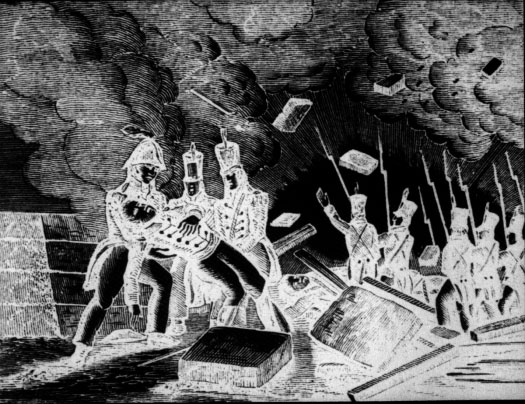
The first of these occurred in Spring, 1829, when the graves of Capt. Neal McNeale and several of the men he had commanded in the grenadier company of the 8th (King’s) Regiment of Foot were exposed by wave action on the Lake Ontario shoreline near the present-day Boulevard Club. They had died opposing the first American landings. When the washout was drawn to the attention of the military authorities at York, they ordered the defenders’ remains conveyed with suitable military ceremony to the Garrison Burying Ground for re-interment there.
The next discovery took place near Bathurst and Front Streets, according to The Globe, 13 Aug. 1860. Workmen employed to excavate footings for a bridge across the railway there came upon the bones of fifteen soldiers buried in a trench ‘opposite Dillon’s Tavern.’ They were identified from buttons, a bayonet, pieces of an officer’s epaulette and some coins as having been both British and American casualties. While the remains were collected carefully, put in a large box, and buried in the Garrison Cemetery by a fatigue party from the Royal Canadian Rifles, the artifacts were entrusted to Sergeant Major Barlow of the 100th Regiment. A few days later he was able to show them to the author Benson J. Lossing who, coincidentally, was visiting Toronto at the time to gather material for his Pictorial Field-book of the War of 1812.
The findings in a third instance may or may not have been related to the Battle of York. In August, 1888, some human remains were found near the newly constructed monument marking the site of Fort Rouillé. When they were shown to Dr. Henry Scadding his opinion was that they dated from the decade 1749-59 when the French occupied the site. Fort Rouillé’s site was still in 1813 a clearing in the woods along the shore, and an attractive place for the Americans to dig new graves for those who fell nearby in the Battle of York? Could these have been soldiers’ bones that were found, and not those of fur traders? No reports have come to notice telling us how the remains were dealt with.
The fourth discovery of a single grave, made in 1894 near the corner of Adelaide and Berkeley, and well-reported in The Globe of 27 August, is enigmatic to say the least. From buttons found with the bones, the remains were identified as those of a soldier of the 8th Regiment. A number of questions followed. Who was the soldier? where was he during the battle? and why was he buried here instead of in the Garrison Cemetery. But there’s no uncertainty about where his remains ended up. A misreading of some of the archaeological evidence in the grave led those in charge to believe that the man was Capt. Neal McNeale; they had forgotten or never known about the 1829 washout and reburial. Hence, a new coffin was purchased, the remains put therein and the lot paraded with much ceremony to Union Station where it was sent off to Halifax in care of the King’s Liverpool Regiment, successors to the 8th.
Miss Jean Geeson of Parkdale, a teacher with a great interest in Toronto’s early history, had cause for concern when in October, 1903, barely two weeks after the Government of Canada agreed to transfer Fort York to the City, the municipality sold a slice of the fort’s east bastion to Park, Blackwell Co., meat packers, for an addition to its plant. When she went to see the encroachments in process she scarcely expected to witness ‘soldiers’ bodies . . . unearthed and their remains carted away with the debris.’ Many of the bones were recovered later and were confirmed by one Lieut.-Col. Gravely to be those of five American soldiers whose nationality was known by coins in their pockets. The well-named Gravely had custody of the bones but we do not know what he did with them.
Only two years later, in May, 1905, the last of the gruesome discoveries, a single skeleton, was made by some officers inspecting some trench-digging near the lake midway between Strachan Avenue and Stanley Barracks. The find was made at a depth of about two feet; two short pipes and one corroded brass button had accompanied the soldier to his grave. The newspaper report concluded on a languid note: “It is believed that there were other bodies buried about the spot, but that the lake had washed that part of the land away.” Again, the fate of the bones is unknown.
From this brief account comes a recognition that the greater number of nearly 140 soldiers who died at York and were buried in haste were nonetheless well buried. Their graves have not yet been found, and may never be. They slumber eternally in peace.
Original printed pages


