It has been often observed that the life of a soldier is characterized by long periods of boredom interrupted by explosive periods of intense stress. For the British soldier performing garrison duty in York, Upper Canada, the former was the more common experience. Desertion rates were high in North America, due in large part to the proximity of the United States: from January of 1839 to January of 1847, some 2228 men deserted from British regiments stationed in Canada. Even those soldiers who didn’t desert too often would spend their idle hours in the canteen or at one of the many taverns characteristic of garrison towns like York. Regimental authorities tried to provide soldiers with alternative ways of spending their leisure time – arguably the most important of which was organized sports. Team games lured the rank and file away from harmful pursuits and offered continuity for the officers whose education would have included sporting events.
Since sports also provided additional training for the battlefield, friendly competition which focused on a soldier’s skills was inevitable. An early Toronto example of this occurred in 1802 when a militia field day concluded with a marksmanship competition – the first prize for which was a pair of beaver hats. One was to be awarded to the “best marksman with the smoothe board [sic] guns and another to the best with there [sic] rifles”. Among the officers, marksmanship was often combined with hunting as in 1848, when Lt. Gilbert Elliot of the 60th rifles, an officer posted to Toronto, wrote “I shot at a rifle match not long ago and slew two very fine birds” which he was able to keep as prizes. Artillery target shooting competitions were also a common occurrence in Toronto. In 1847 the Toronto Independent Artillery Company staged a firing competition which elicited cheers from the “many spectators within the garrison”.
Participating in team games and sports also gave officers the opportunity to mix with the elite and integrate themselves into the local community. In York, this included the popular English game of cricket, with local roots at the Home District Grammar School, founded in 1807, and the Toronto Cricket Club formed in 1827. On at least one occasion in 1837 the garrison common was chosen as the playing ground for a match between the Toronto Cricket Club and the fort’s officers.
After 1837, cricket matches were held at Caer Howell near the site of today’s Princess Margaret Hospital (Caer from the Welsh word for citadel and Howell after the Welsh ancestors of the property’s original owner, William Dummer Powell). In June of 1845, Caer Howell would be the venue for a match between the Toronto Garrison and Upper Canada College; in July of that year, the Toronto Garrison vs. Yonge St.; in 1846 Toronto vs. the Toronto Garrison and; in 1852, Toronto vs. the Military Officers of Canada.
Another sport popular among the local elite and the officers was the English country blood sport known as the fox chase. Equestrian pursuits would rank highly among officers and soldiers as a test of courage, athleticism and riding skill – all of which easily translates to the battlefield. One such event took place in February of 1801 when several members of York society, including Robert Gray, the solicitor general, dined at the blockhouse before joining the officers in pursuing the beast of the chase.
Whether they were chasing foxes, shooting fowl or catching salmon in Garrison Creek, hunting and fishing were among the most popular of sporting activities for the fort’s inhabitants. In her diary Mrs. Simcoe mentions an ingenious combination: “Mr. Pilkington shot a sturgeon” while Gilbert Elliot writes of his hunting expeditions on the garrison common where he would shoot snipe “which make their appearance on small bits of toast in the morning”. Fort York’s archaeological record includes examples of fish hooks, faunal remains of indigenous species and other evidence of a lively culture of game hunting and fishing. One of the more curious objects is the bone from a passenger pigeon, extinct game birds once so plentiful that they darkened the skies for hours during migration. Soldiers standing on the fort’s walls were able to knock them out of the sky with sticks or, as was the case at Fort George in Niagara, sticks with musket balls tied to the end.
The sports field was also one of the few places where officers, NCOs and other ranks could stand in positions of equality. In March of 1801, Sergeant George Purvis of the Queen’s Rangers entered a horse race against Mr. McNab, who had been a lieutenant in the Queen’s Rangers Dragoons during the American Revolution. Purvis won, no doubt gaining the approbation of his colleagues as well as bragging rights. Whether or not a purse of monies was also offered up, we may never know, but McNab and Purvis were engaging in a time-honoured equestrian activity which would evolve into an annual Toronto event hosted by the City of Toronto and Home District Turf Club Races.
By 1841, the St. Leger Course was the venue for the Club Races. Located on land owned by the Boultons, it was situated opposite the present-day site of the Art Gallery of Ontario. The event was open to officers on full pay in Her Majesty’s Militia or Regular Service who had to provide their own horses. The Garrison Plate of £7 10s was the prize for the officer who could complete the mile-and-a-half course in the best time. Unfortunately, Sergeant Purvis would not have qualified, nor was he likely to have been able to afford the £5 entry fee.
Sporting events also provided the garrison with the opportunity to maintain good relations with civilian society. This was of particular value during the Rebellion period, 1837-1841. In 1838 the 93rd (Sutherland Highlanders) Regiment of Foot arrived in Toronto to relieve the Canadian militia and provide a strong military presence in the provincial capital. During their years in Toronto the 93rd would establish an annual sporting event known as “The Gathering”. This is a reference to the traditional clan gatherings and highland games proscribed by the English after 1745 which, like other aspects of Scottish culture, would enjoy a renaissance during the reign of Queen Victoria.
An 1841 newspaper account describes the various games which comprised The Gathering in October of that year, as well as the winners, both military and civilian. Games include the running long leap, running hitch and kick, one mile foot race, sack race, putting heavy ball, putting light ball, wrestling, rifle shooting and several others. The event concluded with a pig race which was won by a soldier of the 43rd who was seen “carrying the prize off the field with great glee”. The friendly competition and good faith that appears to have been engendered by this annual Gathering, no doubt helped the officers and soldiers of the 93rd to establish their presence in the community and represent the British government in a positive light. As an affirmation of cultural identity, the celebration of Scottish heritage would also raise the morale of Highland units like the 93rd.
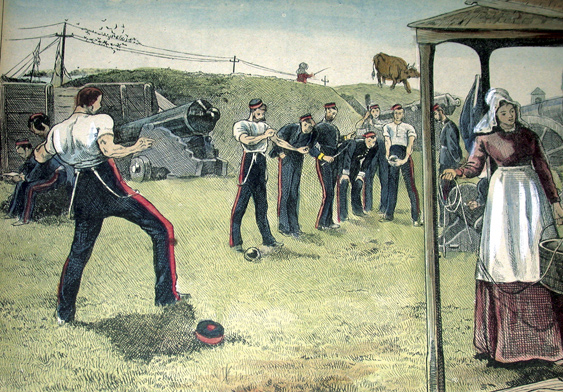
For the military, athletic pursuits often embodied ideals of masculine toughness and strength. The inevitability of soldiers hurling cannon balls in a display of physical strength could only lead to the development of a sporting event.
Shot put is one example of a sport whose origins are military and we know both from the preceding account of the Highland Games, as well as from the accompanying illustration, that it was a pastime engaged in by soldiers who garrisoned Fort York.
The Canadian winter offered games in which the fort’s officers were eager participants. Skating, curling and sleighing are all mentioned regularly in Lt. Elliot’s letters home. The latter excited particular interest in the young officer as it provided the opportunity for flirtation, however sophomoric, with the ladies of Toronto, viz.:
Last week we had great fun on the ice when all the ladies made their appearance, some skating, others walking, the walkers all expected to be pulled about the ice on small sleighs by the gentlemen, I succeeded in upsetting more of the fair sex than most people; it was a most absurd sight to see the whole ice covered with little sleighs containing one or two ladies with men harnessed to them; the great object seemed, to upset them as often as possible by shooting them out.
Whatever the nature of the game, there is no doubt that sport contributed immeasurably to life at Fort York for officers, soldiers and their families. Recognizing the positive effects of sport, authorities would continue to foster a culture of friendly competition that, by the 20th century, would lead to the establishment of regimental sports days, sports officers responsible for the oversight and organization of team games, and by 1918 an Army Sport Control Board to organize sports throughout the army.

Original printed pages