The restoration of Victoria Memorial Square, conceived in 2001, is at last complete. It was in the February 2004 issue of Fife and Drum that I reported the beginning of the city’s contracting process, hardly anticipating that construction would proceed in three separate phases and take seven long years. When Lieutenant-Governor Simcoe effectively opened the garrison cemetery with the interment of his infant daughter Katherine, in 1794, he could not have imagined that more than 200 years later this space would be the central amenity in the new neighbourhood of Wellington Place.
The burying ground was in use until 1863 when it was declared full and a new garrison cemetery opened near Strachan Avenue. After twenty years of neglect the former’s derelict state persuaded the city to appoint a commission to clean up the site and preserve the surviving artifacts. From the mid-1880’s, though still owned by the Government of Canada and containing the original estimated 500 burials, Victoria Memorial Square has been operated by the city as a park.
For many more years the Square sat in a commercial and industrial wasteland, a consequence of the coming of the railways to Toronto’s waterfront. In 1919 one writer described it as “a slum of Toronto, a shabby little park or base-ball ground.” Finally, in the mid-1990’s, when the city changed the planning rules for the area to permit residential occupancy through the “Kings” (King/Spadina and King/Parliament) initiative, a booming mixed-use neighbourhood was born.
New residents quickly realized the importance of the two-acre Square as a focus around which a community could grow and were prepared by 2002 to submit a restoration proposal to the city through the Wellington Place Neighbourhood Association (WPNA), formed in 1999, and with the active participation of the Friends of Fort York.
WPNA had taken the initiative by raising funds to engage a landscape architect who would lead a series of community meetings with the goal of producing a concept plan for the restoration. The meetings, led by David Leinster (ENVision – the Hough Group), identified the primary objectives of the plan: enhancement of the park facility for community use while protecting and interpreting the historical significance of the cemetery and its related artifacts. The Square’s hybrid nature is the key to its restoration and interpretation.
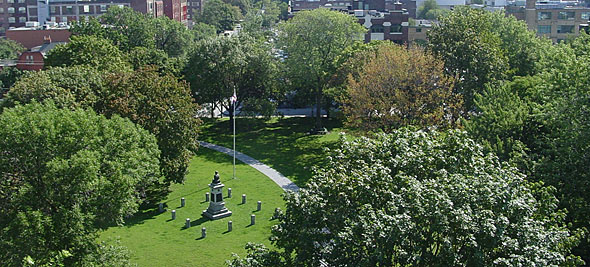
Work proceeded according to the availability of funding. The community began a fundraising campaign (a local theatre contributed one night’s receipts, an individual made a private gift of $10,000) to augment the Parks Department’s limited capital budget. The critical factor proved to be the overheated condo market in the area when contributions from developers began to flow in as a result of Section 45 agreements under the Planning Act made at the Committee of Adjustment in return for minor variances. The assistance of our local councillors, first Olivia Chow and now Adam Vaughan, has been crucial. In 2003 the importance of the enterprise was recognized when the Historic Sites and Monuments Board of Canada declared the Square to be a part of the Fort York National Historic Site.
In April of 2004 a design team had been selected, consisting of Michael McClelland of ERA Architects and landscape architect David Leinster (now with The Planning Partnership). By November of 2005 sufficient funds had accrued to the account to allow Phase 1 to be contracted and work began in May 2006.

Phase 1 consisted of: conducting a new survey of the park, archaeological scanning of the burial sites (establishing that some were only 20cm deep) by Ron Williamson’s Archaeological Services Inc, re-grading of the site (to protect the burials and improve drainage), new irrigation system, new pathways, a tree inventory, removal of the headstones (embedded in concrete around the base of the monument) for restoration and removal of the monument fence. All restoration was carried out under the supervision of the city’s conservator, Sandra Lougheed.
Phase 2, contracted in October 2007, consisted of: removal of dead trees, a granite walkway to mark the boundaries of the cemetery, restoration of the surviving headstones and their re-installation in a “memorial wall,” restoration of the Old Soldier sculpture by Walter Allward, relocation of the flagpole outside the cemetery, replacement of the restored monument fence, new park lighting and furniture, and fencing for the children’s playground.
Phase 3 was primarily concerned with the interpretation of the site. This consisted of: attaching to each headstone an aluminum plaque bearing its original inscription (washed away by decades of acid rain but available from the City Archives in a notebook prepared by the burial commission in the 1880’s), finding a place in the park for the cornerstone of Eden Smith’s garrison church (demolished in 1963), and installing a series of panels explaining the significance of the park, the cemetery, and all of the various artifacts. This phase has benefitted from the guiding hand and research skills of Gary Miedema of Heritage Toronto.
Now that the contractor has at long last completed the basic work of restoration, WPNA is looking to the future and exploring the potential to set up a “PIA” (Parks Improvement Association) that would enable the community to play an ongoing stewardship role in overseeing the maintenance and care of this unique and priceless public space.
Original printed pages