This is one of our favourite summertime recipes. The hardest part of making this recipe is stirring – and waiting until its set before you eat it!
Historic Information:
Ice cream was initially referred to as iced cream. These early iced creams or iced puddings would typically include cream or custard and were flavoured with fruit purées, dried fruits, jams, nuts and liquors. The British first learned of ices from French translations. The earliest British recipe appears in Mrs. Eales’ Recipes, 1718, and in 1751 Hannah Glasse adds ices to a new edition of The Art of Cookery Made Plain and Easy. The following recipe is from one of her later editions.
Cookbook:
Glasse, Hannah. The Art of Cookery Made Plain and Easy, London: facsimile of the 1796 edition, (Hamden, Connecticut: Archon Books, 1971, with an introduction by Fanny Craddock), page 323.
Original Recipe:
Pare and stone twelve apricots, and scald them, beat them fine in a mortar, add to them six ounces of double-refined sugar, and a pint of scalding cream, and work it through a sieve; put it in a tin with a close cover, and set it in a tub of ice broken small, with four handfuls of salt mixed among the ice; when you see your cream grows thick round the edges of your tin, stir it well, and put it in again till it is quite thick; when the cream is all froze up, take it out of the tin, and put it into the mould you intend to turn it out of; put on the lid and have another tub of salt and ice ready as before; put the mould in the middle, and lay the ice under and over it; let it stand four hours, and never turn it out till the moment you want it, then dip the mould in cold spring-water, and turn it into a plate. You may do any sort of fruit the same way.
For your Modern Kitchen:
| 2 cups | fresh fruit | 500 ml |
| ¾ cup | fruit sugar * | 175 ml |
| 2 cups | whipping cream | 500 ml |
| 12 cups | crushed ice | 2 L |
| 3 cups | rock or kosher salt | 750 ml |
* or white granulated sugar worked in a food processor.
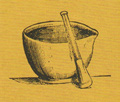
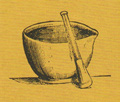
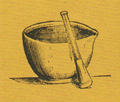
Clean and pare fruit. If using fruit that is firm, scald the fruit to allow for easy pounding. Pound fruit in a mortar with a pestle or purée in your food processor. Add sugar to fruit and stir until sugar is dissolved. Add cream to sweetened fruit mixture. (It is not necessary to scald the cream because of modern pasteurization.) Sieve or strain fruit mixture to remove seeds, pulp, etc. and create a smooth creamy fruit purée. Place in a tin or metal container (this allows for easier freezing) with a lid. Put ice in a larger bowl than the one used for the ice cream and layer crushed ice and rock salt. (Salt lowers the temperature at which the iced mixture freezes so it produces a smoother ice cream. You can substitute kosher salt. A ratio of 3 or 4:1 parts of ice to salt is used.) Immerse metal container filled with ice cream into the ice and salt. (or into refridgerator freezer.) Stir ice cream as it begins to set along the sides of the container. It’s important to stir regularly to prevent ice crystals from forming. Stir every 20 minutes. It will take 1 – 2 hours for the ice cream to set. To mould the ice cream, remove the mixture from the metal container and transfer it to a decorative mould making sure to fill the mould completely. Let ice cream set for several hours either in fresh ice and salt or in freezer. (This is referred to as mellowing) To remove ice cream from the mould simply dip in slightly cool water, and as Glasse mentions never turn it out till the moment you want it.
Original printed pages