

The two colours (or flags) of the Third Regiment of York Militia, exhibited at St James’ Cathedral for many years, are significant artefacts in Toronto’s history. They evoke the patriotism of the Georgian-era women who made them, and of the citizen soldiers who fought to preserve Upper Canada during the War of 1812 when the Americans attempted – but failed – to conquer the British colony. Intended to honour the contributions of the flank companies of the York Militia in the capture of Detroit, the colours were sewn by some of the town’s leading young ladies in 1812-13 to a design prepared by 21-year-old Mary Warren Baldwin. These women met at the home of the prominent John and Catherine McGill family (on the site of today’s Metropolitan United Church) to do their work and to receive visitors, including Major-General Isaac Brock, the victor of Detroit. Other men entertained them as they sewed, as occurred when someone performed a reading of Sydney Croker’s poem, The battle of Talavera, a stirring celebration of the Duke of Wellington’s 1809 triumph over the forces of Napoleonic despotism.
At the time the ladies laboured over the colours, the militia embraced most of the able-bodied male population between the ages of 16 and 60. (The government exempted pacifists from certain churches along with people in important jobs or professions, such as ferry operators and clergymen.) Most Upper Canadian males belonged to the ‘sedentary militia,’ which possessed only a limited amount of training and equipment, but which nevertheless could be called out when needed. While service in the sedentary militia was obligatory, many men volunteered to fight in militia flank companies and other formations where they received additional training and better equipment so they could take a more active part in the colony’s defence.
Traditionally, a stand of colours comprised two flags that were carried at the centre of the battalion as it formed in line, either to parade or to engage the enemy. In combat, the colours served as a rallying point in the confusion of battle, communicated orders (depending upon how they were waved), allowed generals to see where their battalions were in large battles, and acted as symbols of honour to motivate soldiers. It was this last function that generally was the most important and which clearly stirred the minds of the people who embroidered the flags in 1812-13.
The women presented the colours to the Third York in March, 1813, following evensong at the town’s Anglican church (not yet named for St James). They were given to the regiment by one of the daughters of Judge William Dummer Powell (we do not know which, but perhaps it was the oldest, 26-year-old Anne). In her speech, Miss Powell noted that York’s young ladies offered the colours as a ‘public testimony of their gratitude to their countrymen returning from victory’ (which by then also included the battle of Queenston Heights in addition to the capture of Detroit). She then said she wanted the militiamen to receive the colours ‘as a proof that they [i.e., the women] strongly participate in that generous patriotism which burns with so pure a flame through the Province, and when you behold it unfurled on the day of battle, let it become a kind of remembrancer of the unlimited confidence which they place in the efficiency of your protection.’ Sadly, the Third York’s next battle resulted in a defeat, at York in April, 1813; but rather than surrender the colours as war trophies, someone buried them in the town where the enemy could not find them so they could be recovered for the regiment after the Americans left the colonial capital.
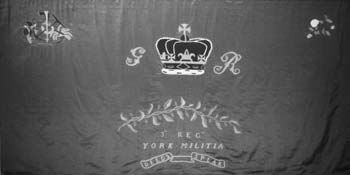
As is typical for a stand of colours, those of the Third York consist of two objects, a ‘king’s colour,’ which fundamentally is a Union Jack with a regimental crest at its centre, and a ‘regimental colour.’ Normally the regimental colour looks like an ensign (with a small Union Jack in the corner), but in the case of the Third York its design is distinctly unorthodox, having a plain background upon which are embroidered a number of symbols and words. At its centre is a crown, flanked by the initials ‘GR’ for Georgius Rex (Latin for King George). At the left of the flag is a depiction of the arms of Upper Canada, and at the right is the white rose of York. Under the crown is a branch with leaves on it (presumably laurel), below which are the words ‘3d Regt York Militia’ and the motto ‘Deeds Speak’ (chosen by the town’s rector, the Revd John Strachan, in light of the glow of victory at Detroit). We do not know why the colour is so unusual. Presumably it spoke to the local, amateur effort of people who were unfamiliar with the niceties of correct military design. In fact, its conception is reminiscent of American colours; perhaps Mary Baldwin and her friends saw captured US flags displayed in the town after the British victories at Detroit and Queenston.
Most Canadian colours of the War of 1812 era were produced immediately after the conflict, which makes those of the Third Regiment of York Militia particularly enthralling because of their creation during the dark tensions of the war’s uncertainties. Beyond that, they are important symbols of the efforts of the town’s women to contribute to the dignity of the local regiment. Combined with the primary documents associated with these evocative artefacts, they invite us to explore some of the more elusive themes of the war’s history, such as the loyalty of Upper Canada’s female population, the colonial sense of honour, and other similarly fascinating topics.
Further Reading
A delightful Victorian narrative of the story of the colours is Mary Agnes Fitzgibbon’s ‘A historic banner,’ in the Women’s Canadian Historical Society of Toronto Transactions 1 (1896), 6-22.
Original printed pages


