

Sir Sandford Fleming (1827-1915) is remembered for accomplishments of sweeping scope and magnitude. His work as a surveyor laid much of the groundwork for a network of railways that stretched from Halifax to the Pacific Ocean, and his invention and promotion of universal time played a major role in standardizing timekeeping around the world. Fleming’s remarkable career is also significant for contributions of a much smaller and more local scale. The Blue Barracks of Fort York holds an important artifact that commemorates Fleming’s connection with Toronto’s waterfront: a model of the western entrance to Toronto harbour built by the surveyor and engineer in 1850 to demonstrate that nature was quickly taking away the unrivalled advantage of a sheltered bay that had drawn John Graves Simcoe to establish a permanent settlement on its shore less than sixty years earlier.
Sandford Fleming left his native Scotland in April 1845 to pursue his livelihood as a surveyor in Canada West. He initially stayed with family in Peterborough before settling in Toronto in 1847. Part-time surveying work helped Fleming develop connections with the city’s prominent engineers and architects, including John Howard, Kivas Tully, and Frederic Cumberland. The bulk of his income came from employment with Scobie and Balfour, printers and lithographers, and after 1848, much of Fleming’s time was spent drawing and engraving the large topographical plan of Toronto published by Hugh Scobie in 1851. It was left to Fleming to fill in many of the details not included in initial surveys for the plan. His early diaries, which were edited by Jean Murray Cole and published by Natural Heritage Books in 2009, reveal a growing involvement with Toronto’s waterfront. He surveyed the Garrison Reserve in July 1848, as well as sections of the lakeshore in early 1849. Work went on regardless of the season; in January 1850 Fleming was on skates, taking soundings through the ice covering the bay. By April he was attempting to track down a pamphlet on the harbour’s development, the result of a curiosity that extended well beyond the requirements of mapmaking.
This time in Fleming’s life was also marked by growing prominence within his professional community despite his relative youth (Fleming was in his early twenties during his years in Toronto). He was among a group of ten individuals who met in the office of Kivas Tully on 20 June 1849 to start an association of surveyors, engineers, and architects who would exchange ideas through scientific papers and discussion. This initiative became the Canadian Institute, and by March 1850 it had settled into a schedule of weekly meetings (now the Royal Canadian Institute for the Advancement of Science). Sandford Fleming was a frequent speaker at its meetings, and on the evening of June 1, he spoke for nearly an hour on “Toronto Harbour – Its Formation and Preservation.”
The text of his presentation was published in 1853-1854 in The Canadian Journal: A Repertory of Industry, Science, and Art; and a Record of the Proceedings of the Canadian Institute. Fleming attributed Toronto’s prosperity “to the unequalled excellence of this harbour” at a time when waterborne transportation was essential for exporting staples and importing manufactured goods. An examination of old charts, however, revealed a serious problem: nature was quickly closing the harbour’s only entrance. Wind and waves eroded the Scarborough Bluffs and lake currents carried the sediment westwards. The currents were slowed by the delta of the Don River, leading to the deposit of more than twelve hectares of sediment along the peninsula that bordered the harbour’s southern edge since Joseph Bouchette’s survey of 1792. About 8,410 cubic metres of sand were added to the shoal at the northern tip of the peninsula each year, reducing the navigable channel through the harbour’s western entrance from 439 metres in 1792 to 110 metres in 1850.
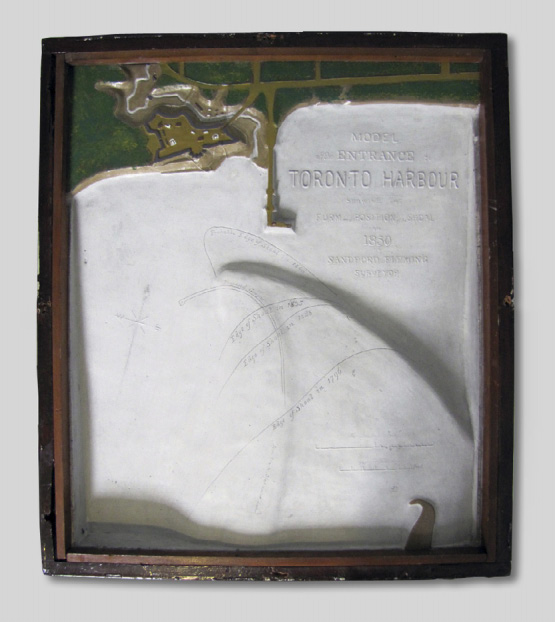
Fleming discussed several potential solutions for nature’s attack upon the commercial viability of Toronto harbour and its port, including a breakwater along the south edge of the entrance channel and revival of a proposition, first put forward in 1835, to construct an eastern entrance to the harbour (storms finally delivered this remedy in 1858 when the peninsula was permanently breached). His remarks were well received, and sparked much discussion. Buoyed by this interest, Fleming petitioned the City and the Toronto Board of Trade so that he could lay his concerns before those who could effect solutions to the harbour’s problems. Council deferred the matter to its Committee on Wharves and Harbours, and when the Board of Trade called a special meeting to hear Fleming’s views, only its secretary turned out. Fleming was ahead of his time. The harbour would be studied for several more decades before his breakwater was finally constructed, and a new Western Channel constructed in deeper water to provide a final solution to the steady northerly march of the sandy shoal.

Fleming’s model won a diploma at the Provincial Exhibition in Montreal in October 1850, and he likely used it to good advantage during subsequent presentations on the preservation and improvement of Toronto harbour to the Canadian Institute in 1851. The following year, however, Fleming was appointed assistant engineer for the Ontario, Simcoe and Lake Huron Railway, and his attention turned from Toronto’s waterfront to construction of a network of steel across the country. It is likely that his model and plans of the harbour were acquired around this time by the Harbour Trust, a permanent commission established in 1850 to ensure a safe and navigable harbour. The model then passed to the Toronto Harbour Commissioners until 1951, when it was borrowed by Dr. Walter Tovell, curator of geology at the Royal Ontario Museum, as work got underway to develop an exhibit explaining the development of Toronto’s Islands over the last 5,000 years. Tovell credited Fleming as the first person to describe correctly the formation of the islands, and a replica of the model was a mainstay of the exhibit until its removal in 1980. The original model was returned to the Toronto Harbour Commissioners in 1954, where it remained until it was transferred to the Toronto Historical Board in the 1960s. It serves as an important reminder that while Fort York offered protection to Simcoe’s “natural arsenal of Lake Ontario” from military invasion from the south, Toronto’s prosperity needed defence from a much more relentless force: wind, waves, currents, and sediment from Scarborough’s shoreline.
Original printed pages


