

Eleven lions left York with the Americans when Commodore Isaac Chauncey’s squadron finally sailed away, days after the 27 April 1813 capture of the province’s capital. One stood alone while the others were rampant on colourful fields.
The lions were among the trophies of war taken by the victorious American expedition. Who picked them up and delivered them to their senior officers has yet to come to light. And any other treasures that disappeared during the plundering of the town have not been discovered. As it is, only some of the trophies remain in existence.
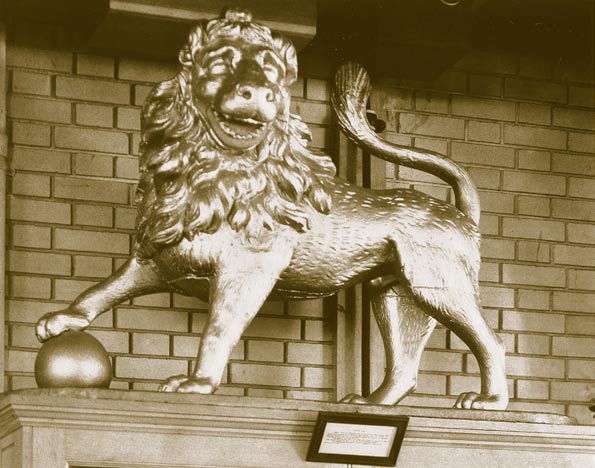
The lonely lion still stands alone. It is a wooden carving, painted in gold. Its place was probably on top of a lofty canopy above the speaker’s dais in Upper Canada’s Legislative Assembly at the eastern end of York. Along with other items, it was shipped to Washington for deposit in ‘the archives.’ At some point in the 1800s officials moved it to the institution that evolved into the United States Naval Academy Museum at Annapolis, Maryland. Currently, the lion is packed away along with the museum’s other holdings since the building is undergoing a major renovation. It should be on view again in the spring of 2009 when the museum reopens.
A full description of the lion appears in John Ross Robertson’s Landmarks of Toronto (ser. 5, 168-9), the renowned Toronto historian having made a visit to the museum around 1900. In his account Robertson repeated a story that a carpenter in town named Starkweather had carved it. The lion returned to Toronto in 1984, to the Royal Ontario Museum as part of the exhibition ‘Georgian Canada.’
In appearance, the wooden lion resembles some of his fellows on the fields of colour. These are the ten lions on the Royal Standard, the flag that still soared on the staff outside Major General Sir Roger Sheaffe’s provincial residence when the grand magazine, located close by, blew up on the day of the battle. It represented the monarchy and Sheaffe’s position as acting lieutenant governor of the province. The Standard was removed and ended up in Annapolis where it is still held.
The Royal Standard features two sets of three lions ‘rampant gardant’ on red backgrounds, in quadrants diagonal to each other, representing England. In the upper right corner one lion rears up on a gold field for Scotland. Ireland’s quadrant on the bottom left does not have a lion, but there are three more in the coat of arms of the Hanover family at the centre of the flag.
It has frequently been stated that the Royal Standard was the flag delivered to Commodore Chauncey on the U.S. Ship Madison in time for him to slip it beneath the head of Brigadier General Zebulon Pike just before he died on the afternoon of the battle. A few weeks later, however, Chauncey sent the flag he used, the fifth trophy of war, to Pike’s widow as a keepsake which she had until it and all of Pike’s personal belongings were lost in a fire in the 1840s. This second flag was probably a Union Jack, the type that was routinely flown at a garrison and which appears in contemporary depictions of the military buildings at York.
Also removed from the Legislative Assembly and delivered to Washington was the ceremonial mace carried into sessions by the master-at-arms. Robertson saw it too and described it as a gilt, wooden pole, more than 4 feet in length, its head bearing a crown 4.5 inches in diameter. This symbol of authority now lies on display at the Ontario Legislature, Queen’s Park, because Franklin Roosevelt’s government sent it back to Toronto in 1934 as part of the city’s centennial celebration.
Of the trophies of war taken at York, none quite matched the human scalp said to have been discovered in the Legislative Assembly. Some observers suggested that it was only the speaker’s peruke but comments made by Chauncey and Major General Henry Dearborn confirmed its identity. The commodore sent the Royal Standard and lion to the navy department along with the mace, ‘over which was hanging,’ he explained, ‘a human scalp. These articles were taken from the Parliament House by one of my officers and presented to me. The scalp I caused to be presented to General Dearborn.’ To this, the general added confirmation: ‘A scalp was found in the Executive and Legislative Council chamber, suspended near the Speaker’s chair, in company with the mace and other emblems of royalty.’
What the scalp was doing in the Assembly has never been explained but its presence earned it more attention than any of the other trophies. Almost immediately it was linked to the murder of wounded Americans by Native warriors following the British victory at Frenchtown, Michigan, the previous January. As the editor of The Weekly Register of Baltimore reported, the scalp was seen as ‘truly symbolical of the British power in Canada.’ ‘It is fact, horrible fact,’ the newspaper later alleged, ‘that the legislature of “unoffending Canada” did sanction (by hanging up in their hall, in evidence of their authority; a human scalp) the murders of our people by the savages.’ Even though such claims were refuted as ‘false and ridiculous’ by the likes of the Reverend John Strachan and others, they endured and were used to justify the destruction of the Parliament Buildings.
Dearborn sent the scalp to Secretary of War John Armstrong who rejected it and sent it right back. What became of it has yet to be discovered.
Some trophies of war were not public holdings and were not sent to Washington. General Sheaffe’s wine ended up in Dearborn’s possession as did his golden music box. It was probably one of the miniature Swiss devices first fashioned during the late 1700s. It had two compartments, the lower one housing a clockwork motor and the delicate musical combs and drum, the upper one made to hold snuff. Estimated by one source to be worth $500 at the time, it was said to have been capable of playing more than one tune, activated by the wind up mechanism. Dearborn apparently paid a soldier $100 for it.
In his brigade order prior to the attack, Pike had stated that private property ‘must be held sacred’ and anyone found guilty of plundering it would be tried and ‘if convicted, punished with death.’ There is little doubt, however, that invaders took away numerous belongings because the residents complained about losing their household goods, clothing, and furniture. No one appears to have been formally punished, however, and Captain John Scott of the Fifteenth U.S. Regiment of Infantry later claimed that few of the officers were involved in the looting. After the attack on Fort George, however, their attitude changed and Scott wrote, ‘Some filled 3 or 4 trunks without enquiring whether it was public or private property. My hands are yet unstained with plunder.’
So, three of the original, official trophies are still in existence, while one is long destroyed and the other vanished. Where that scalp ended up, or sits today, and what happened to all the other items taken from the homes and offices at York, are incomplete aspects of the story of the American attack on York.
Original printed pages


