

In July 1812 Zebulon Montgomery Pike was commissioned a colonel and ordered to command the Fifteenth Infantry Regiment, then training at Greenbush across the Hudson River from Albany, New York. At that time, American infantry regiments fought in linear ranks, two men deep. Based on his reading of military history, Pike decided to experiment and created a third rank behind the first two. They would carry some unusual equipment.
Privates in the third rank were armed with a flintlock musket with a barrel about 46 cm (18 inches) shorter than the standard musket and, to replace the usual bayonet which would not fit on that musket, a sword for use in close-quarters combat. The reduction in firepower was offset, so Pike believed, by providing these men with a pike. These pikes were a 3.7 metre (12 foot) long wooden pole made from ash and tipped with a 33 cm (13-inch) iron spearhead. This type of weapon had a long history.
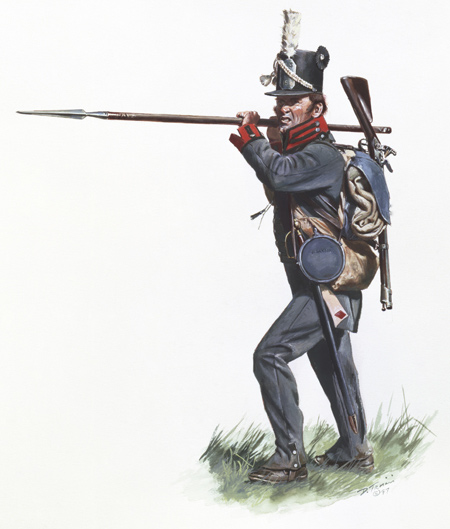
Derived from a simple spear, pikes had been in use for thousands of years, falling in and out of favour as the importance of cavalry on the battlefield waxed and waned. Alexander the Great’s Macedonian phalanx had each man armed with a six metre (20 foot) long pike called a sarissa. Pikes continued in use well into the 1600s both as an offensive weapon—masses of pike-armed infantry would “push” up against each other hoping the enemy would give way first—and as a defence against cavalry. A cavalryman may want to run into and over a mass of pike-armed infantry but his horse was smarter.
With the development of the flintlock musket, and especially the socket bayonet, pikes fell out of favour. By the 1700s they had disappeared from a European battlefield. By 1800 pikes were considered to be useless as an infantry weapon. Colonel Pike, however, felt otherwise.
With the development of the flintlock musket, and especially the socket bayonet, pikes fell out of favour. By the 1700s they had disappeared from a European battlefield. By 1800 pikes were considered to be useless as an infantry weapon. Colonel Pike, however, felt otherwise.
In the early spring of 1813, Pike’s regiment, with two of its six companies armed with pikes, travelled from Plattsburgh to Sackets Harbor. At Sackets, Pike was promoted to brigadier general, leaving the regiment under the command of Major William King.
Captain John Scott, commanding one of the Fifteenth’s pike-armed companies, was enthusiastic, hoping to meet “the 49th British Regt. on some plain.” He believed the additional length would be effective when “we charge bayonet.” So far no record has been found describing what Major King thought of Pike’s pikes, but as the regiment was to participate in the American raid on York barely a month later, there was no time to consider any change in weaponry. By 23 April 1813, 450 men of the Fifteenth Infantry were on board the corvette Madison and the schooner-gunboat Governor Tompkins ready to sail for York. The pike-armed men, about 150, carried their pikes on board with them.
On their arrival at York, the men disembarked into small boats and were rowed ashore. With many of these men probably seasick from the rough spring sailing, getting themselves into those boats would have been difficult enough, but the men who also had to carry their pikes had a much harder time.
Once on shore the uselessness of these pikes in combat, and especially combat in a wooded area, quickly became apparent. Even after considering the lighter weight of the short barrel musket and the absence of a bayonet, carrying the pike and a sword added about 5½ kg (twelve pounds) to the soldier’s load. Furthermore, participating in a “bayonet” charge while carrying a long pike was not an effective use of that weapon even in its European prime in the 1500s. Also, the pike was too long and too heavy to be thrown like a spear. Colonel Cromwell Pearce, commanding the American Sixteenth Infantry at York, made the understated observation that Pike’s pikes were “found not to answer the purposes anticipated.”
So far nothing from Pike himself has emerged that justifies arming one-third of his regiment with an ineffective and obsolete weapon. So long as the enemy remained some distance away from the pike-armed men those weapons were totally useless. Presumably they would then drop their pikes and fire their muskets. Accuracy and range, however, was not great even with the regular musket and would be worse with the short barreled version. Pikes would be useful in repelling a cavalry attack, but cavalry (as opposed to dragoons or mounted infantry) was never used in combat by either side during the War of 1812.

Unfortunately Pike was mortally wounded during the raid. With their sponsor now dead, it is almost certain that those pikes, or most of them, never arrived at Niagara along with the Fifteenth Infantry in early May. There is no record that they were present during the attack on Fort George at the end of that month. Many might have been dropped quietly overboard while sailing to Niagara or simply left at York.
There is no record that pikes were ever used again by an American regular army infantry regiment.
Original printed pages


