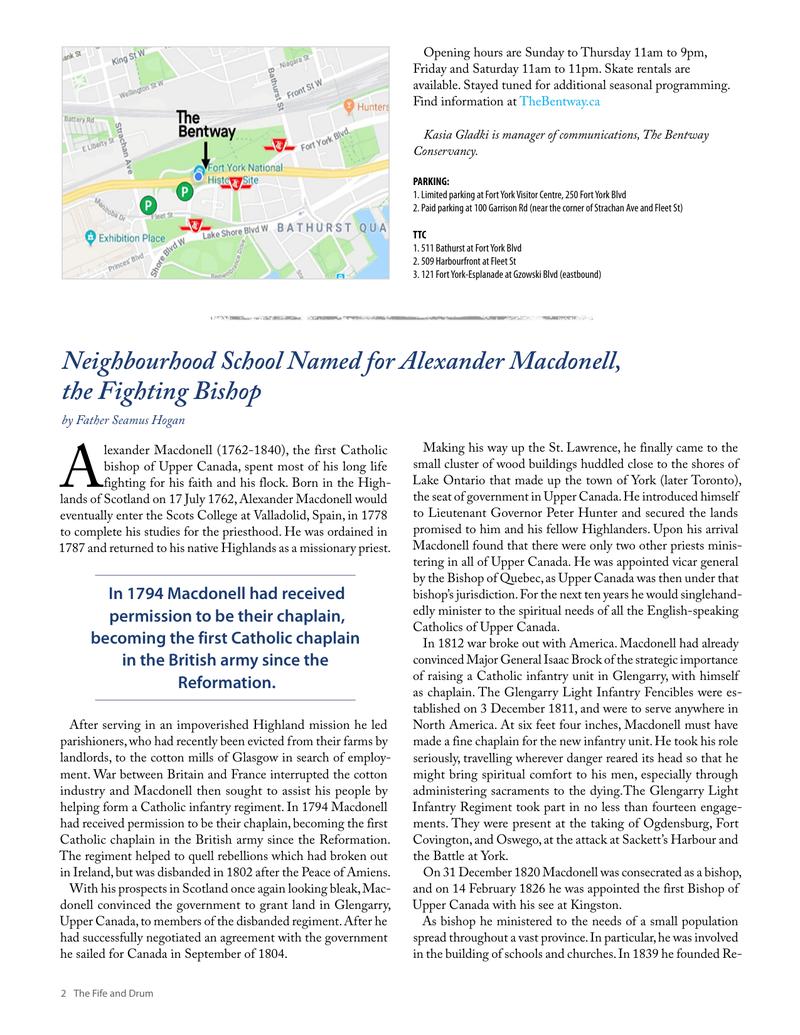
Alexander Macdonell (1762-1840), the first Catholic bishop of Upper Canada, spent most of his long life fighting for his faith and his flock. Born in the Highlands of Scotland on 17 July 1762, Alexander Macdonell would eventually enter the Scots College at Valladolid, Spain, in 1778 to complete his studies for the priesthood. He was ordained in 1787 and returned to his native Highlands as a missionary priest.
In 1794 Macdonell had received permission to be their chaplain, becoming the first Catholic chaplain in the British army since the Reformation.
After serving in an impoverished Highland mission he led parishioners, who had recently been evicted from their farms by landlords, to the cotton mills of Glasgow in search of employment. War between Britain and France interrupted the cotton industry and Macdonell then sought to assist his people by helping form a Catholic infantry regiment. In 1794 Macdonell had received permission to be their chaplain, becoming the first Catholic chaplain in the British army since the Reformation. The regiment helped to quell rebellions which had broken out in Ireland, but was disbanded in 1802 after the Peace of Amiens.
With his prospects in Scotland once again looking bleak, Macdonell convinced the government to grant land in Glengarry, Upper Canada, to members of the disbanded regiment. After he had successfully negotiated an agreement with the government he sailed for Canada in September of 1804.
Making his way up the St. Lawrence, he finally came to the small cluster of wood buildings huddled close to the shores of Lake Ontario that made up the town of York (later Toronto), the seat of government in Upper Canada. He introduced himself to Lieutenant Governor Peter Hunter and secured the lands promised to him and his fellow Highlanders. Upon his arrival Macdonell found that there were only two other priests ministering in all of Upper Canada. He was appointed vicar general by the Bishop of Quebec, as Upper Canada was then under that bishop’s jurisdiction. For the next ten years he would singlehandedly minister to the spiritual needs of all the English-speaking Catholics of Upper Canada.
In 1812 war broke out with America. Macdonell had already convinced Major General Isaac Brock of the strategic importance of raising a Catholic infantry unit in Glengarry, with himself as chaplain. The Glengarry Light Infantry Fencibles were established on 3 December 1811, and were to serve anywhere in North America. At six feet four inches, Macdonell must have made a fine chaplain for the new infantry unit. He took his role seriously, travelling wherever danger reared its head so that he might bring spiritual comfort to his men, especially through administering sacraments to the dying. The Glengarry Light Infantry Regiment took part in no less than fourteen engagements. They were present at the taking of Ogdensburg, Fort Covington, and Oswego, at the attack at Sackett’s Harbour and the Battle at York.
On 31 December 1820 Macdonell was consecrated as a bishop, and on 14 February 1826 he was appointed the first Bishop of Upper Canada with his see at Kingston.
As bishop he ministered to the needs of a small population spread throughout a vast province. In particular, he was involved in the building of schools and churches. In 1839 he founded Regiopolis College in the town of Kingston for seminary formation.
Macdonell often found himself at York for political reasons, since he held a seat on the province’s Legislative Council. In the summer of 1832, while dealing with unrest at St. Paul’s Church caused by a troublesome priest named William O’Grady, the bishop witnessed the devastation wrought by a cholera epidemic which arrived by ship and took 450 lives. Some of the dead were buried in a special cholera cemetery on Bathurst Street. After it was closed, the land was given over to Macdonell in 1835, and the first St. Mary’s Church was built on the same site in 1852. There are still some graves under the present church, which, for obvious reasons, has no basement.
If there was one quality above others that marked Macdonell, it would be his complete loyalty to British institutions and an acute distrust of anything that smacked of republicanism. This brought him into many conflicts with the reform minded men of the province who were seeking from the colonial government greater accountability and representation.
With time the flames of political discontent were fanned into open rebellion. During the Rebellions of 1837-1838 unrest engulfed both of the Canadas. Macdonell responded by rallying the men of Glengarry and the Irish Catholics of Upper Canada to defend the government.
In 1839 Macdonell left for the British Isles in search of funding for Regiopolis College. It would be his final trip home. He caught a chill there and died shortly afterwards in Dumfries, Scotland on 14 January 1840.
His legacy in the Fort York area continues however, as the new Catholic elementary school being built next to Canoe Landing Park and slated to open in September 2019, will be named Bishop Alexander Macdonell School, after the fighting bishop.
Original printed pages