Effect on our Military Operations in the provinces. The whole country would be driven to a state of desperation and satisfy them beyond doubt that we had no intention of holding the provinces.” He therefore decided his best course was to make a widespread offer of paroles to Canadians. A parole was a promise by a man “not to bear arms or act in any military capacity against the United States during the present war” until officially exchanged for an American parolee. Dearborn issued a proclamation that all Canadians who came forth voluntarily to give their paroles “shall have their property and persons secured to them inviolate.” So many men took advantage of this offer that the Buffalo Gazette reported that Canadians “appear to be well suited in the recent change of affairs” as “nearly all the militia from Chippawa to Point Abino have come in and received their parole from Colonel Preston at Fort Erie” and from Dearborn at Fort George.
Many of those Canadians who sought paroles were not American sympathizers but loyal subjects who wished only to protect their property. It appears that requesting a parole was not always voluntary, as American detachments visited farmsteads throughout the peninsula, forcing men to take a parole; those who refused were threatened with arrest and imprisonment in the United States. The invaders cast their net very wide – Hamilton Merritt, the young Canadian cavalry commander, sarcastically remarked that they “paroled all males from 14 to 100 years of age.”
“there have been the most shameful acts of rapacity committed on the innocent inhabitants”
Whether voluntary or extorted, American records indicate that 1,193 men were paroled after the loss of Fort George. To counter this erosion of strength, Lieutenant-General George Prevost, the governor-general and commander of the forces, issued a proclamation on June 14 that called on all “loyal and well disposed in this Province, who are not under the immediate control or within the power of the enemy, to use every possible effort in repelling the foe and driving him from our soil.”
After his subsequent withdrawal to Fort George, Dearborn’s attitude toward Canadians again began to change. Beginning on June 19, he carried out a mass arrest of about a hundred civilians in and around Newark. Among them were the local magistrates whom Dearborn had earlier retained in their offices to oversee “due administration of the laws for the suppression of offences against Society.” Many of those arrested were militia officers who had given their paroles. Some of these prisoners were moved across the river to Fort Niagara. An American officer at Fort George noted that Dearborn had taken “some precautionary measures respecting violent British partisans,” with “the most conspicuous” being “sent over the river to be kept in the United States as hostages.”
This same witness also recalled that there was daily skirmishing but that the invaders were seldom successful because “the enemy is best acquainted with the paths, bye-roads, swamps and the country in general.” The British and Canadians also had the assistance of numbers of warriors, not only from the Grand River but also from Lower Canada and the Upper Lakes. They ensured that the cordon around Newark was kept tight.
On July 10, the American lack of local knowledge was remedied when Joseph Willcocks – the prewar government opponent – appeared at Dearborn’s headquarters and offered to form a “corps of volunteers” to fight alongside the American army in the Niagara. Dearborn gladly accepted this offer and, within a week, the newly appointed Major Joseph Willcocks had mustered a company of 54 all ranks. They wore a white cockade and a green silk ribbon around their hats. The Canadian Volunteers, as they were called, were soon guiding enemy patrols and gathering information from American sympathizers. They also gained a reputation for acquiring the private property of loyal Canadians – one American officer described them as “cowboys” because of their propensity for thieving cattle. Willcocks’ Volunteers were not the only irregular unit in the American forces with such a reputation. Dr. Cyrenius Chapin of Buffalo led a small mounted volunteer unit whose conduct was so bad that American regulars nicknamed them “Dr. Chapin and his Forty Thieves.”
“the most of rapacity and many in Dearborn’s army were the innocent”
The depredations of these two groups and others were well known and many in Dearborn’s army were disgusted by their conduct. An American observer commented on the lawlessness of the occupied area: After Fort George was taken by our troops, a system of plunder and outrage was adopted and commenced to an extent almost unequalled in the annals of French warfare. Citizens, while peaceably attending to their business, were seized and sent across the river, and almost at the same time, their property was destroyed. Those who were paroled and promised protection, on suspicion of their possessing moveable property were arrested and their property pillaged. The notorious Traitor, Willcocks, was commissioned to raise a body of marauders expressly to plunder, burn and destroy.
Another American reported that “since the capture of Fort George there have been the most shameful acts of rapacity committed on the innocent inhabitants” of Upper Canada. He added that he was hearing “every day of quantities of plate and other valuable articles being brought from there and sold by the marauders at a small price” and officers “are ashamed to record the commission of acts which stain our national character with such foul disgrace.”
On July 15, Dearborn was removed as commander of the American army and temporarily succeeded by Brigadier-General John Boyd, who was in turn replaced in early September by Major-General James Wilkinson. Wilkinson was under orders to transfer most of the regular units at Fort George east to Sacket’s Harbor to participate in an offensive against Montreal. Although it took him time to get moving, by the first days of October the only American regulars on the Canadian side of the Niagara was Colonel Winfield Scott’s Second Artillery Regiment.
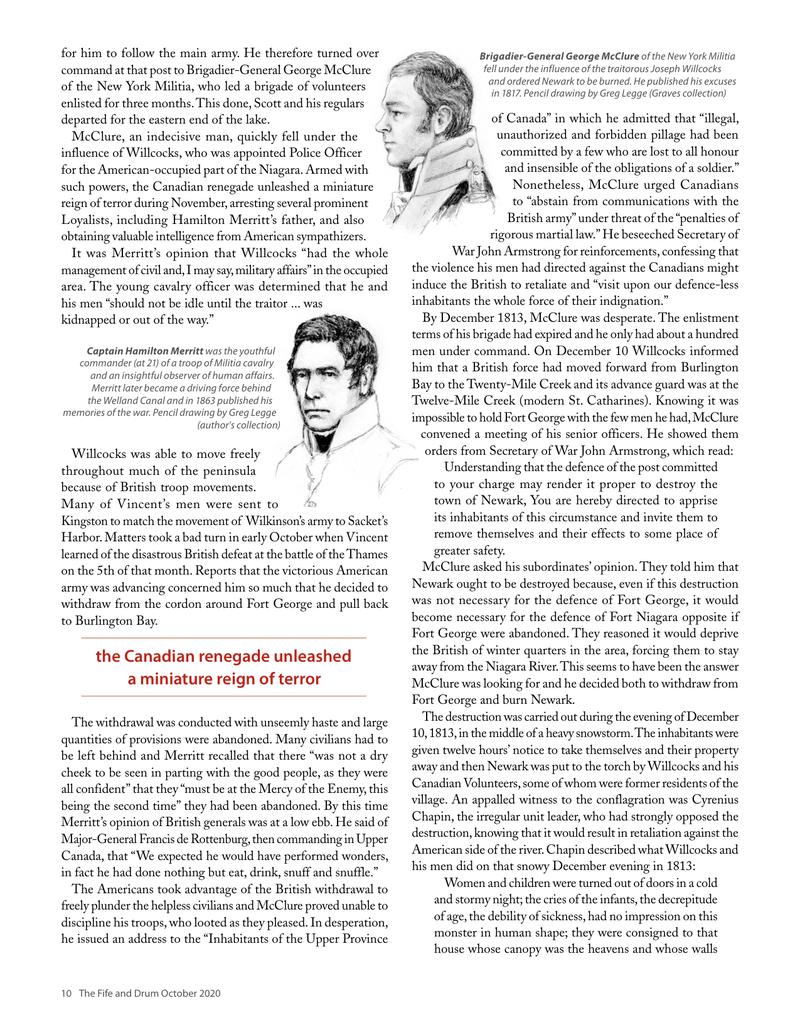
Although he had orders to remain at Fort George, Scott, a very ambitious officer, convinced himself that it would be better for him to follow the main army. He therefore turned over command of the post to Brigadier-General George McClure of the New York Militia, who led a brigade of volunteers enlisted for three months. This done, Scott and his regulars departed for the eastern end of the lake.
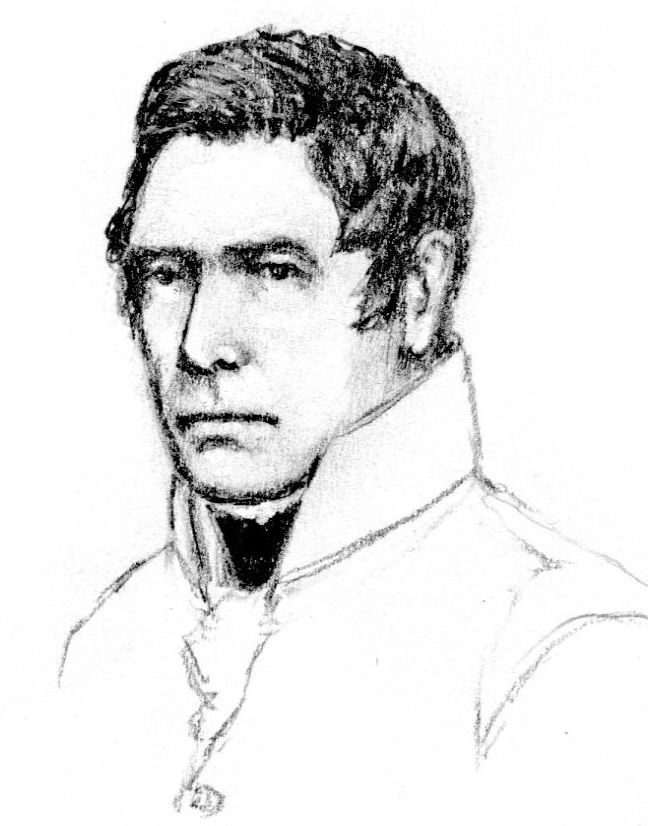
McClure, an indecisive man, quickly fell under the influence of Willcocks, who was appointed Police Officer for the American-occupied part of the Niagara. Armed with such powers, the Canadian renegade unleashed a miniature reign of terror during November, arresting several prominent Loyalists, including Hamilton Merritt’s father, and also obtaining valuable intelligence from American sympathizers.
It was Merritt’s opinion that Willcocks “had the whole management of civil and I may say, military affairs” in the occupied area. The young cavalry officer was determined that he and his men “should not be idle until the traitor… was either kidnapped or out of the way.”
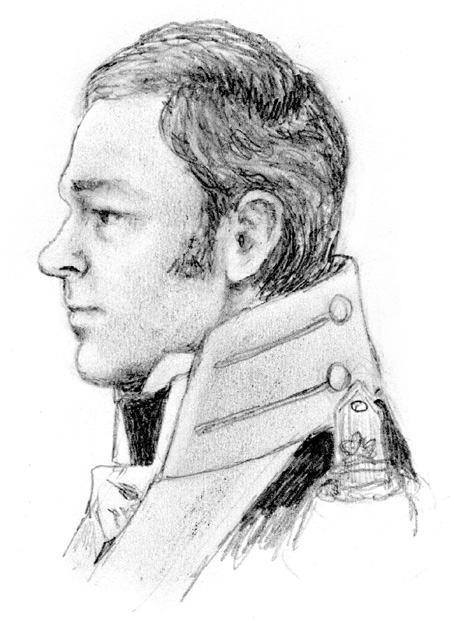
Willcocks was able to move freely throughout much of the peninsula because of British troop movements. Many of Vincent’s men were sent to Kingston to match the movement of Wilkinson’s army to Sacket’s Harbor. Matters took a bad turn in early October when Vincent learned of the disastrous British defeat at the battle of the Thames on the 5th of that month. Reports that the victorious American army was advancing concerned him so much that he decided to withdraw from the cordon around Fort George and pull back to Burlington Bay.
the Canadian renegade unleashed a miniature reign of terror
The withdrawal was conducted with unseemly haste and large quantities of provisions were abandoned. Many civilians had to be left behind and Merritt recalled that there “was not a dry cheek to be seen in parting with the good people, as they were all confident” that they “must be at the Mercy of the Enemy, this being the second time” they had been abandoned. By this time, Merritt’s opinion of British generals was at a low ebb. He said of Major-General Francis de Rottenburg, then commanding in Upper Canada, that “We expected he would have performed wonders, in fact he had done nothing but eat, drink, snuff and snuffle.”
The Americans took advantage of the British withdrawal to freely plunder the helpless civilians and McClure proved unable to discipline his troops, who looted as they pleased. In desperation, he issued an address to the “Inhabitants of the Upper Province of Canada” in which he admitted that “illegal, unauthorized and forbidden pillage had been committed by a few who are lost to all honour and insensible of the obligations of a soldier.” Nonetheless, McClure urged Canadians to “abstain from communications with the British army” under threat of the “penalties of” a “rigorous martial law.” He beseeched Secretary of War John Armstrong for reinforcements, confessing that the violence his men had directed against the Canadians might induce the British to retaliate and “visit upon our defence-less inhabitants the whole force of their indignation.”
By December 1813, McClure was desperate. The enlistment terms of his brigade had expired and he only had about a hundred men under command. On December 10 Willcocks informed him that a British force had moved forward from Burlington Bay to Twenty-Mile Creek and its advance guard was at the Twelve-Mile Creek (modern St. Catharines). Knowing it was impossible to hold Fort George with the few men he had, McClure convened a meeting of his senior officers. He showed them orders from Secretary of War John Armstrong, which read: Understanding that the defence of the post committed to your charge may render it proper to destroy the town of Newark, You are hereby directed to apprise its inhabitants of this circumstance and invite them to remove themselves and their effects to some place of greater safety.
McClure asked his subordinates’ opinion. They told him that Newark ought to be destroyed because, even if this destruction was not necessary for the defence of Fort George, it would become necessary for the defence of Fort Niagara opposite if Fort George were abandoned. They reasoned it would deprive the British of winter quarters in the area, forcing them to stay away from the Niagara River. This seems to have been the answer McClure was looking for and he decided both to withdraw from Fort George and burn Newark.
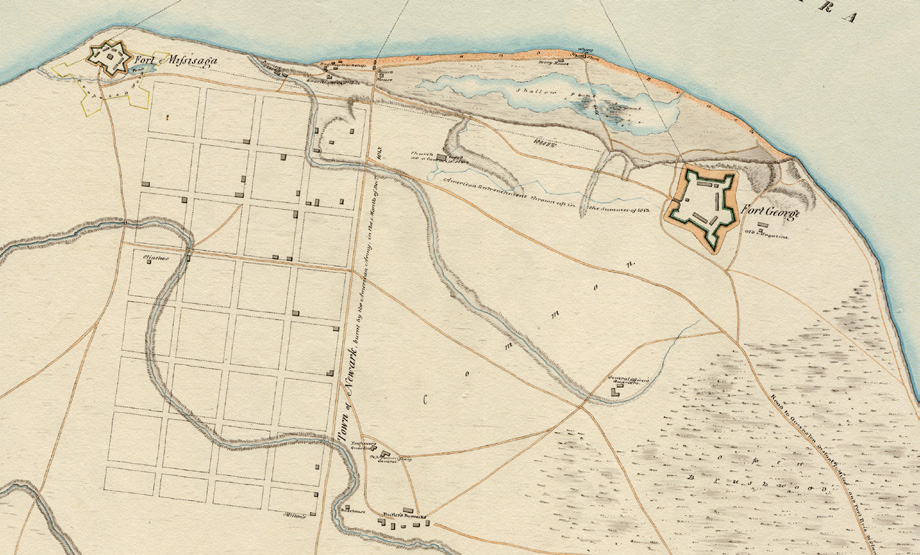
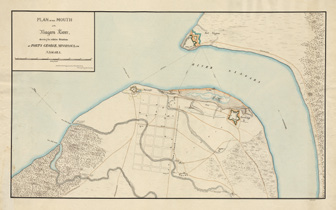
The destruction was carried out during the evening of December 10, 1813, in the middle of a heavy snowstorm. The inhabitants were given twelve hours’ notice to take themselves and their property away and then Newark was put to the torch by Willcocks and his Canadian Volunteers, some of whom were former residents of the village. An appalled witness to the conflagration was Cyrenius Chapin, the irregular unit leader, who had strongly opposed the destruction, knowing that it would result in retaliation against the American side of the river. Chapin described what Willcocks and his men did on that snowy December evening in 1813:
Women and children were turned out of doors in a cold and stormy night; the cries of the infants, the decrepitude of age, the debility of sickness, had no impression on this monster in human shape; they were consigned to that house whose canopy was the heavens and whose walls
were as boundless as the wide world. In the destruction of this town he [McClure] was aided by the most active exertions of Joseph Wilcox [sic] who had for a number of years resided in this pleasant village and … actually led a banditti through the town, setting fire to his neighbours’ dwellings and applying the epithet of tory to everyone who disapproved of this flagrant act of barbarity.
“retributive justice demanded of me a speedy retaliation on the opposite shore of America”
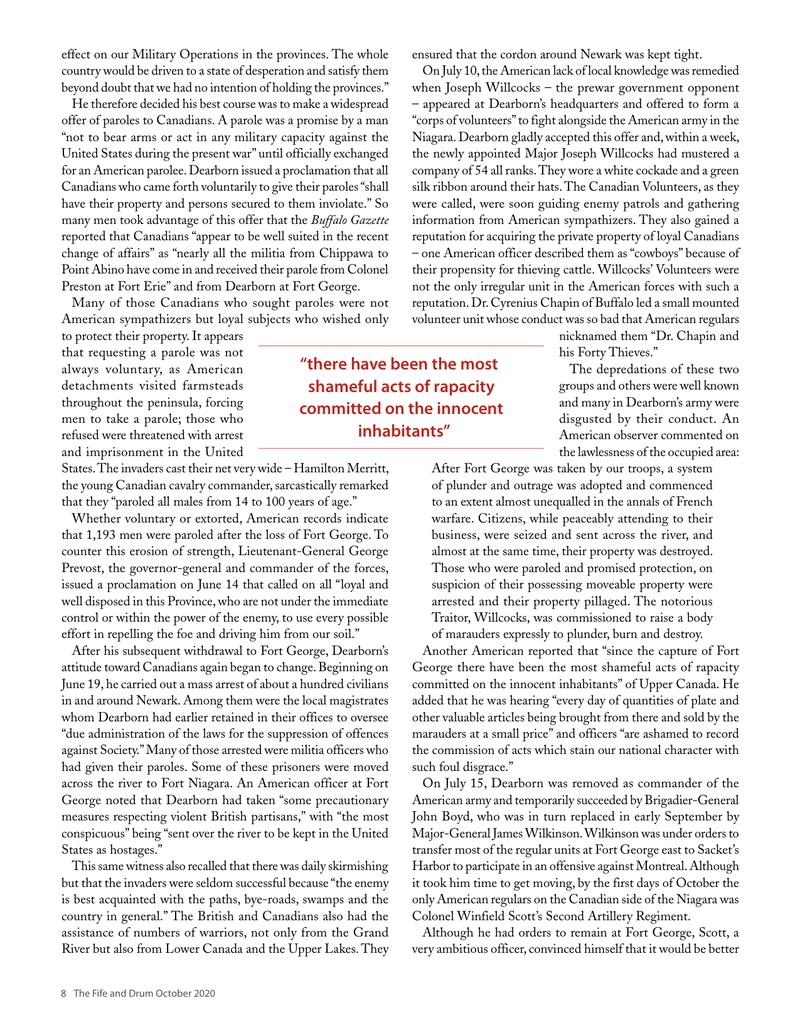
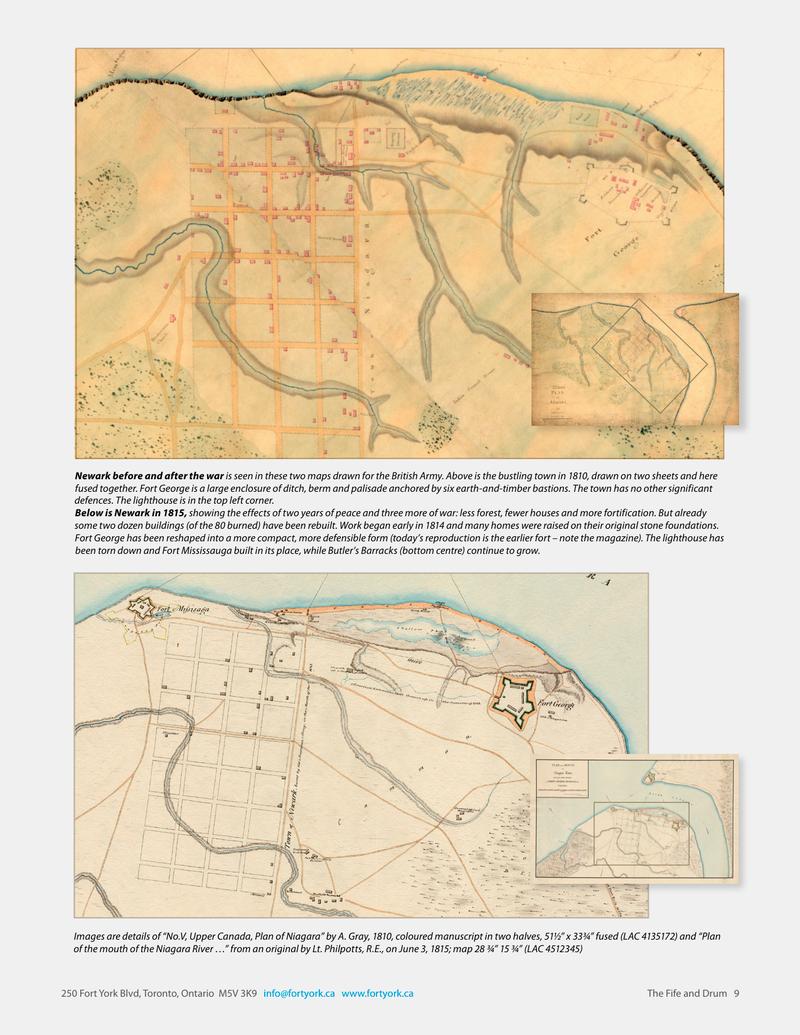
McClure complained that Chapin “drew his pistol” at Willcocks, “swearing he would dispatch the first man who dared put this order into execution.” But Willcocks did not stop and when a British and Canadian force entered Newark on the following morning, Merritt recalled that nothing remained of the town “but heaps of coal and heaps of furniture that the Inhabitants were fortunate enough to get out of their houses.” Except for two structures, the little community of 80 buildings, valued at £30,250 (about $8,530,000 in modern Canadian dollars), had been completely destroyed.
Lieutenant-General Gordon Drummond, who had just replaced De Rottenburg as commander in Upper Canada, was infuriated by the destruction. He immediately queried McClure “whether this atrocious act had been committed by the authority of the American government, or is the unauthorized act of any individual.” McClure replied that he was “only accountable to his own government for any act or procedure of his while commanding.” But both Secretary of War Armstrong and New York Governor Daniel D. Tompkins were appalled by McClure’s deed and Armstrong ordered Wilkinson, the senior American commander on the northern frontier, to publicly disavow the burning of Newark.
Writing to Prevost, Wilkinson referred not only to the destruction of private property at Newark but throughout the Canadian side of the Niagara, which presented “the aspect rather of vindictive fury than just retribution; yet they are reputed more to personal feelings, than any settled form of policy deliberately weighed and adopted.” This did not mollify Drummond, who coldly considered that “retributive justice demanded of me a speedy retaliation on the opposite shore of America.”
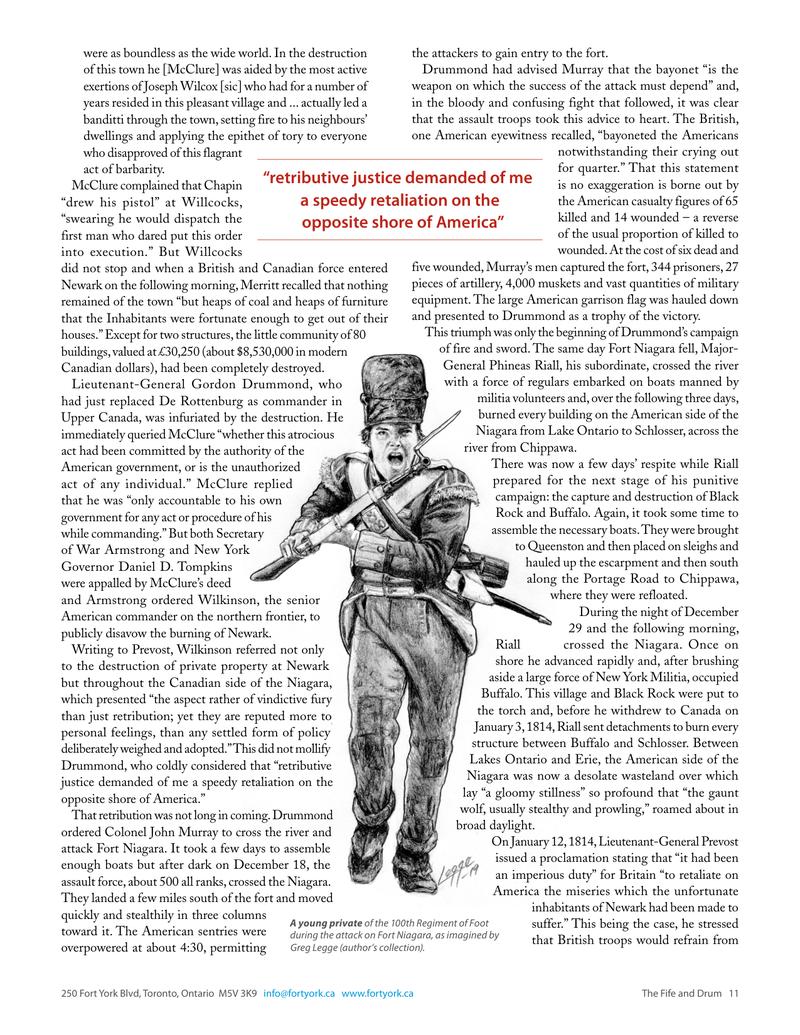
That retribution was not long in coming. Drummond ordered Colonel John Murray to cross the river and attack Fort Niagara. It took a few days to assemble enough boats but after dark on December 18, the assault force, about 500 all ranks, crossed the Niagara. They landed a few miles south of the fort and moved quickly and stealthily in three columns toward it. The American sentries were overpowered at about 4:30, permitting the attackers to gain entry to the fort.
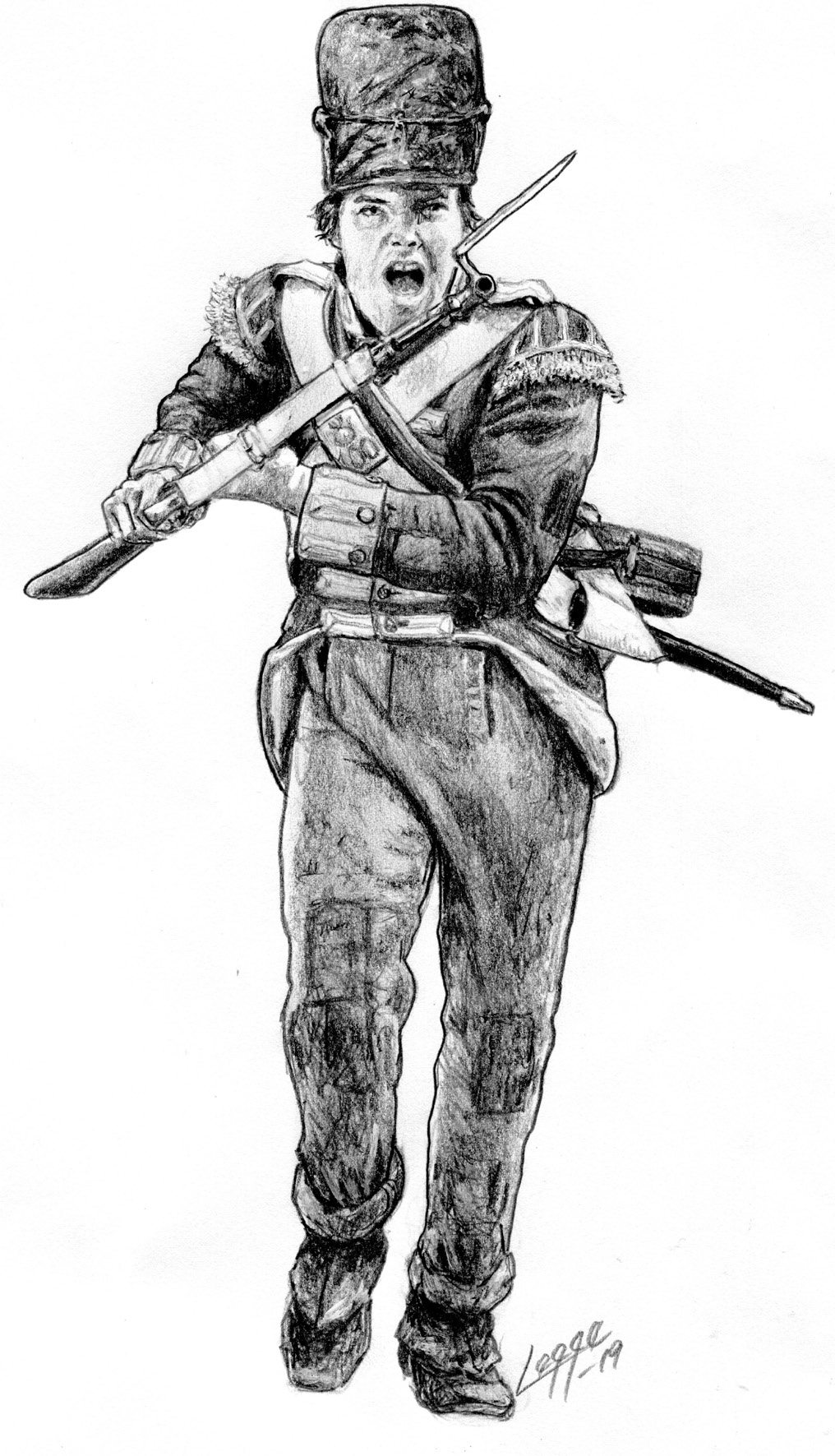
Drummond had advised Murray that the bayonet “is the weapon on which the success of the attack must depend” and, in the bloody and confusing fight that followed, it was clear that the assault troops took this advice to heart. The British, one American eyewitness recalled, “bayoneted the Americans notwithstanding their crying out for quarter.” That this statement is no exaggeration is borne out by the American casualty figures of 65 killed and 14 wounded – a reverse of the usual proportion of killed to wounded. At the cost of six dead and five wounded, Murray’s men captured the fort, 344 prisoners, 27 pieces of artillery, 4,000 muskets and vast quantities of military equipment. The large American garrison flag was hauled down and presented to Drummond as a trophy of the victory.
This triumph was only the beginning of Drummond’s campaign of fire and sword. The same day Fort Niagara fell, Major-General Phineas Riall, his subordinate, crossed the river with a force of regulars embarked on boats manned by militia volunteers and, over the following three days, burned every building on the American side of the Niagara from Lake Ontario to Schlosser, across the river from Chippawa.
There was now a few days’ respite while Riall prepared for the next stage of his punitive campaign: the capture and destruction of Black Rock and Buffalo. Again, it took some time to assemble the necessary boats. They were brought to Queenston and then placed on sleighs and hauled up the escarpment and then south along the Portage Road to Chippawa, where they were reloaded.
During the night of December 29 and the following morning, Riall crossed the Niagara. Once on shore he advanced rapidly and, after brushing aside a large force of New York Militia, occupied Buffalo. This village and Black Rock were put to the torch and, before he withdrew to Canada on January 3, 1814, Riall sent detachments to burn every structure between Buffalo and Schlosser. Between Lakes Ontario and Erie, the American side of the Niagara was now a desolate wasteland over which lay “a gloomy stillness” so profound that “the gaunt wolf, usually stealthy and prowling,” roamed about in broad daylight.
On January 12, 1814, Lieutenant-General Prevost issued a proclamation stating that “it had been an imperious duty” for Britain “to retaliate on America the miseries which the unfortunate inhabitants of Newark had been made to suffer.” This being the case, he stressed that British troops would refrain from such acts in the future unless “measures of the enemy should compel him again to resort to the only mode left him of a prompt and signal vengeance will be taken for every fresh departure of the enemy from that system of warfare which is to subsist between enlightened and civilized nations.”
And so ended 1813, the hardest year of war for the people of the Niagara – on both sides of the river.
Sources & Further Reading
Many volumes of original documents from the War of 1812 have been published and most of these collections are now online. Endlessly entertaining to read, they are the most accessible of the necessary primary sources.
The Library of Congress has the enemy’s side of the story in its American State Papers series, scroll down to Military Affairs, Vol.1, 1789-1819, for a searchable text database. E.A. Cruikshank, comprehensively edited the massive (and slightly chaotic) nine-volume Documentary History of the Campaigns on the Niagara Frontier more than 100 years ago and it remains the definitive collection. With a good library card they can be found in Canadiana Online (which also provides searchable text). The Champlain Society’s four-volume collection of documents, edited by William Wood in the 1920s, provides the helpful introduction that Cruikshank does not. Also helpful are the “Proceedings and Reports of Loyal and Patriotic Society of Upper Canada” – the committee concerned with post-war pensions for widows and orphans – which are in the United of Ontario and available online as well as on microform at the Toronto Public Library.
General McClure published his excuses for the burning of Newark as Causes of the Destruction of the American Towns on the Niagara Frontier, Relative of the Campaigns of the Years 1812 and 1813, printed by his friend Benjamin Smead at Bath, NY, in 1817. A more moderate but still candid account by a Canadian militiaman is A Sketch of piercing and defending my country—The War of 1812 Journals of William Hamilton Merritt, recently edited by Stuart Sutherland. A personable junior officer of the British Army is Merry Hearts Make Light Days: The War of 1812 Journal of Lieutenant John Le Couteur, 104th Foot, edited by Donald E. Graves (Robin Brass Studio. Le Couteur, however, left Niagara for Kingston at the end of September.
An outstanding American account is First Campaign of an ADC: The War of 1812 Memoir of Lieutenant William Jenkins Worth, United States Army (Old Fort Niagara, 2012), also edited by Graves. Worth left Niagara for Sacket’s Harbor at the same time as Le Couteur. Many other first-person accounts are sampled in the miscellaneous of the American Occupation of the Niagara, “in Niagara Historical Society Publications, Vol.11 (1904).
The most important unpublished documents on the campaigns in Niagara are found in Library & Archives Canada, Colonial Office 42, “Correspondence of the Governor-General” and Record Group 81, “British Military Records.” In the United States National Archives, find Record Group 107, “Correspondence of the Secretary of War.”
The only secondary accounts that focus on the nastier events of the campaign are rather obscure. Look for Paul Couture, “A Study of the Non-Regular Forces on the Niagara Frontier, 1812-1814” (1985) Parks Canada, Microfiche Report Series 193, or Graves, “Lawless Banditti: Joseph Willcocks, his Canadian Volunteers and the Mutual Destruction on the Niagara during the Winter of 1813” (Old Fort Niagara, 2007). Cruikshank wrote “Blockade of Port Georges, 1813” for the Niagara Historical Society Records, Vol. 3 (1897).
For a thorough discussion of the consequences of burning and looting in the War of 1812, see Graves, “Why the White House Burned: An Investigation into the British Destruction of Public Buildings at Washington in August 1814,” Journal of Military History, Vol.76 (Oct 2012), or a summary in The Fife and Drum, April 2020. Insights into how the irregular campaigning especially affected women are scattered throughout Dianne Graves, In the Midst of Alarms: The untold story of women and the War of 1812 (Robin Brass, 2007).
Original printed pages