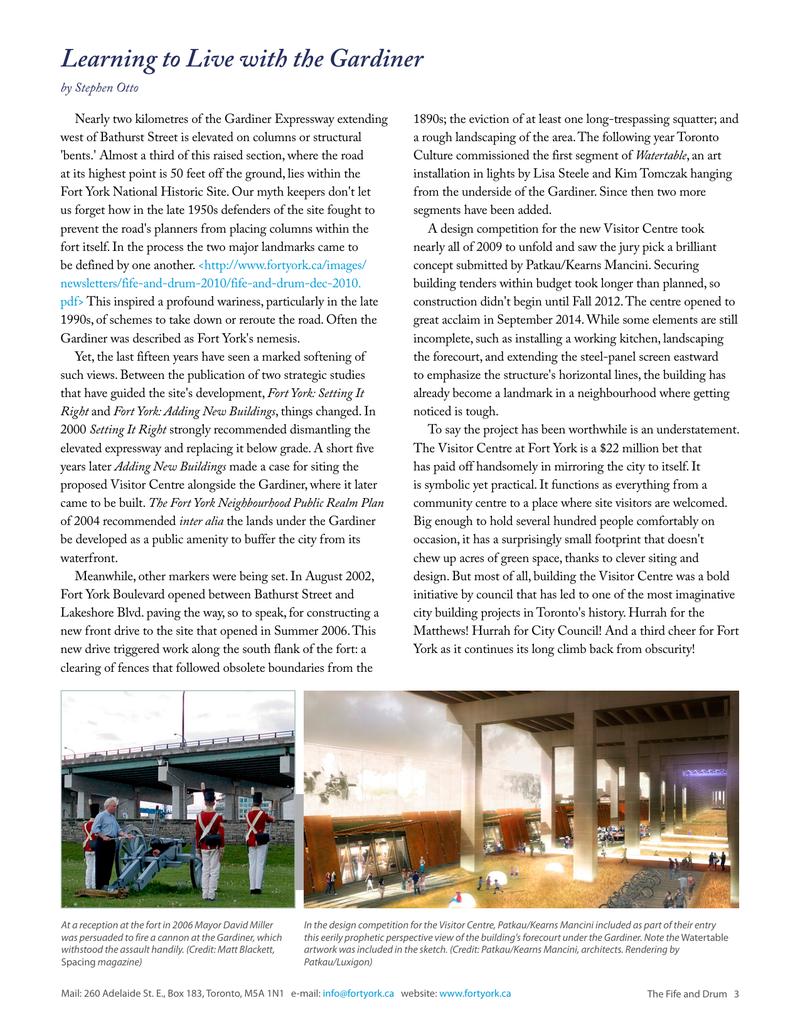
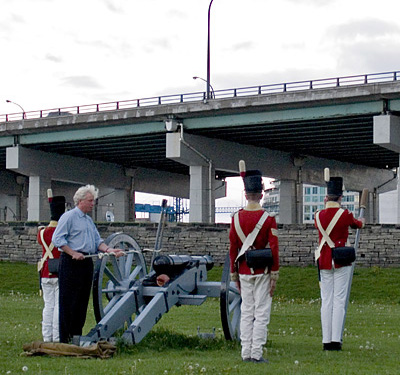
Nearly two kilometres of the Gardiner Expressway extending west of Bathurst Street is elevated on columns or structural ‘bents.’ Almost a third of this raised section, where the road at its highest point is 50 feet off the ground, lies within the Fort York National Historic Site. Our myth keepers don’t let us forget how in the late 1950s defenders of the site fought to prevent the road’s planners from placing columns within the fort itself. In the process the two major landmarks came to be defined by one another. This inspired a profound wariness, particularly in the late 1990s, of schemes to take down or reroute the road. Often the Gardiner was described as Fort York’s nemesis.
Yet, the last fifteen years have seen a marked softening of such views. Between the publication of two strategic studies that have guided the site’s development, Fort York: Setting It Right and Fort York: Adding New Buildings, things changed. In 2000 Setting It Right strongly recommended dismantling the elevated expressway and replacing it below grade. A short five years later Adding New Buildings made a case for siting the proposed Visitor Centre alongside the Gardiner, where it later came to be built. The Fort York Neighbourhood Public Realm Plan of 2004 recommended inter alia the lands under the Gardiner be developed as a public amenity to buffer the city from its waterfront.
Meanwhile, other markers were being set. In August 2002, Fort York Boulevard opened between Bathurst Street and Lakeshore Blvd. paving the way, so to speak, for constructing a new front drive to the site that opened in Summer 2006. This new drive triggered work along the south flank of the fort: a clearing of fences that followed obsolete boundaries from the 1890s; the eviction of at least one long-trespassing squatter; and a rough landscaping of the area. The following year Toronto Culture commissioned the first segment of Watertable, an art installation in lights by Lisa Steele and Kim Tomczak hanging from the underside of the Gardiner. Since then two more segments have been added.
A design competition for the new Visitor Centre took nearly all of 2009 to unfold and saw the jury pick a brilliant concept submitted by Patkau/Kearns Mancini. Securing building tenders within budget took longer than planned, so construction didn’t begin until Fall 2012. The centre opened to great acclaim in September 2014. While some elements are still incomplete, such as installing a working kitchen, landscaping the forecourt, and extending the steel-panel screen eastward to emphasize the structure’s horizontal lines, the building has already become a landmark in a neighbourhood where getting noticed is tough.
To say the project has been worthwhile is an understatement. The Visitor Centre at Fort York is a $22 million bet that has paid off handsomely in mirroring the city to itself. It is symbolic yet practical. It functions as everything from a community centre to a place where site visitors are welcomed. Big enough to hold several hundred people comfortably on occasion, it has a surprisingly small footprint that doesn’t chew up acres of green space, thanks to clever siting and design. But most of all, building the Visitor Centre was a bold initiative by council that has led to one of the most imaginative city building projects in Toronto’s history. Hurrah for the Matthews! Hurrah for City Council! And a third cheer for Fort York as it continues its long climb back from obscurity!

Original printed pages