From Not For Themselves But For Their Country: A History of The Lincoln and Welland Regiment, to be published by The Lincoln and Welland Regiment Foundation in late 2019.
Introduction
Following his defeat at the battle of Chippawa on July 5, 1814, the British commander, Major-General Phineas Riall, remained on the north bank of the Chippawa (Welland) River for three days and then retreated to Lake Ontario. Leaving a strong garrison in Forts George and Mississauga, he next withdrew the greater part of his division to an area near the modern city of St. Catharines. There, Riall waited. His American counterpart, Major-General Jacob Brown, paused for a few days and then advanced to Queenston. There he also waited because he was expecting the American naval squadron on Lake Ontario to besiege the forts at the mouth of the Niagara River. The result was a period of nearly three weeks when the regular forces of the two belligerents were not seriously engaged. There was, however, constant skirmishing as the Canadian militia carried out an active guerrilla campaign against the invaders.
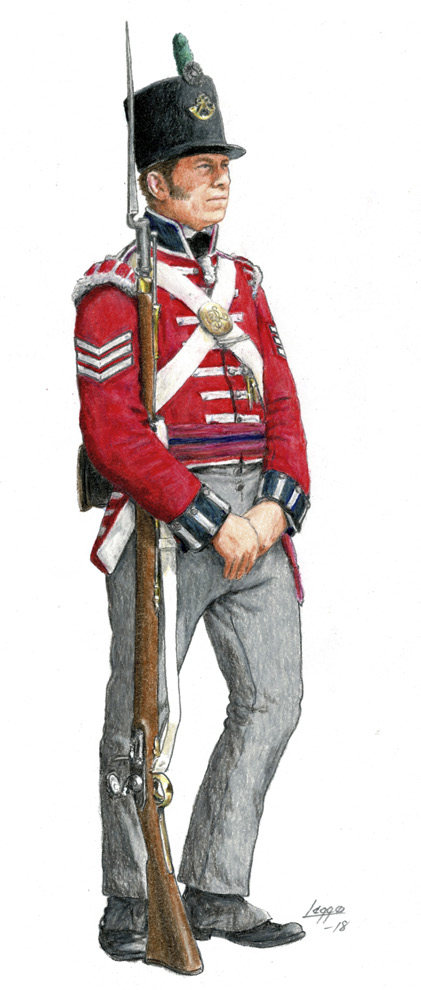
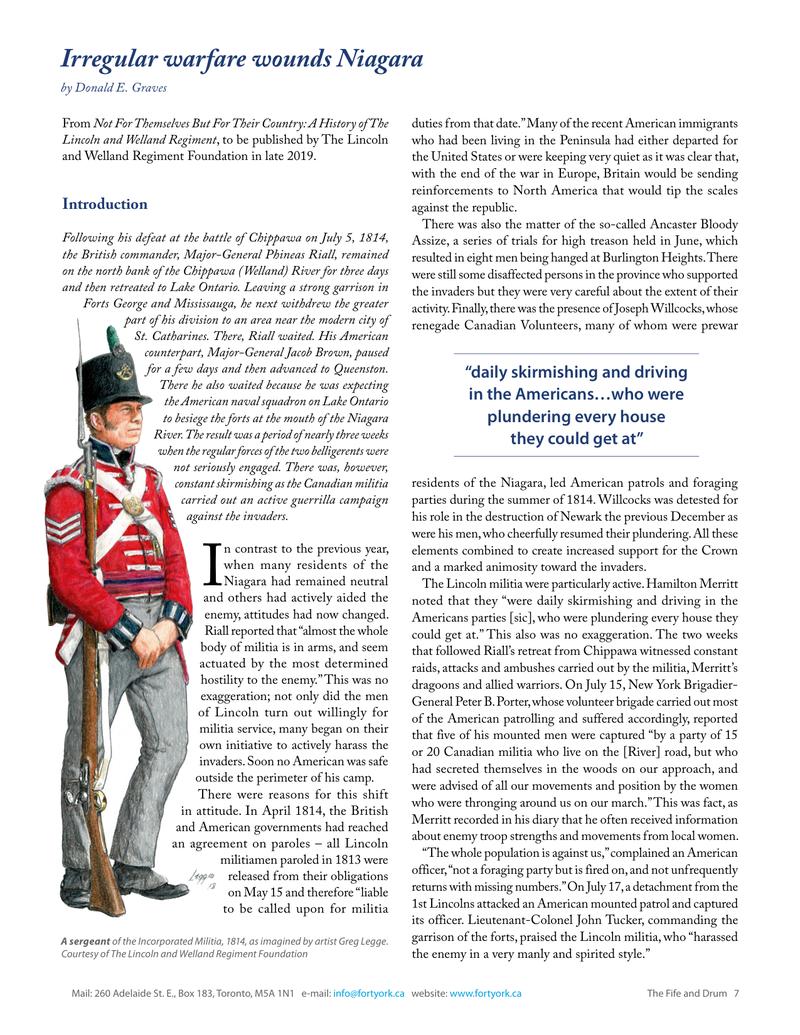
In contrast to the previous year, when many residents of the Niagara had remained neutral and others had actively aided the enemy, attitudes had now changed. Riall reported that “almost the whole body of militia is in arms, and seem actuated by the most determined hostility to the enemy.” This was no exaggeration; not only did the men of Lincoln turn out willingly for militia service, many began on their own initiative to actively harass the invaders. Soon no American was safe outside the perimeter of his camp.
There were reasons for this shift in attitude. In April 1814, the British and American governments had reached an agreement on paroles – all Lincoln militiamen paroled in 1813 were released from their obligations on May 15 and therefore “liable to be called upon for militia duties from that date.” Many of the recent American immigrants who had been living in the Peninsula had either departed for the United States or were keeping very quiet as it was clear that, with the end of the war in Europe, Britain would be sending reinforcements to North America that would tip the scales against the republic.
There was also the matter of the so-called Ancaster Bloody Assize, a series of trials for high treason held in June, which resulted in eight men being hanged at Burlington Heights. There were still some disaffected persons in the province who supported the invaders but they were very careful about the extent of their activity. Finally, there was the presence of Joseph Willcocks, whose renegade Canadian Volunteers, many of whom were prewar residents of the Niagara, led American patrols and foraging parties during the summer of 1814. Willcocks was detested for his role in the destruction of Newark the previous December as were his men, who cheerfully resumed their plundering. All these elements combined to create increased support for the Crown and a marked animosity toward the invaders.
“daily skirmishing and driving in the Americans…who were plundering every house they could get at”
The Lincoln militia were particularly active. Hamilton Merritt noted that they “were daily skirmishing and driving in the Americans parties [sic], who were plundering every house they could get at.” This also was no exaggeration. The two weeks that followed Riall’s retreat from Chippawa witnessed constant raids, attacks and ambushes carried out by the militia, Merritt’s dragoons and allied warriors. On July 15, New York Brigadier-General Peter B. Porter, whose volunteer brigade carried out most of the American patrolling and suffered accordingly, reported that five of his mounted men were captured “by a party of 15 or 20 Canadian militia who live on the [River] road, but who had secreted themselves in the woods on our approach, and were advised of all our movements and position by the women who were thronging around us on our march.” This was fact, as Merritt recorded in his diary that he often received information about enemy troop strengths and movements from local women.
“The whole population is against us,” complained an American officer, “not a foraging party but is fired on, and not unfrequently returns with missing numbers.” On July 17, a detachment from the 1st Lincolns attacked an American mounted patrol and captured its officer. Lieutenant-Colonel John Tucker, commanding the garrison of the forts, praised the Lincoln militia, who “harassed the enemy in a very manly and spirited style.”
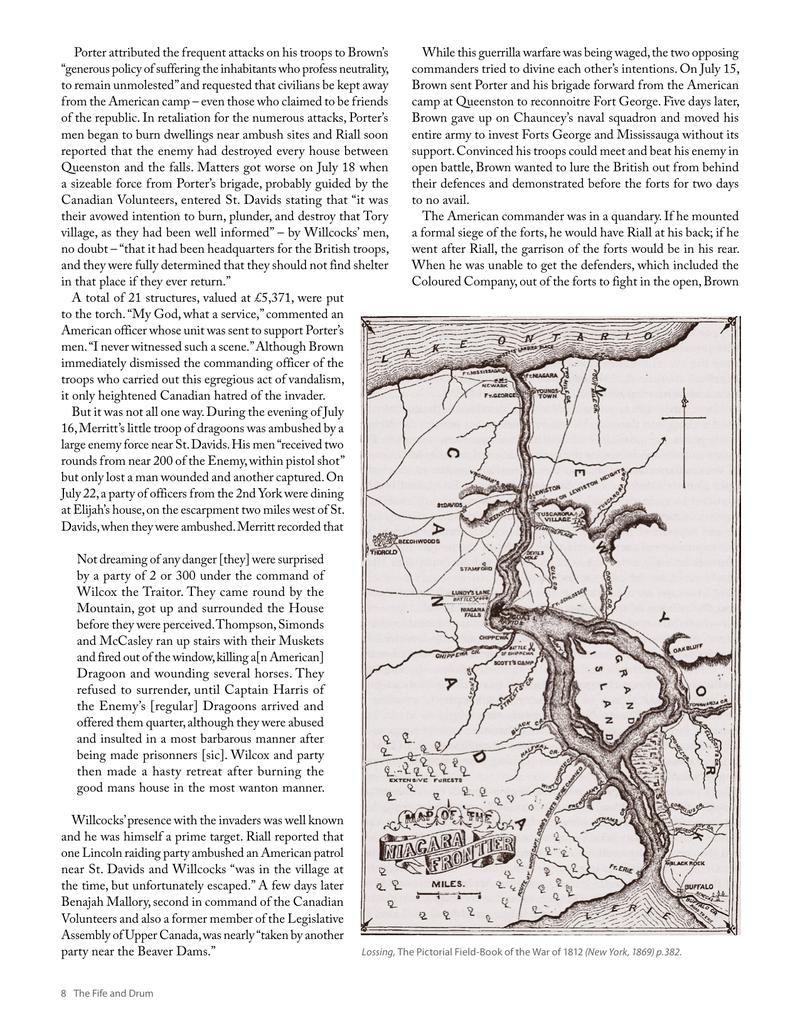
Porter attributed the frequent attacks on his troops to Brown’s “generous policy of suffering the inhabitants who profess neutrality, to remain unmolested” and requested that civilians be kept away from the American camp – even those who claimed to be friends of the republic. In retaliation for the numerous attacks, Porter’s men began to burn dwellings near ambush sites and Riall soon reported that the enemy had destroyed every house between Queenston and the falls. Matters got worse on July 18 when a sizeable force from Porter’s brigade, probably guided by the Canadian Volunteers, entered St. Davids stating that “it was their avowed intention to burn, plunder, and destroy that Tory village, as they had been well informed” – by Willcocks’ men, no doubt – “that it had been headquarters for the British troops, and they were fully determined that they should not find shelter in that place if they ever return.”
A total of 21 structures, valued at £5,371, were put to the torch. “My God, what a service,” commented an American officer whose unit was sent to support Porter’s men. “I never witnessed such a scene.” Although Brown immediately dismissed the commanding officer of the troops who carried out this egregious act of vandalism, it only heightened Canadian hatred of the invader.
But it was not all one way. During the evening of July 16, Merritt’s little troop of dragoons was ambushed by a large enemy force near St. Davids. His men “received two rounds from near 200 of the Enemy, within pistol shot” but only lost a man wounded and another captured. On July 22, a party of officers from the 2nd York were dining at Elijah’s house, on the escarpment two miles west of St. Davids, when they were ambushed. Merritt recorded that
Not dreaming of any danger [they] were surprised by a party of 2 or 300 under the command of Wilcox the Traitor. They came round by the Mountain, got up and surrounded the House before they were perceived. Thompson, Simonds and McCasley ran up stairs with their Muskets and fired out of the window, killing a[n American] Dragoon and wounding several horses. They refused to surrender, until Captain Harris of the Enemy’s [regular] Dragoons arrived and offered them quarter, although they were abused and insulted in a most barbarous manner after being made prisonners [sic]. Wilcox and party then made a hasty retreat after burning the good mans house in the most wanton manner.
Willcocks’ presence with the invaders was well known and he was himself a prime target. Riall reported that one Lincoln raiding party ambushed an American patrol near St. Davids and Willcocks “was in the village at the time, but unfortunately escaped.” A few days later Benajah Mallory, second in command of the Canadian Volunteers and also a former member of the Legislative Assembly of Upper Canada, was nearly “taken by another party near the Beaver Dams.”
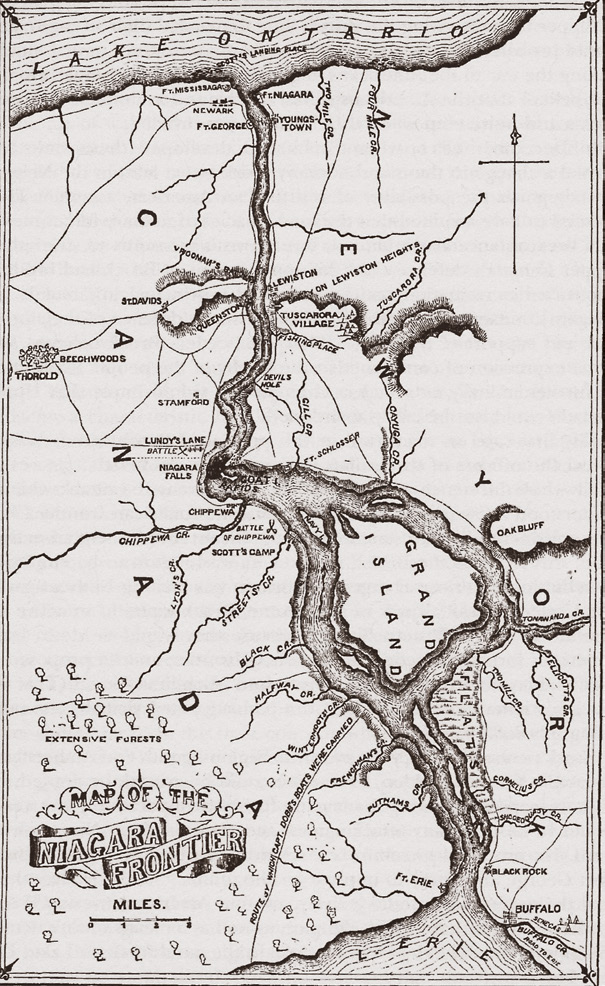
While this guerrilla warfare was being waged, the two opposing commanders tried to divine each other’s intentions. On July 15, Brown sent Porter and his brigade forward from the American camp at Queenston to reconnoitre Fort George. Five days later, Brown gave up on Chauncey’s naval squadron and moved his entire army to invest Forts George and Mississauga without its support. Convinced his troops could meet and beat his enemy in open battle, Brown wanted to lure the British out from behind their defences and demonstrated before the forts for two days to no avail.
The American commander was in a quandary. If he mounted a formal siege of the forts, he would have Riall at his back; if he went after Riall, the garrison of the forts would be in his rear. When he was unable to get the defenders, which included the Coloured Company, out of the forts to fight in the open, Brown began to withdraw his army to Queenston on July 21, intending to fall back to the higher ground at the foot of the escarpment at Samuel Street’s farm just south of Chippawa.
Riall also re-aligned his division. On July 18, he echeloned his army from his advanced post at the 4-Mile Creek to the 12-Mile and 20-Mile Creeks. The Incorporated Militia were at the advanced post, brigaded with the Glengarry Light Infantry under the redoubtable Lieutenant-Colonel Thomas Pearson. Lieutenant-General Drummond had previously ordered the militia of the peninsula and surrounding area to assemble at Burlington Bay and when they arrived in large numbers, he formed them into two brigades under regular officers. The 1st Brigade, under Lieutenant-Colonel Love Parry Jones of the 103rd Foot, comprised the 1st, 2nd, 4th and 5th Lincolns and 2nd York Regiments, while the 2nd Brigade, under Lieutenant-Colonel Christopher Hamilton of the 100th Foot, comprised the 1st and 2nd Norfolk, 1st Essex and 1st Middlesex County Regiments. Riall described the militia at “this service” as mainly farmers, but warned that “their hay being now receiving injury and their corn ripening fast, they will not be induced, I fear,” to remain in service for a long period.
On July 19 Riall moved Jones’ 1st Brigade forward to the 10-Mile Creek and threw out pickers on a line from there to DeCew’s house. The following day, when Merritt reported that “Queenston Heights and village had been evacuated by the enemy, Jones ordered the 1st and 2nd Lincolns to occupy the area. Jones expected that Riall would shift the major part of his forces to join him in what was “the best position in the country” but Riall was intent on watching Brown in front of Fort George.
When the Americans withdrew from Fort George on July 21, they found that the 1st Lincoln and the 2nd York Regiments had somewhat cheekily occupied Queenston Heights. The result was a day-long skirmish in and around the heights but American numbers soon told and the Lincolns and Yorkers were unceremoniously swept out of the area. Two days later, Brown withdrew to the area of the falls and, on July 24, pulled back farther south to Chippawa.
The stage was now set for the Battle of Lundy’s Lane, not far from the falls, on the following night. It would be the bloodiest action of the war fought on Canadian soil.
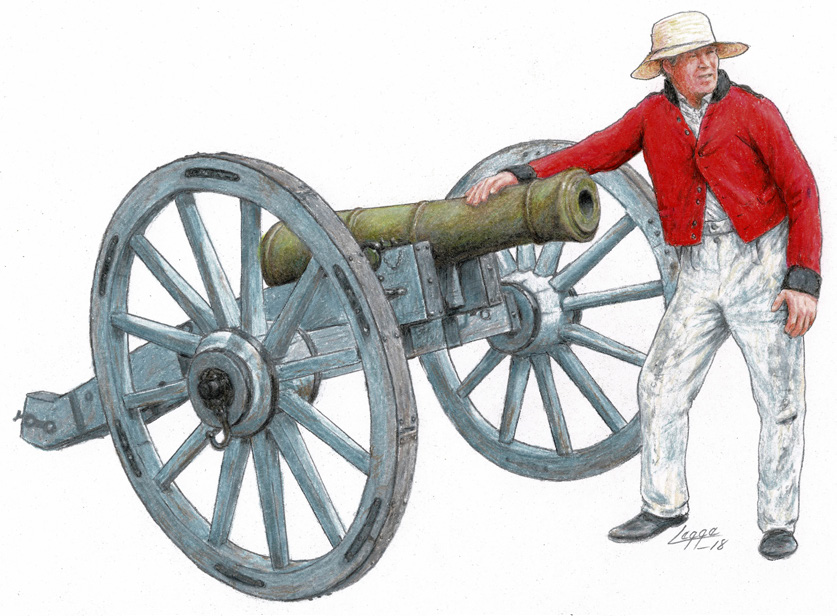
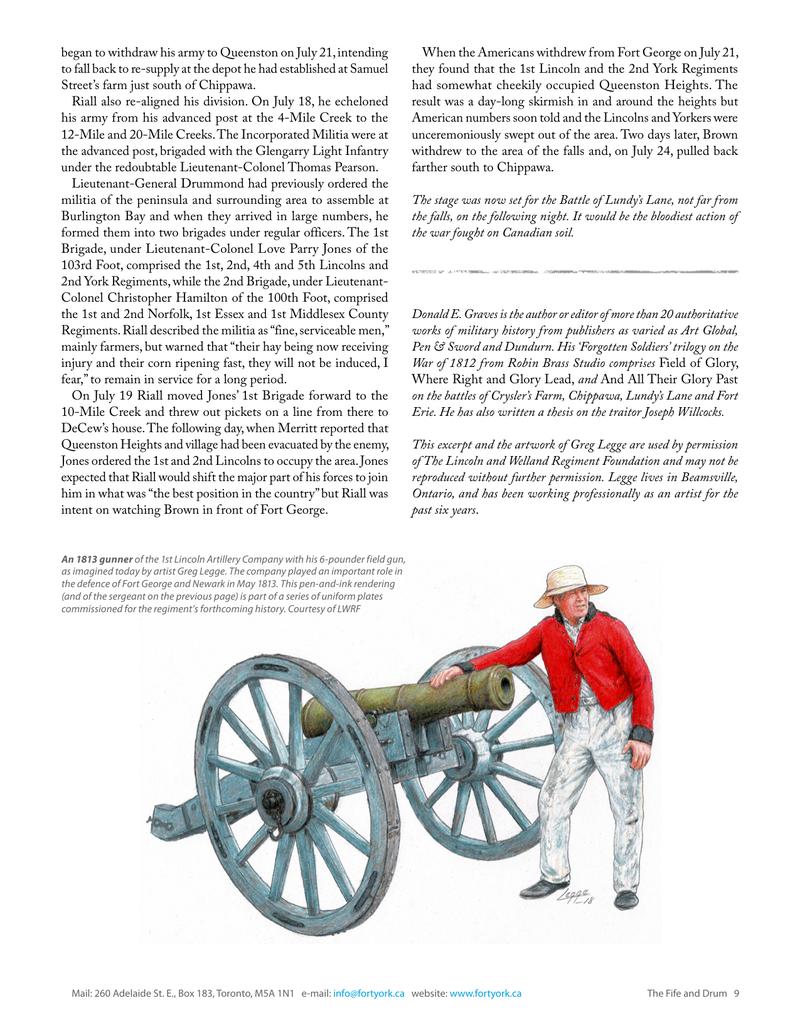
This excerpt and the artworks of Greg Legge are used by permission of The Lincoln and Welland Regiment Foundation and may not be reproduced without further permission. Legge lives in Beamsville, Ontario, and has been working professionally as an artist for the past six years.
Original printed pages