

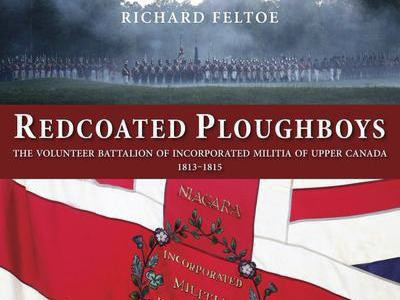
The British regulars that provided the backbone to the defence of the Canadas during the War of 1812 were, until the late autumn of 1814, outnumbered by the entirety of the US Army. To augment their manpower, British commanders looked, in addition to their Native allies, to the resources of the militia of Upper and Lower Canada. Unfortunately, and despite last minute attempts to improve their skills on the eve of the war, most of the sedentary militia lacked the discipline, training, and equipment to allow their being employed in the line, alongside regulars. As this problem continued into 1813, the role of the militia was further modified and expanded in both Canadas. Between March and June 1813, the legislature in Upper Canada approved of the formation of volunteer incorporated militia to serve as infantry, three troops of cavalry, two artillery companies, and a corps of artillery drivers for the duration of the conflict. The story of one of these units, the Volunteer Battalion of Incorporated Militia of Upper Canada, is the topic of this book.
Some historians have argued that the Anglo-American war of 1812 to 1815 began not in 1812, but in 1811, when President James Madison became convinced that the differences between his country and Britain could be resolved only by war, while a military regime was installed in British North America under Lieutenant-General Sir George Prevost that commenced its own military preparations. One might further argue that unpreparedness on the part of the Americans and the absence of a professional British naval service on the inland waters, meant that the events of 1812 were merely a series of uncoordinated actions undertaken without sufficient means and that the war did not begin in earnest until 1813, when a revived American army took to the field, the Royal Navy arrived on the lakes, and the strength of troops serving in Upper Canada increased.
It was in 1813 that three regiments of incorporated militia were recruited for service in Upper Canada. This was an improvement over the previous system as incorporated units were to consist of volunteers that were trained, armed, and equipped like regular troops. The first of the incorporated infantry units was raised in the region between Kingston and Lower Canada, the second between York and the Head of Lake Ontario, while the third was raised in the territory between the Niagara River and the Grand River.
By early 1814, manpower limitations had made it evident that the individual company detachments could not be expanded into three battalions and it was decided to concentrate the embodied divisions at York, where they would be grouped into a single regiment. Beginning in March, a vigorous programme of company- and battalion-level instructional drills commenced under the watchful eyes of Lieutenant-Colonel William Robinson, a professional officer appointed to command the regiment, and drillmaster Sergeant-Major William Robinson, from the 41st Foot. Within a few weeks, the independent divisions—who were joined by new recruits and by regular officers and NCOs— had been made into a cohesive battalion of ten companies.
By June 1814, the 29 officers and 377 personnel of the regiment had been assigned to the Right Division of the Army of Upper Canada and in July the battalion moved from York to the Niagara Peninsula where it was stationed around Fort Mississauga before joining the reorganized Right Division’s Light Brigade and fighting in the battle of Lundy’s Lane. The battalion then participated in the siege of Fort Erie before moving to the defensive line along the Chippawa River that September. The end of the war found the battalion in Butler’s Barracks at the northern end of the Niagara Peninsula. In late March 1815, plans to transform the battalion into a light infantry regiment ended when the unit was disbanded.
The story of the Incorporated Militia of Upper Canada did not end there, and in April 1822, the lieutenant-governor of Upper Canada awarded the battle honour “Niagara” to the Incorporated Militia Battalion of Upper Canada in recognition of its wartime service. The colours bearing this honour are now in the Canadian War Museum.
The research undertaken by this author is impeccable. Historian Ben Greenhous once commented that most regimental history “developed imperceptibly over a series of late-night sessions in the mess, conceived over a whisky and soda, born of a good claret, and weaned on port.” While this is also true for other regimental histories, Feltoe has made superlative use of archival material to craft a balanced examination of the history of the Volunteer Battalion of Incorporated Militia of Upper Canada within the context of the greater events of the War of 1812.
Of interest are the many maps, which the author created, that not only depict the movements of the regiment, but also provide useful context for the campaigns and battles it participated in. Having taken over fifty military groups on staff rides of the 1814 Niagara Campaign over the last several years, I found the eleven maps portraying the events of the battle of Lundy’s Lane instructive and superior to anything published to date. Historians, re-enactors, and War of 1812 mavens alike will appreciate the appendices that provide specifics on the careers of individuals from the regiment, information on weapons and clothing, and details on soldiering, discipline, diet, health, and military families.
The parade of new and re-issued books leading up to the bicentenary of the War of 1812, has in the main, been disappointing for a lack of originality, shortfalls in research and writing, repetition of tired myths, or unwarranted brevity. In his Redcoated Ploughboys, Richard Feltoe brings us a well-researched and written illustrated history of an important Canadian unit from the War of 1812. No one unit can claim to have won the war, however, without good unit histories, our understanding of how the war was won suffers; Redcoated Ploughboys is a model of how such histories should be written.
Original printed pages


