This little book is a complete transcription of Hannah Peters Jarvis’s journal with entries dating from the late 1700s through to the 1840s. The original at the Guelph University Library has been transcribed and published by Willowbank School of Restoration Arts and Centre for Cultural Heritage in Queenston, Ontario, to honour the Jarvis and Hamilton families.
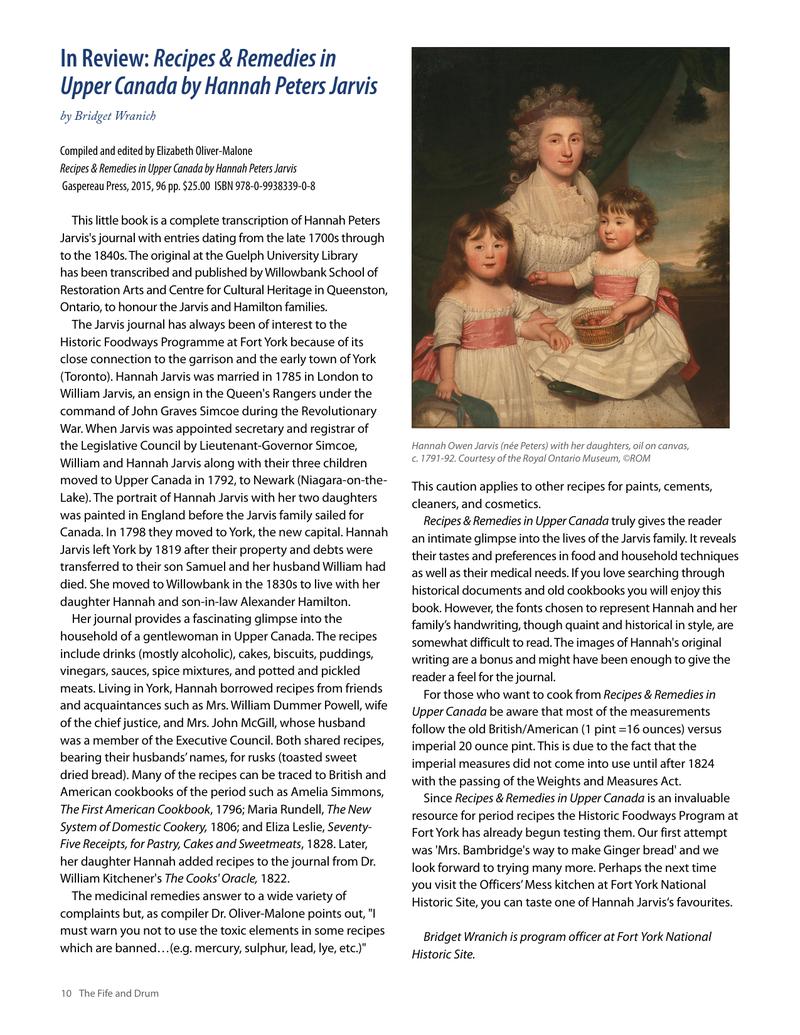
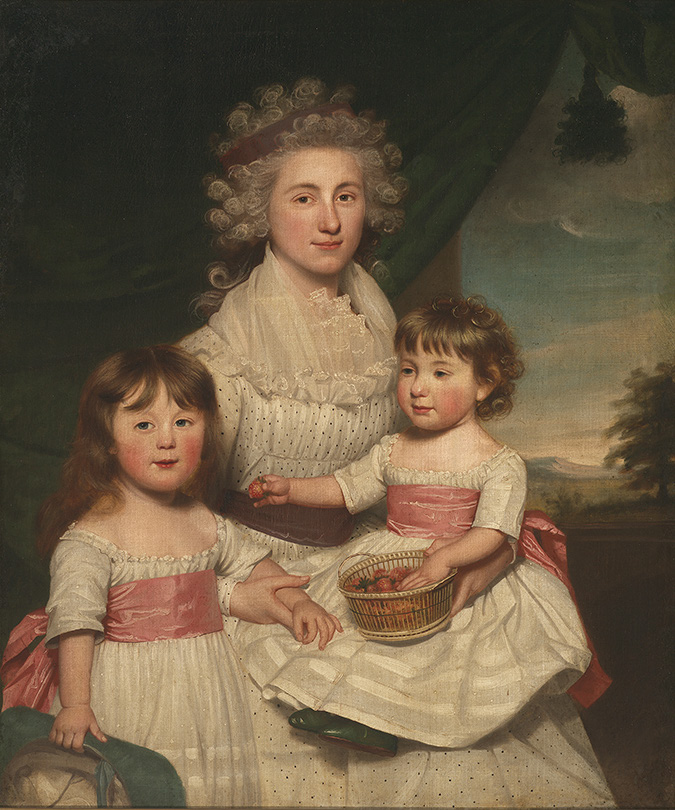
The Jarvis journal has always been of interest to the Historic Foodways Programme at Fort York because of its close connection to the garrison and the early town of York (Toronto). Hannah Jarvis was married in 1785 in London to William Jarvis, an ensign in the Queen’s Rangers under the command of John Graves Simcoe during the Revolutionary War. When Jarvis was appointed secretary and registrar of the Legislative Council by Lieutenant-Governor Simcoe, William and Hannah Jarvis along with their three children moved to Upper Canada in 1792, to Newark (Niagara-on-the-Lake). The portrait of Hannah Jarvis with her two daughters was painted in England before the Jarvis family sailed for Canada. In 1798 they moved to York, the new capital. Hannah Jarvis left York by 1819 after their property and debts were transferred to their son Samuel and her husband William had died. She moved to Willowbank in the 1830s to live with her daughter Hannah and son-in-law Alexander Hamilton.
Her journal provides a fascinating glimpse into the household of a gentlewoman in Upper Canada. The recipes include drinks (mostly alcoholic), cakes, biscuits, puddings, vinegars, sauces, spice mixtures, and potted and pickled meats. Living in York, Hannah borrowed recipes from friends and acquaintances such as Mrs. William Dummer Powell, wife of the chief justice, and Mrs. John McGill, whose husband was a member of the Executive Council. Both shared recipes, bearing their husbands’ names, for rusks (toasted sweet dried bread). Many of the recipes can be traced to British and American cookbooks of the period such as Amelia Simmons, The First American Cookbook, 1796; Maria Rundell, The New System of Domestic Cookery, 1806; and Eliza Leslie, Seventy-Five Receipts, for Pastry, Cakes and Sweetmeats, 1828. Later, her daughter Hannah added recipes to the journal from Dr. William Kitchener’s The Cooks’ Oracle, 1822.
The medicinal remedies answer to a wide variety of complaints but, as compiler Dr. Oliver-Malone points out, “I must warn you not to use the toxic elements in some recipes which are banned…(e.g. mercury, sulphur, lead, lye, etc.)” This caution applies to other recipes for paints, cements, cleaners, and cosmetics.
Recipes & Remedies in Upper Canada truly gives the reader an intimate glimpse into the lives of the Jarvis family. It reveals their tastes and preferences in food and household techniques as well as their medical needs. If you love searching through historical documents and old cookbooks you will enjoy this book. However, the fonts chosen to represent Hannah and her family’s handwriting, though quaint and historical in style, are somewhat difficult to read. The images of Hannah’s original writing are a bonus and might have been enough to give the reader a feel for the journal.
For those who want to cook from Recipes & Remedies in Upper Canada be aware that most of the measurements follow the old British/American (1 pint =16 ounces) versus imperial 20 ounce pint. This is due to the fact that the imperial measures did not come into use until after 1824 with the passing of the Weights and Measures Act.
Since Recipes & Remedies in Upper Canada is an invaluable resource for period recipes the Historic Foodways Program at Fort York has already begun testing them. Our first attempt was ‘Mrs. Bambridge’s way to make Ginger bread’ and we look forward to trying many more. Perhaps the next time you visit the Officers’ Mess kitchen at Fort York National Historic Site, you can taste one of Hannah Jarvis’s favourites.
Original printed pages