

The full name of our organization is The Friends of Fort York and Garrison Common, and while looking out for the fort’s well-being has consumed most of our energies for a long time, it has always been our aim to ensure that the history of the Garrison Common was better known too. This goal is an ambitious one, since the Common originally included all the land north of the lake bounded by Peter Street, Queen, and a line west of Macdonell Avenue, some 1200 acres in total. But everything has a beginning, hence we look here at the two breweries that once operated on the Common, both located on the south side of Queen Street where it crossed the Garrison Creek.
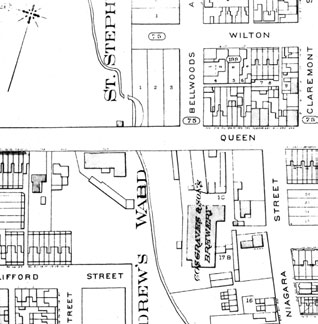
The earlier of the pair was Farr’s or the Queen Street Brewery on the west side of the creek, built in 1820 by John Farr. He had started brewing elsewhere in York [Toronto] in 1819, but moved the following year to a two-acre parcel on Garrison Creek that he occupied by license from H.M. Officers of The Ordnance. In 1838, while he was absent in England, his log-built brewery was entirely consumed by fire, but was soon re-erected in brick and back in operation. By 1847 Farr had prospered enough to be able to erect a substantial brick house near the brewery. Today his home survives at 905 Queen as part of a condominium development, having served until recently as a social centre for the city’s Polish community. In 1858 Farr, who had retired shortly before, sold John Wallis the part of his property where the brewery stood. Wallis carried on the business in partnership, first with John Moss and then with John Cornnell. After Wallis died in 1872 and Cornnell in 1879, the latter’s executors ran the brewery until it closed in 1886. Two years later the building was torn down and a block of stores erected there that is still standing today.

The second brewery, known as the West Toronto Brewery, was established in 1844 on the east side of Garrison Creek. The first brewers there, Thomas Baines and Isaac Thompson, were succeeded in 1863 by Patrick Cosgrave. Following a fire in 1878 that destroyed all the buildings on the site, new ones were put up to designs by Smith & Gemmell, at that time the city’s leading architects for commercial and industrial buildings. By 1892, under the management of Cosgrave’s son, production at the brewery exceeded 425,000 gallons of pale ale and porter a year, and gave employment to 55 men in winter and 45 in summer. The family remained in control of the business until 1934 when E. P. Taylor acquired and merged it with the Dominion Brewery. From 1945 until it closed the West Toronto Brewery operated first under the O’Keefe banner, then under Carlings’. The buildings, or at least some of them, were torn down in 1961/62.

Original printed pages


