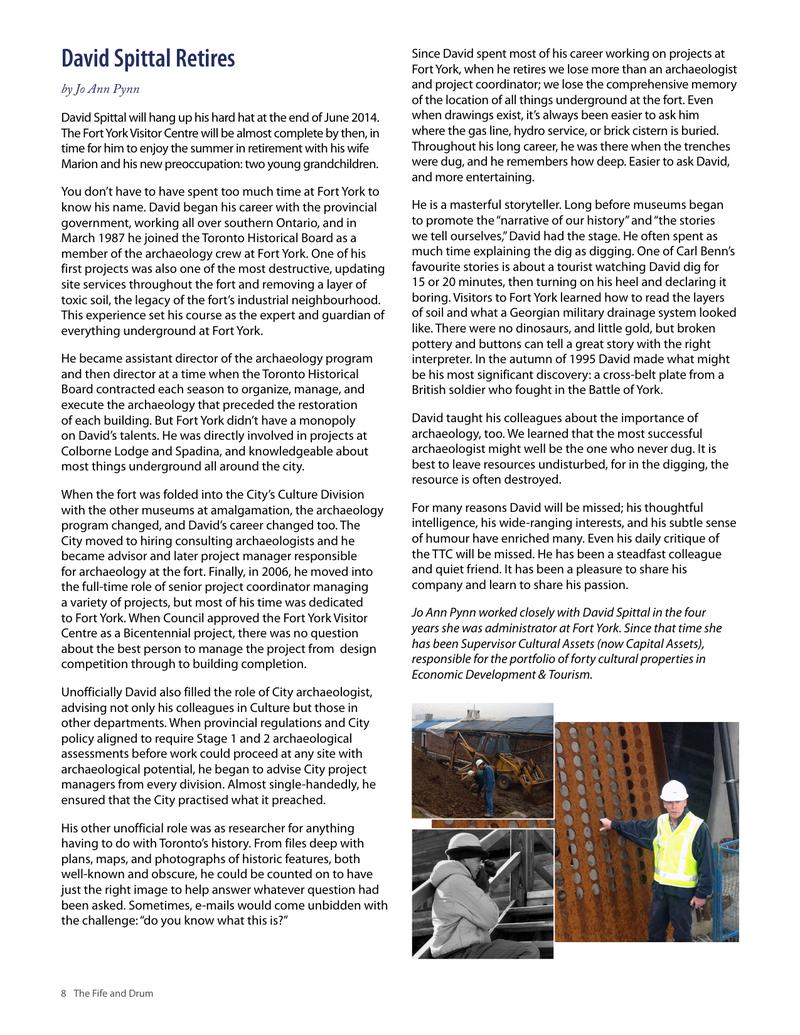
David Spittal will hang up his hard hat at the end of June 2014. The Fort York Visitor Centre will be almost complete by then, in time for him to enjoy the summer in retirement with his wife Marion and his new preoccupation: two young grandchildren.
You don’t have to have spent too much time at Fort York to know his name. David began his career with the provincial government, working all over southern Ontario, and in March 1987 he joined the Toronto Historical Board as a member of the archaeology crew at Fort York. One of his first projects was also one of the most destructive, updating site services throughout the fort and removing a layer of toxic soil, the legacy of the fort’s industrial neighbourhood. This experience set his course as the expert and guardian of everything underground at Fort York.
He became assistant director of the archaeology program and then director at a time when the Toronto Historical Board contracted each season to organize, manage, and execute the archaeology that preceded the restoration of each building. But Fort York didn’t have a monopoly on David’s talents. He was directly involved in projects at Colborne Lodge and Spadina, and knowledgeable about most things underground all around the city.
When the fort was folded into the City’s Culture Division with the other museums at amalgamation, the archaeology program changed, and David’s career changed too. The City moved to hiring consulting archaeologists and he became advisor and later project manager responsible for archaeology at the fort. Finally, in 2006, he moved into the full-time role of senior project coordinator managing a variety of projects, but most of his time was dedicated to Fort York. When Council approved the Fort York Visitor Centre as a Bicentennial project, there was no question about the best person to manage the project from design competition through to building completion.
Unofficially David also filled the role of City archaeologist, advising not only his colleagues in Culture but those in other departments. When provincial regulations and City policy aligned to require Stage 1 and 2 archaeological assessments before work could proceed at any site with archaeological potential, he began to advise City project managers from every division. Almost single-handedly, he ensured that the City practised what it preached.
His other unofficial role was as researcher for anything having to do with Toronto’s history. From files deep with plans, maps, and photographs of historic features, both well-known and obscure, he could be counted on to have just the right image to help answer whatever question had been asked. Sometimes, e-mails would come unbidden with the challenge: “do you know what this is?”
Since David spent most of his career working on projects at Fort York, when he retires we lose more than an archaeologist and project coordinator; we lose the comprehensive memory of the location of all things underground at the fort. Even when drawings exist, it’s always been easier to ask him where the gas line, hydro service, or brick cistern is buried. Throughout his long career, he was there when the trenches were dug, and he remembers how deep. Easier to ask David, and more entertaining.
He is a masterful storyteller. Long before museums began to promote the “narrative of our history” and “the stories we tell ourselves,” David had the stage. He often spent as much time explaining the dig as digging. One of Carl Benn’s favourite stories is about a tourist watching David dig for 15 or 20 minutes, then turning on his heel and declaring it boring. Visitors to Fort York learned how to read the layers of soil and what a Georgian military drainage system looked like. There were no dinosaurs, and little gold, but broken pottery and buttons can tell a great story with the right interpreter. In the autumn of 1995 David made what might be his most significant discovery: a cross-belt plate from a British soldier who fought in the Battle of York.
David taught his colleagues about the importance of archaeology, too. We learned that the most successful archaeologist might well be the one who never dug. It is best to leave resources undisturbed, for in the digging, the resource is often destroyed.
For many reasons David will be missed; his thoughtful intelligence, his wide-ranging interests, and his subtle sense of humour have enriched many. Even his daily critique of the TTC will be missed. He has been a steadfast colleague and quiet friend. It has been a pleasure to share his company and learn to share his passion.

Original printed pages