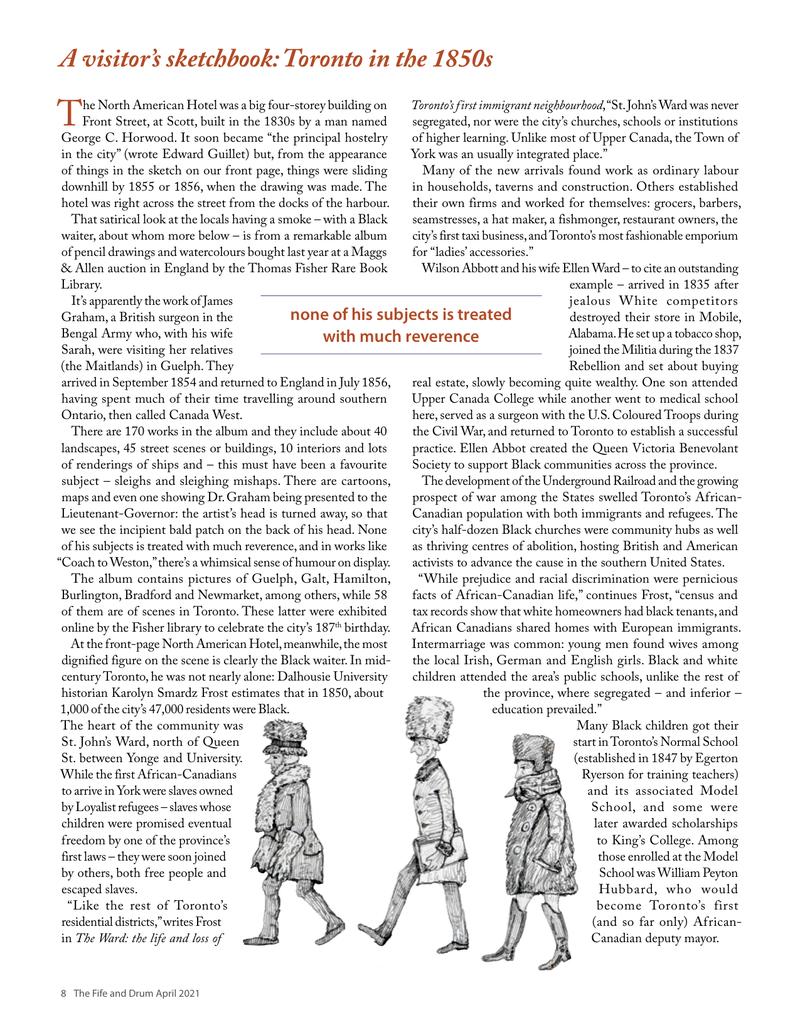
The North American Hotel was a big four-storey building on Front Street, at Scott, built in the 1830s by a man named George C. Horwood. It soon became “the principal hostelry in the city” (wrote Edward Guillet) but, from the appearance of things in the sketch on our front page, things were sliding downhill by 1855 or 1856, when the drawing was made. The hotel was right across the street from the docks of the harbour. That satirical look at the locals having a smoke – with a Black waiter, about whom more below – is from a remarkable album of pencil drawings and watercolours bought last year at a Maggs & Allen auction in England by the Thomas Fisher Rare Book Library.
It’s apparently the work of James Graham, a British surgeon in the Bengal Army who, with his wife Sarah, were visiting her relatives (the Maitlands) in Guelph. They arrived in September 1854 and returned to England in July 1856, having spent much of their time travelling around southern Ontario, then called Canada West.
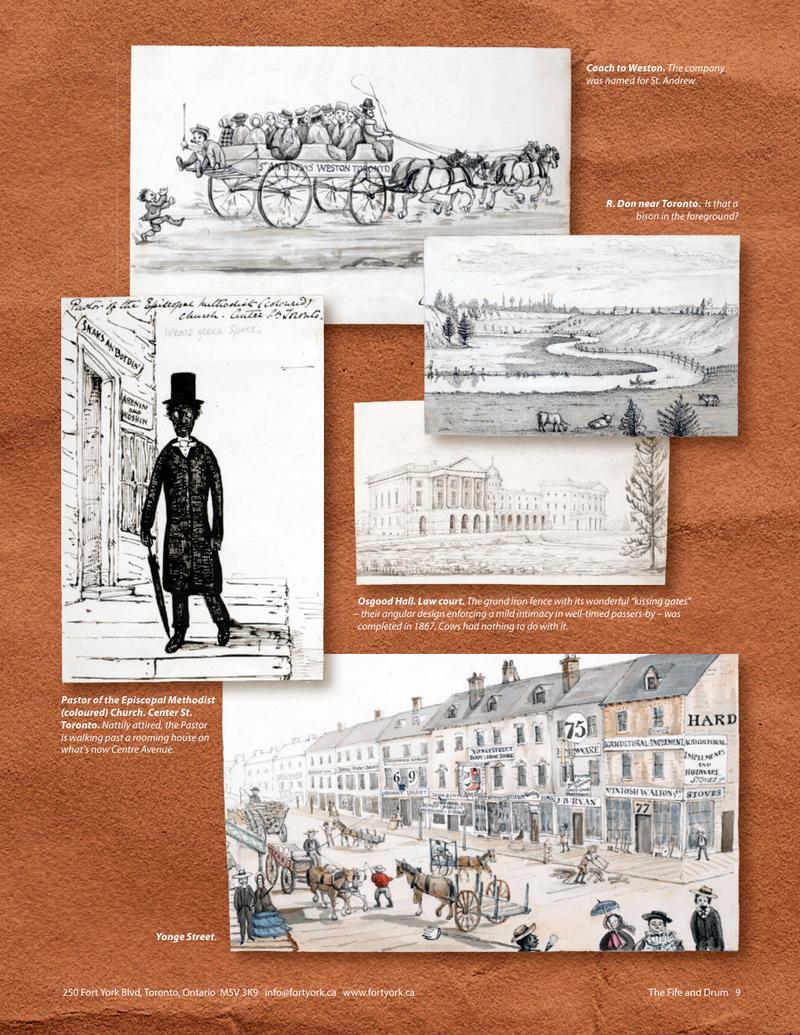
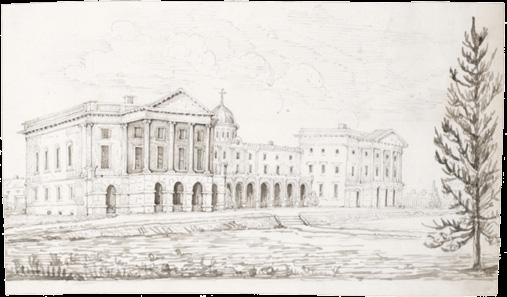
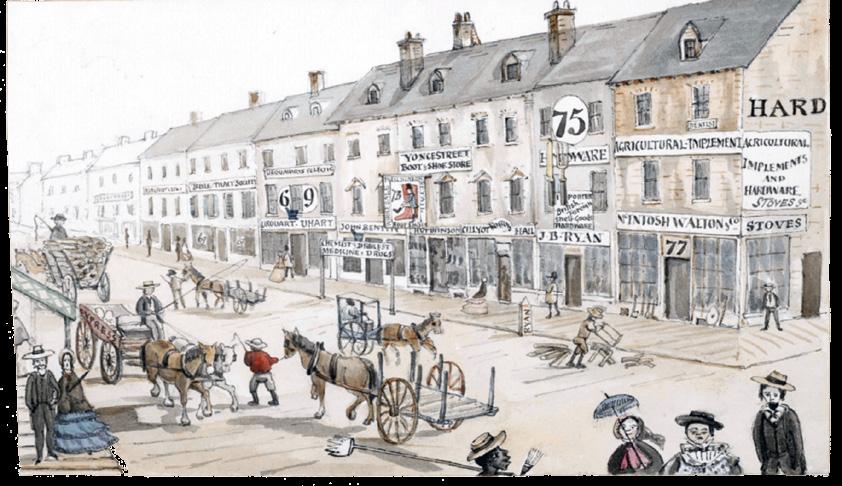
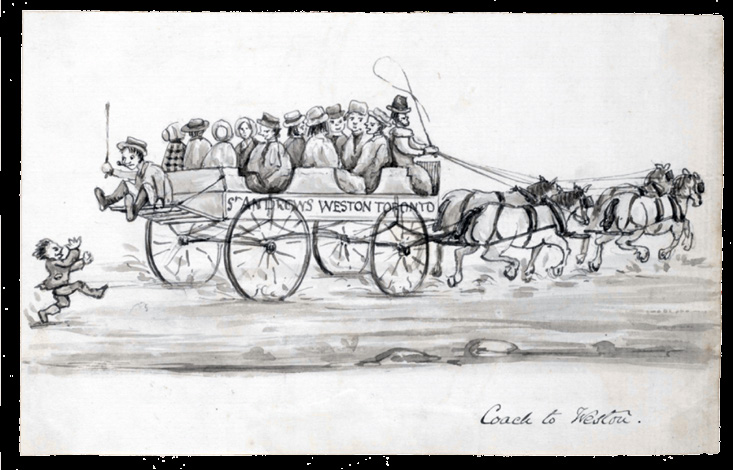
There are 170 works in the album and they include about 40 landscapes, 45 street scenes or buildings, 10 interiors and lots of renderings of ships and – this must have been a favourite subject – sleighs and sleighing mishaps. There are cartoons, maps and even one showing Dr. Graham being presented to the Lieutenant-Governor: the artist’s head is turned away, so that we see the incipient bald patch on the back of his head. None of his subjects is treated with much reverence, and in works like “Coach to Weston,” there’s a whimsical sense of humour on display.
none of his subjects is treated with much reverence
The album contains pictures of Guelph, Galt, Hamilton, Burlington, Bradford and Newmarket, among others, while 58 of them are of scenes in Toronto. These latter were exhibited online by the Fisher library to celebrate the city’s 187th birthday.
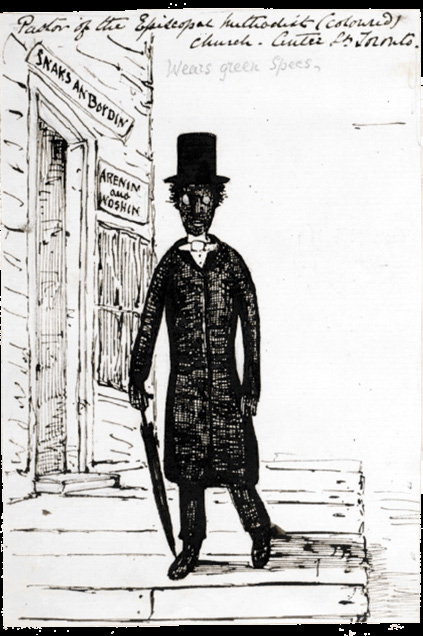
At the front-page North American Hotel, meanwhile, the most dignified figure on the scene is clearly the Black waiter. In midcentury Toronto, he was not nearly alone: Dalhousie University historian Karolyn Smardz Frost estimates that in 1850, about 1,000 of the city’s 47,000 residents were Black.
The heart of the community was St. John’s Ward, north of Queen St. between Yonge and University. While the first African-Canadians to arrive in York were slaves owned by Loyalist refugees – slaves whose children were promised eventual freedom by one of the province’s first laws – they were soon joined by others, both free people and escaped slaves.
“Like the rest of Toronto’s residential districts,” writes Frost in The Ward: the life and loss of Toronto’s first immigrant neighbourhood, “St. John’s Ward was never segregated, nor were the city’s churches, schools or institutions of higher learning. Unlike most of Upper Canada, the Town of York was an usually integrated place.”
Many of the new arrivals found work as ordinary labour in households, taverns and construction. Others established their own firms and worked for themselves: grocers, barbers, seamstresses, a hat maker, a fishmonger, restaurant owners, the city’s first taxi business, and Toronto’s most fashionable emporium for “ladies’ accessories.”
Wilson Abbott and his wife Ellen Ward – to cite an outstanding example – arrived in 1835 after jealous White competitors destroyed their store in Mobile, Alabama. He set up a tobacco shop, joined the Militia during the 1837 Rebellion and set about buying real estate, slowly becoming quite wealthy. One son attended Upper Canada College while another went to medical school here, served as a surgeon with the U.S. Coloured Troops during the Civil War, and returned to Toronto to establish a successful practice. Ellen Abbot created the Queen Victoria Benevolant Society to support Black communities across the province.
The development of the Underground Railroad and the growing prospect of war among the States swelled Toronto’s African-Canadian population with both immigrants and refugees. The city’s half-dozen Black churches were community hubs as well as thriving centres of abolition, hosting British and American activists to advance the cause in the southern United States.
“While prejudice and racial discrimination were pernicious facts of African-Canadian life,” continues Frost, “census and tax records show that white homeowners had black tenants, and African Canadians shared homes with European immigrants. Intermarriage was common: young men found wives among the local Irish, German and English girls. Black and white children attended the area’s public schools, unlike the rest of the province, where segregated – and inferior – education prevailed.”
Many Black children got their start in Toronto’s Normal School (established in 1847 by Egerton Ryerson for training teachers) and its associated Model School, and some were later awarded scholarships to King’s College. Among those enrolled at the Model School was William Peyton Hubbard, who would become Toronto’s first (and so far only) African-Canadian deputy mayor.

Original printed pages