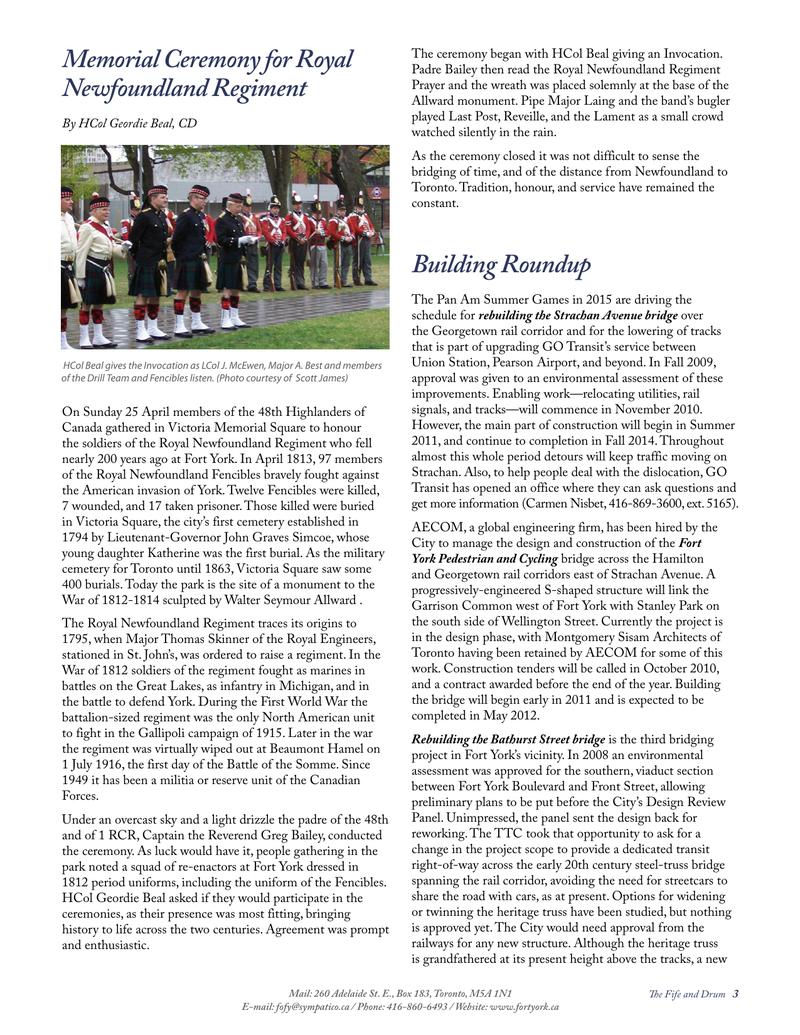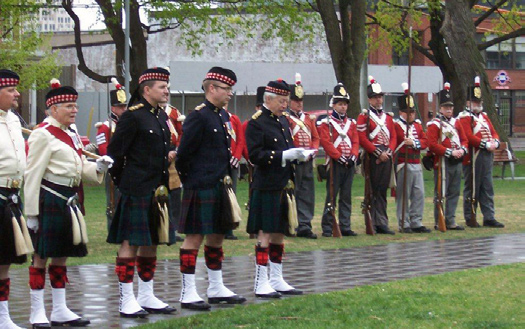
On Sunday 25 April members of the 48th Highlanders of Canada gathered in Victoria Memorial Square to honour the soldiers of the Royal Newfoundland Regiment who fell nearly 200 years ago at Fort York. In April 1813, 97 members of the Royal Newfoundland Fencibles bravely fought against the American invasion of York. Twelve Fencibles were killed, 7 wounded, and 17 taken prisoner. Those killed were buried in Victoria Square, the city’s first cemetery established in 1794 by Lieutenant-Governor John Graves Simcoe, whose young daughter Katherine was the first burial. As the military cemetery for Toronto until 1863, Victoria Square saw some 400 burials. Today the park is the site of a monument to the War of 1812-1814 sculpted by Walter Seymour Allward.
The Royal Newfoundland Regiment traces its origins to 1795, when Major Thomas Skinner of the Royal Engineers, stationed in St. John’s, was ordered to raise a regiment. In the War of 1812 soldiers of the regiment fought as marines in battles on the Great Lakes, as infantry in Michigan, and in the battle to defend York. During the First World War the battalion-sized regiment was the only North American unit to fight in the Gallipoli campaign of 1915. Later in the war the regiment was virtually wiped out at Beaumont Hamel on 1 July 1916, the first day of the Battle of the Somme. Since 1949 it has been a militia or reserve unit of the Canadian Forces.
Under an overcast sky and a light drizzle the padre of the 48th and of 1 RCR, Captain the Reverend Greg Bailey, conducted the ceremony. As luck would have it, people gathering in the park noted a squad of re-enactors at Fort York dressed in 1812 period uniforms, including the uniform of the Fencibles. HCol Geordie Beal asked if they would participate in the ceremonies, as their presence was most fitting, bringing history to life across the two centuries. Agreement was prompt and enthusiastic.
The ceremony began with HCol Beal giving an Invocation. Padre Bailey then read the Royal Newfoundland Regiment Prayer and the wreath was placed solemnly at the base of the Allward monument. Pipe Major Laing and the band’s bugler played Last Post, Reveille, and the Lament as a small crowd watched silently in the rain.
As the ceremony closed it was not difficult to sense the bridging of time, and of the distance from Newfoundland to Toronto. Tradition, honour, and service have remained the constant.
Original printed pages