

In the turbulent years that followed the Mackenzie Rebellion of 1837, many thousands of provincial troops saw service in the defence of Upper Canada. Yet, relatively few of their uniforms exist in public collections today. And those uniforms that do exist almost always belonged to commissioned officers. There is, however, a rare private’s coat from the Rebellion era that soldiers on in the collection of the City of Toronto Museums.
Marked to the 1st Incorporated Militia Battalion, the coat is made from coarse red wool, with the facings–the cuffs and collar–made from dark blue wool of similar quality. The half-inch lace is white and plain. On the front of the coat, the lace is arranged in square-ended pairs that taper in width from the top of the chest to the waist. The throat was held closed above the top button by a hook and eye, although only the eye remains. The red colour of the wool now has a slight brownish cast, which is probably due to the dye pigment oxidizing. The inside of the collar is lined with lightweight red wool and is smudged with black streaks. These streaks likely came from blackball, the polish used by the soldier to shine his leather neck stock, which later rubbed off on the lining. The body, skirts, and sleeves are also lined throughout with a lighter weight, white wool. The remaining pewter buttons are three-quarters of an inch in diameter, domed, and hold the cypher of Queen Victoria–the letters VR in script with the image of St. Edward’s Crown above–in the centre. Around the edge of the buttons are raised the words “Canadian Militia”. In the late 1830’s, the shoulder straps on the other-ranks’ battalion-company coats took the form of an epaulette. Unfortunately, the shoulder straps are no longer with this coat. Although, the left shoulder still retains a small loop of white cloth that might have been a part of the shoulder strap attachment.
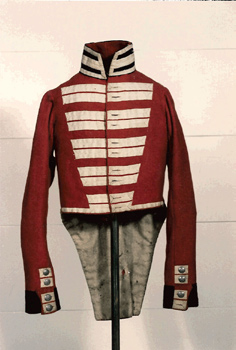
There is nothing outwardly that identifies the coat as having belonged to the 1st Incorporated Militia Battalion, which had its headquarters at Hamilton (five incorporated militia battalions were raised between 1838 and 1839). However, the original owner of the coat wrote the following on the lining: 1.I.M.B. C. AH. 190. “1 IMP” stands for the 1st Incorporated Militia Battalion. The letter “C” refers to C Company (some documents also referred to it as 3rd Company). The number “190” was the soldier’s regimental number; “AH” were most likely the owner’s initials.
During the 1st Battalion’s first term of service, the monthly pay lists were organised by company. An examination of those lists returns only one soldier in C or 3rd Company with the initials A. H., Anthony Hinchey. Unfortunately, the pay list does not also include the soldiers’ number, so there is no way to correlate Hinchey’s name and number to be certain that he was the A.H. who owned the coat. After April 1840, Hinchey’s name disappears from the pay list, suggesting that he did not re-enlist when the Incorporated Militia’s first term of service expired.
A surviving letter from Captain Thomas Benson, the paymaster of the 3rd Incorporated Militia Battalion at Niagara, gives us some insight as to perhaps why so few other-ranks uniforms exist today. At the beginning of June 1841, Benson’s 3rd Battalion had more summer trousers on hand than they needed. Indeed, their surplus was enough that Benson was willing to sell it, with the modest profit going to the 3rd Battalion coffers. In a letter to Lieutenant-Colonel William Gourlay of the 1st Battalion, dated 16th June 1841, the enterprising Benson agreed to sell the trousers–which he would later value at just over five shillings apiece–for six shillings eight pence each. But, before Benson could process the sale, the demands of his own men almost ran the surplus into deficit.
On 28 June, Benson wrote again to Gourlay, explaining that, “…since I wrote to you on the 16th we shall require all the white trousers for our own men.” He concluded his note with disgust, “It’s astonishing how fast these thriftless dogs destroy their clothing.”
What became of Anthony Hinchey after his service in the Incorporated Militia is unknown. But in 1850, Thomas Benson was elected the first mayor of Peterborough, Ontario. Later, he became the secretary treasurer of the Port Hope, Lindsay and Beaverton Railway. On 12 March 1857, while travelling from Toronto to Hamilton, the locomotive pulling the train on which Benson was a passenger plunged from the bridge it was crossing and into the frozen Desjardins Canal, 20 metres below. Benson was one of 59 people killed in the accident.
Currently, the Incorporated Militia coat is in the reserve collection of the City of Toronto Museums. It’s hoped that someday, it may be on display in the new Visitor Centre currently planned for Fort York National Historic Site.
Acknowledgements
I would like to thank Lisa Buchanan, Richard Gerrard, Kevin Hebib, and Chris Laverton of Toronto Culture for their invaluable assistance in the research of this article.
Original printed pages


