The new high-density residential community emerging between Fort York and Fleet Street will eventually contain approximately 5,000 residential units. Called the Fort York Neighbourhood and considered a gateway to the downtown from the west, it is a key piece in the redevelopment of Toronto’s West Central Waterfront. One of many former industrial areas in the city being revitalized by housing, it is unusual in having the Fort York National Historic Site as a focus for the design of its public realm, which will bring the fort to the forefront in the public mind.
Planning of the new Neighbourhood has been underway for a number of years, but not until 2003 were steps taken by means of a three-day urban design charette towards creating a public realm plan for the area. This process was a collaboration between the City of Toronto, the public and three of the developers (Wittington, Plazacorp and Malibu) who owned lands there.
The plan emphasizes public space throughout the Neighbourhood by providing a design scheme for streetscapes, landscaping and sidewalks. Because parks and open spaces are vital to making the area more livable, the plan also includes the conceptual design of the principal local parks including the extensive grounds around Fort York, June Callwood Park, Gore Park, and the park east of the fort’s ramparts at the former mouth of Garrison Creek. As well, there are architectural design guidelines so that buildings will be designed to reflect the unique character of Fort York and built with pedestrian needs to the fore.
The Historical Setting
This master planning of the Fort York Neighbourhood has been informed by and responds to its historically rich setting. Fort York is Toronto’s birthplace, established in 1793 on a site where Garrison Creek entered Lake Ontario. Eventually the Garrison Common surrounding Fort York was developed for railways, industrial uses, bridges and the Gardiner Expressway, in the course of which the fort was hidden. Plans for the redevelopment of the Neighbourhood establish the fort’s prominence again by making its history and identity a part of street design, open space design, landscape interventions and by including interpretive features. Streetnames reflect the area’s history, for example, ‘Gzowski’ and ‘Grand Magazine.’ Interpretive signage will be installed to encourage a greater understanding of the community’s location and rich traditions among residents and visitors.
The Parks
A landscaping plan for the 16.6 ha. (41 acres) immediately surrounding Fort York, a designated National Historic Site, has emerged through studies such as Fort York: Setting it Right. Elements in the plan include the creation of a new drive from Fort York Boulevard (opened in 2006), relocation of the tree nursery, and interpretation of the site’s archaeological resources.
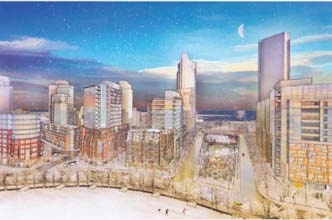
June Callwood Park is a central focus for the residential neighbourhood. Running north-south between Fort York Blvd. and Fleet Street, it will provide a view corridor between Fort York, Coronation Park and the waterfront beyond. Its detailed design is yet to be determined, likely through a design competition.
Gore Park on Lakeshore Blvd. is the forecourt to the Princes’ Gate at Exhibition Place. A conceptual design for it interprets Lake Ontario, which originally covered the area, by means of meadow that represents the ‘lake’ and a line of trees that mark the shoreline. East of Gore Park stands the Queen’s Wharf Lighthouse.
The park at the east end of Fort York and underneath the Bathurst Street [now Sir Isaac Brock] Bridge is part of the municipally-designated Fort York Heritage Conservation District. One of the goals in this area is to interpret its archaeological resources, including the old path that linked the fort to the Town of York, the Queen’s Wharf, and remnants of the Grand Trunk Railway. The park will be closely related to the development of housing, a library and daycare on Blocks 36 and 32 east of Bathurst Street.
The Buildings
The concept of the Fort York Neighbourhood is now being realized as people begin to move into the community. The edge along Fleet Street has been the first part to go ahead. Today some buildings at the west end are occupied and much construction is taking place east of that.
On the western tip of the Neighbourhood, H&R/Lanterra/Lifetime are completing construction of their fifth and final building. When finished, this consortium’s contribution will include three point-towers of 38, 28 and 38 storeys, and two lower-rise podium buildings of 12 and 16 storeys, for a total of approximately 1500 units. Several of the buildings are already occupied. An elaborate sculpture will wrap around the development as part of a public art contribution. Designed by New York artist Dan Acconci, the sculpture features metal ribbons that undulate around the perimeter of the site with metal sculpted trees and landscaping integrated with the sculpture.
After demolishing the vast, former Molson’s Brewery, Plazacorp Group has begun construction on Blocks 3A and 3B located just east of June Callwood Park. Its plan calls for a two-phase development of two towers of 36 and 26 storeys containing approximately 850 units. Currently the construction for Phase I and excavation for Phase II is underway. A sculptural frieze on the face of the 36-storey building will be the public art component for Phase I.
Construction is also well underway on the Malibu site located on the west side of Bathurst, north of Fleet Street. The Malibu building consists of a 32-storey point-tower with a five-storey podium and a total of 513 suites.
Wittington Properties own three development blocks in the northeast part of the Neighbourhood, including Block 3, currently occupied by St. Mary’s Cement which will be relocating by mid-2009. When the development of Block 3 moves ahead, the construction of June Callwood Park can take place. Not all of the planning for Wittington’s properties has been completed, although preliminary schemes have passed through the rezoning process.
From Concept to Reality
On blocks 32 and 36 east of Bathurst, planning is underway for a 655-unit housing complex of affordable and market-priced units developed by Toronto Community Housing Corporation on lands separated from the Fort York National Historic Site by a park at the mouth of the former Garrison Creek. Plans call for a 20-storey tower on Block 36 and a 30-storey tower on Block 32. A public library is being planned as part of the Block 36 development, along with a daycare facility.
With the construction sites moving full steam ahead and people starting to move in, we are seeing the formation of the new Fort York Neighbourhood. Fort York welcomes the new neighbours, and continues its role as, not only the birthplace of Toronto, but also the inspiration for a whole new waterfront community.
Original printed pages