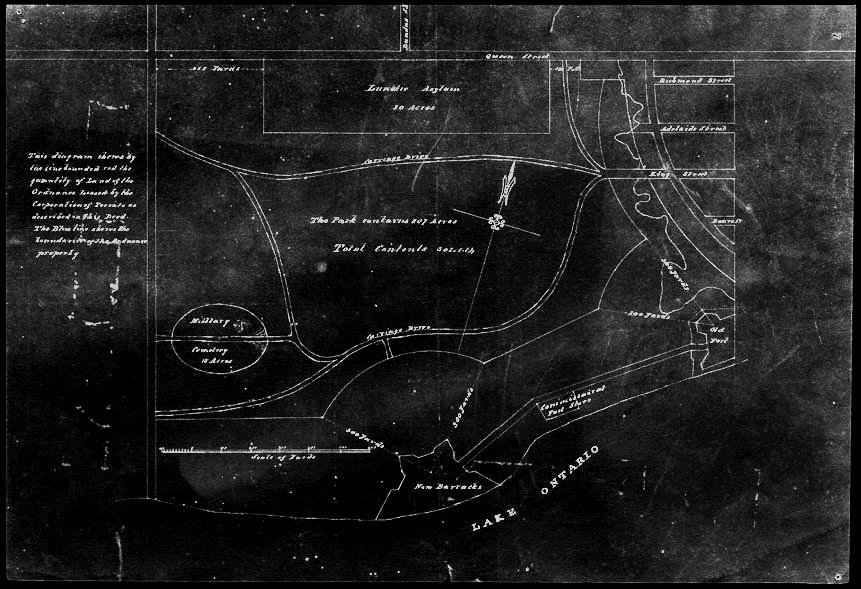
Recently the city’s archaeologist David Spittal turned up an old sketch plan of the area northwest of Fort York among some papers at the fort. Dr. Carl Benn, chief curator for the City’s museums and authority on the work of John G. Howard, recognized it immediately for what it was: a proposal for laying out the Western Park, one of Toronto’s early lost causes. Although unsigned, it was in Howard’s hand, and on the reverse were some pencil sketches for the framing for a barn on Howard’s High Park estate. The plan shows carriage drives winding their ways across the park, and an area of 15 acres near Dufferin Street set aside for a Military Cemetery to replace the burying ground in Victoria Square, although the latter was not yet full. The park’s boundaries curve in arcs 300 yards distant from the guns of the old and new forts, leaving room for cannons to be fired. (See plan)
The story of the Western Park begins in March, 1848, when the Officers of H. M. Ordnance who had charge of the Garrison Reserve lands leased to the City of Toronto for 999 years a parcel 287 acres in size lying south of the Lunatic Asylum (Queen St. Mental Health Centre), north of the New Fort (Stanley Barracks), and from a line west of Garrison Creek to Dufferin Street. The lease was conditional on the city fencing and landscaping the area and building a stone bridge over Garrison Creek at the west end of King Street where the main entrance was to be located.
For all its foresight in securing the lands before they were sold off like those east of Garrison Creek, the City moved slowly on its leasehold obligations. The bridge was built in late 1850 but Council waited until Spring, 1851, before taking steps towards having the land leveled and to commission the City surveyor, architect John G. Howard, to design an entrance gate and fence. Howard’s sketches and specifications for these features are among his papers in the Toronto Reference Library’s Baldwin Room. Certainly the City’s tardiness wasn’t the main reason why in December, 1851, the Ordnance Officers demanded the surrender of the lease, as they were empowered to do. They cited military purposes, specifically the need to settle there British military pensioners who wanted to stay in Canada rather than return to Britain. And they had the powerful support of the Secretary at War. In a letter of July, 1851, one of his underlings wrote: “Considering the Reserve extends over nearly 250 acres, such a space is never likely to be required merely as a Park or pleasure ground for so small a town as Toronto; indeed it is doubtful whether the whole of London possesses so much.”
In responding to the Ordnance Officers, our City fathers made a strategic mistake by negotiating to take a smaller parcel, particularly if the City would own it outright, and by submitting to insult and bad-faith bargaining. Ultimately, they lost everything, though this did not become clear until 1858, by which time the authority of the Ordnance Officers had been superceded by that of the Province of Canada.
Meanwhile, in October, 1851, Lady Elgin turned some sod on the lakeshore between John and Simcoe streets to mark the start of construction on the province’s first railway, the Ontario, Simcoe & Huron Union Railroad. Its line was surveyed to run north from Toronto about four miles west of Yonge street through Aurora and Newmarket to Barrie, and later to Collingwood. Obviously, there was no way the railway could leave from the front of the city and take its line without bisecting Toronto’s new park. In February, 1852, City Council objected strongly to the impending clash of uses, but to no avail. A month later Mayor John Bowes wrote of inducing “the Northern, Western and Eastern Railroad companies to unite and enter the City by the Garrison Ravine.” If this failed, however, because the Ordnance Officers believed they were powerless to stop the railways’ running their tracks wherever they chose, he suggested the City receive in exchange lands down to the water, “so that the Park may be bounded on the front by the Lake, a great and important advantage.”
But neither event came to pass. Thus, Toronto lost what might have been a magnificent park, on the water or back from it, and was left with great handicaps to the circulation of local traffic that still exist. As well, very few pensioners chose in the end to settle here.
Original printed pages