Amidst the shells bursting asunder above their heads, with dark smoke choking the air and shot striking the ground about their feet, the young drummer boys stood firm, steadfast; the sound of their martial music pushing their comrades unto glory.
Or so the story goes.
Reality was much different for the drummers of the 8th (King’s) Regiment at York in April 1813 and far from the romanticized – and incorrect – archetype of the young “drum boy” in battle.
The regiment was in the midst of shifting its strength from Kingston to Fort George, and York’s garrison and stores made it the natural rest stop along the way. At the time of the American attack on April 27, two companies were present: Captain McNeale’s grenadier company, which had enjoyed a day of rest after arriving by batteaux on the 25th, and No. 3 company under Captain Eustace, augmented by a detachment of men from various other companies.
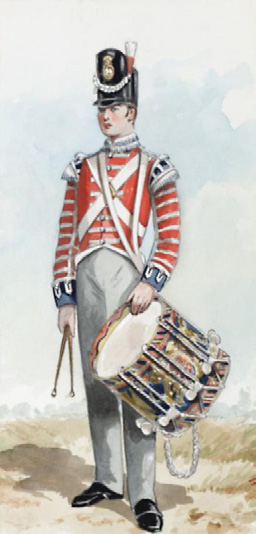
At full strength, a battalion mustered 22 drummers in addition to a drum major: two drummers for each battalion company, and four for the grenadiers.
the practical work of clearing the wounded and supplying ammunition
Far from being “drum boys,” by 1813 all the drummers in the King’s Regiment were between the age of 20 and 30 with most having between four and seven years of experience.
Attached to Eustace’s company were William Ash and William Chandler. Drummer Ash had joined the regiment in August 1803 and was 27 at York. An illiterate weaver, he was born in Stone, Staffordshire and measured an average height of 5’5″.
The four drummers of McNeale’s company were James Hinds, Benjamin Meaton, John Smith, and Joseph Taylor. Drummer Meaton was 26 and, like Ash, also joined in 1803 and saw action in the West Indies when the regiment participated in the taking of Martinique. Standing 5’8″, he was the third-tallest drummer in the regiment and was a natural fit among the grenadiers.
Drummers played an integral role in regulating the soldiers’ day from waking the men by beating Reveille, calling the men to drill and posting guards, to summoning the men back to barracks and ending the day by beating The Taptoo and The Retreat. Regimental inspection reports leading up to the war find no deficiency in the drummer’s abilities and show a competent and experienced group of musical warriors.
The appearance of the American fleet on the evening of April 26 disrupted the regular routine of duty beatings. Once it became apparent the Americans intended to land in force, the undermanned garrison prepared to defend the incomplete and untenable works at York; regimental and company commanders sought every able body to contest the landing.
So desperate was the situation and the want of men that Colonel Heathcote, commanding the Royal Newfoundland Regiment, ordered seven of his drummers capable of bearing arms to carry firelocks. These drummers left their drums behind in the barracks and took their place in the ranks to fight.
While certainly unusual and indicating the garrison’s precarious position, the drummers of the King’s Regiment were not strangers to the other ranks and most certainly drilled, albeit occasionally, with firelocks.
It was not uncommon for a drummer to find himself serving as a private, and for a private to trade his musket for a drum. Drummer Thomas McMahon was broken to private in July 1812, and Private John Truss was promoted to drummer in June 1813 to fill casualty vacancies. Drummers William Dix and George Young were broken to private on the same day in March 1814, presumably for a related transgression.
Even drum majors were not immune to being broken. William Ankers was promoted to drum major from corporal in January 1811 until his reduction to private in May 1814, when he was replaced by Private Hugh Brown.
Unlike the Royal Newfoundland Regiment’s drummers, those of the King’s carried their drums as they marched against the enemy. Captain McNeale fell leading his charging grenadiers at the water’s edge, and the British regrouped at the ruins of Fort Rouille, where No. 3 company joined the fight.
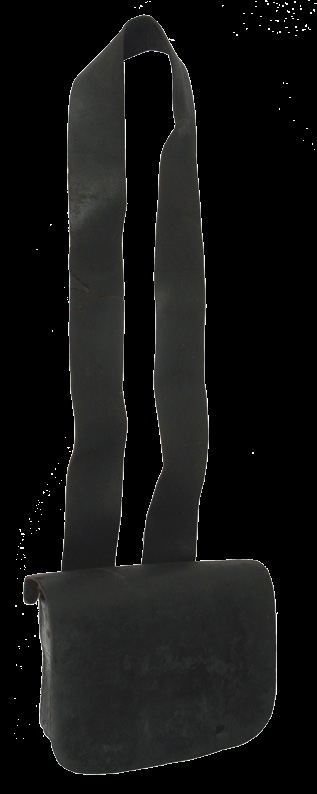
It was during the ensuing firefight that the drummers undertook their battlefield role, not one of playing martial music but the practical work of clearing the wounded and supplying ammunition. With cartridges running low, Captain Eustace ordered his drummers to the rear to fetch more, and it is likely the grenadier drummers were ordered to do the same. Either Ash or Chandler left his drum beside the portable magazine in the Western Battery for safe keeping as he went to replenish his company’s ammunition supply.
Under fire by both the American infantry and the vessels just offshore, the British retired and began to reform at the Western Battery. Then, the battery’s portable magazine exploded, blasting away the men manning the guns and the silent drum. It was clear York could not be held, and the British regulars began their long retreat to Kingston without knapsacks, great coats, canteens, or haversacks, the men having been ordered to leave them in barracks at the start of the action.
The King’s Regiment would go on to take part in nearly every major action of the war and ended 1814 very much a broken regiment. At the war’s end, the corps of drums numbered 16 drummers, many of whom were new faces, though all the drummers present at York survived.
Benjamin Meaton was wounded in the right thigh at Sackets Harbor a month later but would go on to serve the remainder of the war as a drummer and an additional ten years as a private. William Chandler found himself facing another amphibious assault at Fort George a month later and was wounded and taken prisoner. James Hinds was broken to the ranks of the light company in March 1814. Joseph Taylor and William Ash spent several months in 1814 sick at York, and both men emerged unscathed.

Original printed pages