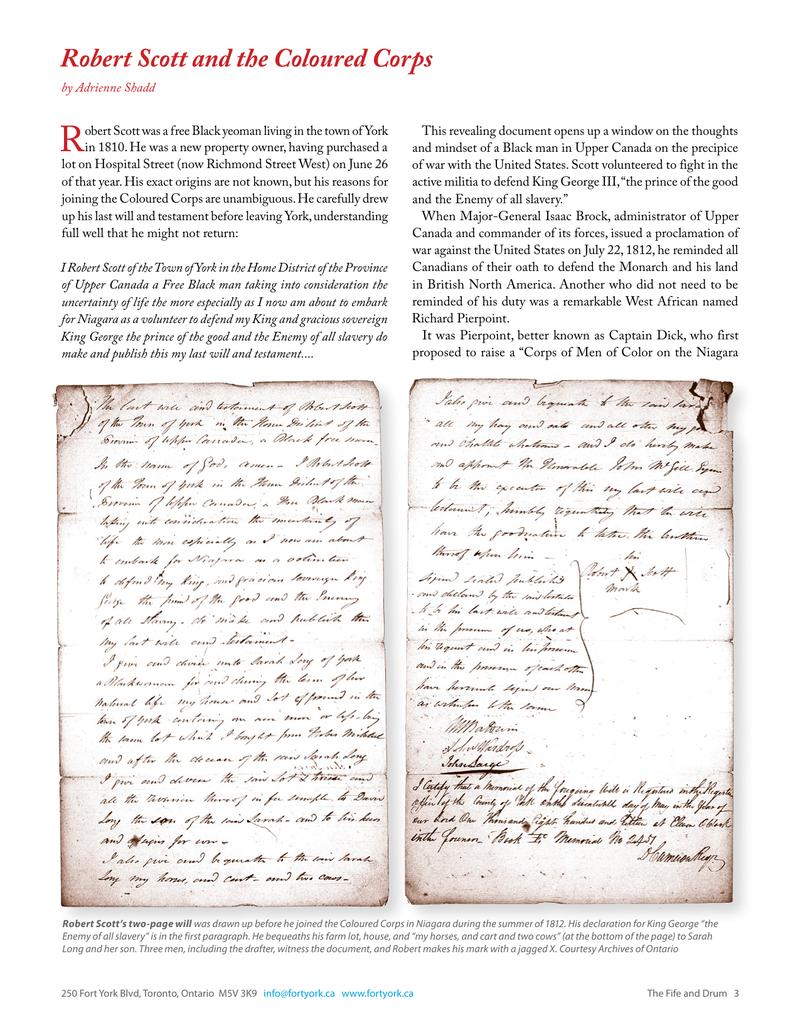
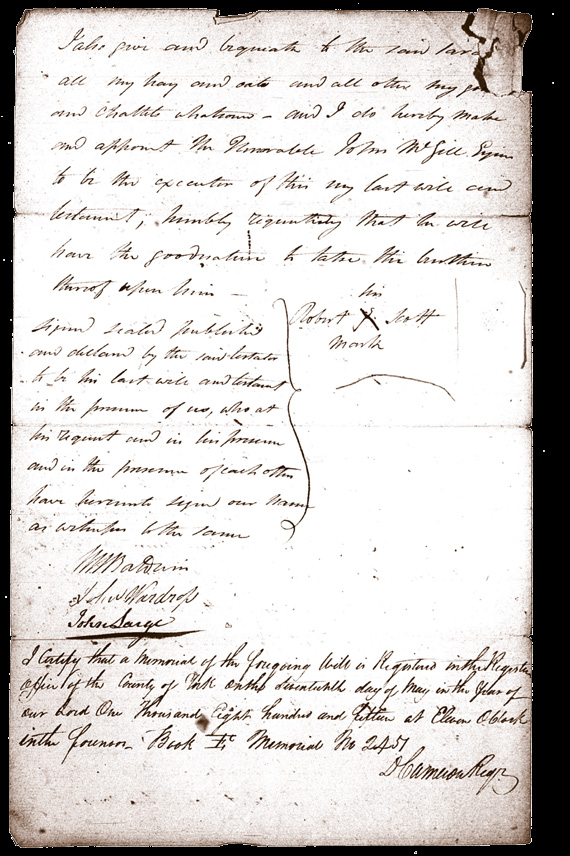
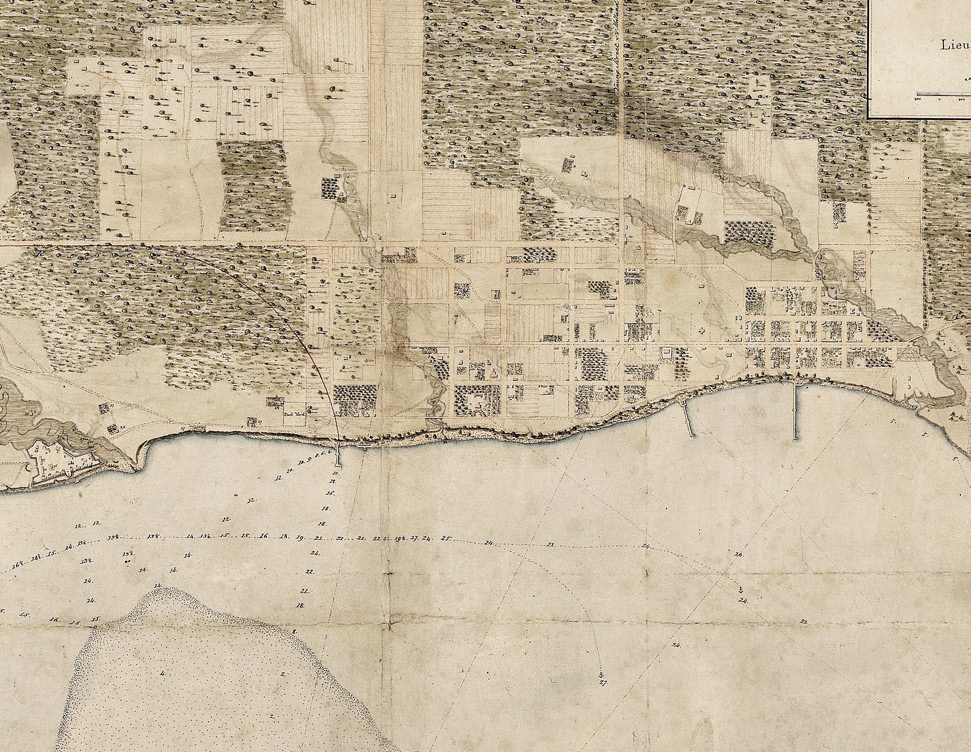
Robert Scott was a free Black yeoman living in the town of York in 1810. He was a new property owner, having purchased a lot on Hospital Street (now Richmond Street West) on June 26 of that year. His exact origins are not known, but his reasons for joining the Coloured Corps are unambiguous. He carefully drew up his last will and testament before leaving York, understanding full well that he might not return:
I Robert Scott of the Town of York in the Home District of the Province of Upper Canada a Free Black man taking into consideration the uncertainty of life the more especially as I now am about to embark for Niagara as a volunteer to defend my King and gracious sovereign King George the prince of the good and the Enemy of all slavery do make and publish this my last will and testament….
This revealing document opens up a window on the thoughts and mindset of a Black man in Upper Canada on the precipice of war with the United States. Scott volunteered to fight in the active militia to defend King George III, “the prince of the good and the Enemy of all slavery.”
When Major-General Isaac Brock, administrator of Upper Canada and commander of its forces, issued a proclamation of war against the United States on July 22, 1812, he reminded all Canadians of their oath to defend the Monarch and his land in British North America. Another who did not need to be reminded of his duty was a remarkable West African named Richard Pierpoint.
It was Pierpoint, better known as Captain Dick, who first proposed to raise a “Corps of Men of Color on the Niagara Frontier.” At the age of 68, Pierpoint also signed up with this special company, sometimes called Captain Runchey’s Coloured Men, and more often just the Coloured Corps.
The War of 1812 showed the Americans that most Canadians were willing to fight for the right to remain a colony of the British Empire rather than be swallowed up by her great neighbour to the south. Yet, the diverse nature of the racial background of its participants is still not fully recognized.
Certainly, most of the soldiers and militia on the Canadian side were of European origin, but an important component of the success of the British war strategy was the alliance and participation of the First Nations warriors, led by Tecumseh, the great Shawnee chief, and Teyoninhokarawen (also known as John Norton) of the Six Nations on the Grand River. Less well-known is that Canadians of African origin also lent their valour and blood to the war effort.
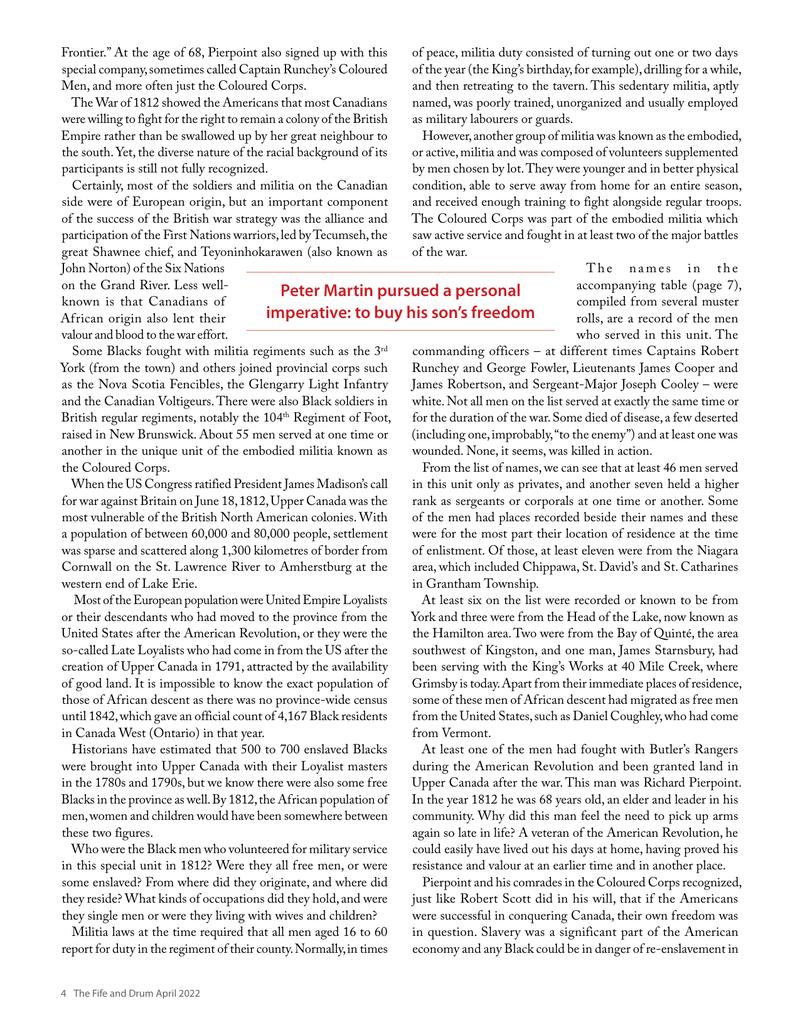
Peter Martin pursued a personal imperative: to buy his son’s freedom
Some Blacks fought with militia regiments such as the 3rd York (from the town) and others joined provincial corps such as the Nova Scotia Fencibles, the Glengarry Light Infantry and the Canadian Voltigeurs. There were also Black soldiers in British regular regiments, notably the 104th Regiment of Foot, raised in New Brunswick. About 55 men served at one time or another in the unique unit of the embodied militia known as the Coloured Corps.
When the US Congress ratified President James Madison’s call for war against Britain on June 18, 1812, Upper Canada was the most vulnerable of the British North American colonies. With a population of between 60,000 and 80,000 people, settlement was sparse and scattered along 1,300 kilometres of border from Cornwall on the St. Lawrence River to Amherstburg at the western end of Lake Erie.
Most of the European population were United Empire Loyalists or their descendants who had moved to the province from the United States after the American Revolution, or they were the so-called Late Loyalists who had come in from the US after the creation of Upper Canada in 1791, attracted by the availability of good land. It is impossible to know the exact population of those of African descent as there was no province-wide census until 1842, which gave an official count of 4,167 Black residents in Canada West (Ontario) in that year.
Historians have estimated that 500 to 700 enslaved Blacks were brought into Upper Canada with their Loyalist masters in the 1780s and 1790s, but we know there were also some free Blacks in the province as well. By 1812, the African population of men, women and children would have been somewhere between these two figures.
Who were the Black men who volunteered for military service in this special unit in 1812? Were they all free men, or were some enslaved? From where did they originate, and where did they reside? What kinds of occupations did they hold, and were they single men or were they living with wives and children?
Militia laws at the time required that all men aged 16 to 60 report for duty in the regiment of their county. Normally, in times of peace, militia duty consisted of turning out one or two days of the year (the King’s birthday, for example), drilling for a while, and then retreating to the tavern. This sedentary militia, aptly named, was poorly trained, unorganized and usually employed as military labourers or guards.
However, another group of militia was the embodied, or active, militia and was composed of volunteers supplemented by men chosen by lot. They were younger and in better physical condition, able to serve away from home for an entire season, and received enough training to fight alongside regular troops. The Coloured Corps was part of the embodied militia which saw active service and fought in at least two of the major battles of the war.
The names in the accompanying table (page 7), compiled from several muster rolls, are a record of the men who served in this unit. The commanding officers – at different times Captains Robert Runchey and George Fowler, Lieutenants James Cooper and James Robertson, and Sergeant-Major Joseph Cooley – were white. Not all men on the list served at exactly the same time or for the duration of the war. Some died of disease, a few deserted (including one, improbably, “to the enemy”) and at least one was wounded. None, it seems, was killed in action.
From the list of names, we can see that at least 46 men served in this unit only as privates, and another seven held a higher rank as sergeants or corporals at one time or another. Some of the men had places recorded beside their names and these were for the most part their location of residence at the time of enlistment. Of those, at least eleven were from the Niagara area, which included Chippawa, St. David’s and St. Catharines in Grantham Township.
At least six on the list were recorded or known to be from York and three were from the Head of the Lake, now known as the Hamilton area. Two were from the Bay of Quinté, the area southwest of Kingston, and one man, James Starnsbury, had been serving with the King’s Works at 40 Mile Creek, where Grimsby is today. Apart from their immediate places of residence, some of these men of African descent had migrated as free men from the United States, such as Daniel Coughley, who had come from Vermont.
At least one of the men had fought with Butler’s Rangers during the American Revolution and been granted land in Upper Canada after the war. This man was Richard Pierpoint. In the year 1812 he was 68 years old, an elder and leader in his community. Why did this man feel the need to pick up arms again so late in life? A veteran of the American Revolution, he could easily have lived out his days at home, having proved his resistance and valour at an earlier time and in another place.
Pierpoint and his comrades in the Coloured Corps recognized, just like Robert Scott did in his will, that if the Americans were successful in conquering Canada, their own freedom was in question. Slavery was a significant part of the American economy and any Black could be in danger of re-enslavement in the South if Canada were to become part of the United States. For Pierpoint, there was no option. He joined the Coloured Corps and defended Canadian territory against the invaders.
George Martin was another who served in the Coloured Corps. Coming from the Mohawk Valley in New York State, George was the son of Peter Martin, a former slave of Colonel John Butler, the Loyalist leader of Butler’s Rangers. Alongside his brother Richard, Peter Martin also served in Butler’s Rangers during the American Revolution. However, at the cessation of fighting in 1783, or some time shortly thereafter, Richard died. In 1797, Peter Martin decided to pursue an urgent but intensely personal imperative. He petitioned the Lieutenant Governor for the land grant that was owed to his deceased brother for military service during the war. His reason was particularly poignant: he wanted to sell the land to raise money to buy the freedom of his enslaved son, George, from Colonel Butler’s son, Thomas. It appears the two men had settled close to each other (in today’s York Currency) as the price of George’s liberty. The grant was awarded, and presumably George was freed. Fifteen years later, George Martin enlisted in the Coloured Corps and fought in the War of 1812.
Although George Martin was freed through purchase by his father, slavery was still legal in Upper Canada at the time that war was declared. (Simcoe’s legislation in 1793 had only banned the further import of enslaved people and declared that the children of the enslaved would be free when they were 25 years of age, and those who were enslaved at the time of Bondage still.) It is not known from muster rolls who was free and who may still have been enslaved.
By enlisting in the Coloured Corps, did enslaved men hope to win their freedom by showing their loyalty and willingness to defend Great Britain’s territories? Sadly, this strategy did not work for at least one man, as this letter from a general’s staff officer reveals:
York March 12, 1814
W.A. Nelles
40 Mile Creek
Sir,
I beg to acquaint you that I have this day, by command of his Honor Lieutenant General Drummond, written to Major General Riall, directing the discharge from the Corps of Colour, of the Black man generally called Jack, whom you state in your letter of the 8th Inst. in fact to belong to you. –
L. Foster
Adjt Genl of Militia
Nelles owned a man named Jack and he wanted him back. Apparently, if an owner requested it, a enslaved person could be summarily discharged from the military. This was, of course, in direct contrast to the war strategy of Britain against the Americans. Just as the British had done during the American Revolution, a proclamation issued on April 2, 1814, invited any American resident who wished to become a British citizen to take refuge behind British lines and they would be ‘sent as Free Settlers to the British Possessions in North America or the West Indies.”
Once again, as during the revolution, thousands of Blacks availed themselves of the opportunity, and in the end over 2,000 sailed to Nova Scotia on British ships in 1814.
Who was Jack, the enslaved man mentioned in the letter? There were a number of men with the first name John, so without further information, it would be hard to know.
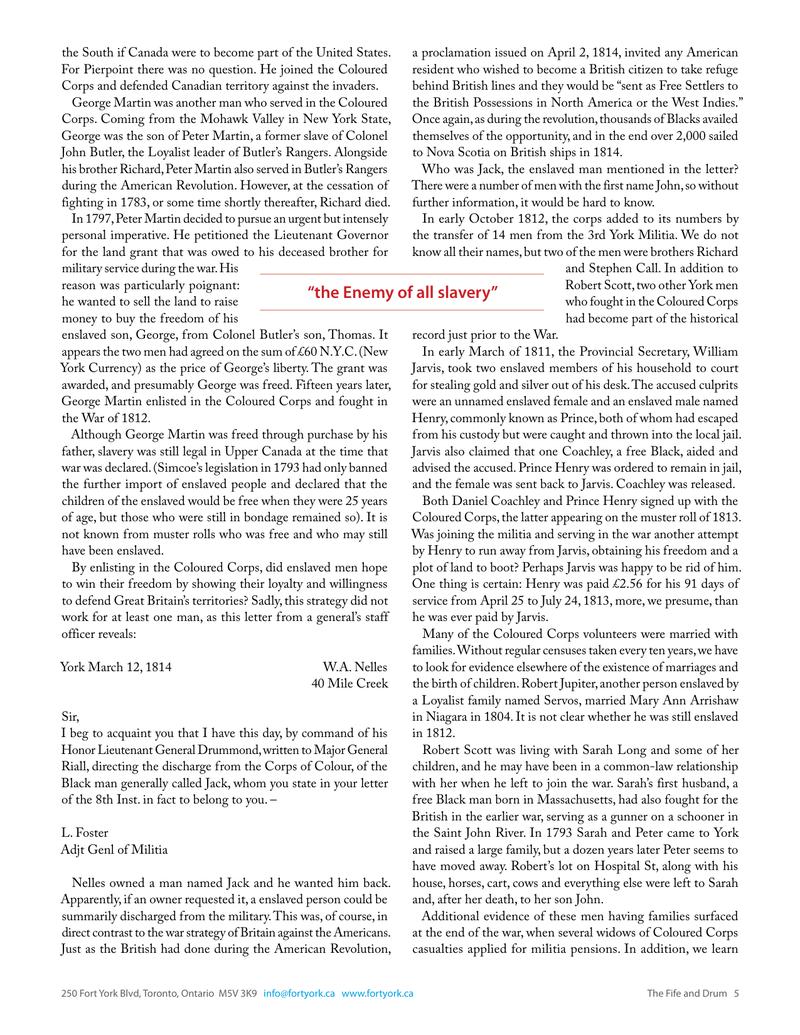
“the Enemy of all slavery”
In early October 1812, the corps added to its numbers by the transfer of 14 men from the 3rd York Militia. We do not know all their names, but two of the men were brothers Richard and Stephen Caul. In addition to Robert Scott, two other York men who fought in the Coloured Corps had become part of the historical record just prior to the War.
In early March of 1811, the Provincial Secretary, William Jarvis, took two enslaved members of his household to court for stealing gold and silver from his desk. The accused culprits were an unnamed enslaved female and an enslaved male named Henry, commonly known as Prince, both of whom had escaped from this custody but were caught and thrown into the local jail. Jarvis also claimed that one Coachley, a free Black, aided and advised the accused. Prince Henry was ordered to remain in jail, and the female was sent back to Jarvis. Coachley was released.
Both Daniel Coachley and Prince Henry signed up with the Coloured Corps, the latter appearing on the muster roll of 1813. Was joining the militia and serving in the war another attempt by Henry to run for freedom, obtaining his freedom and a plot of land to boot? Perhaps Jarvis was happy to be rid of him. One thing is certain: Henry was paid 42.56 for his 91 days of service from April 25 to July 24, 1813, more, we presume, than he was ever paid by Jarvis.
Many of the Coloured Corps volunteers were married with families. Without regular censuses taken every ten years, we have to look for evidence elsewhere of the existence of marriages and the birth of children. Robert Jupiter, another person enslaved by a Loyalist family named Servos, married Miry Ann Arrishaw in Niagara in 1804. It is not clear whether he was still enslaved in 1812.
Robert Scott was living with Sarah Long and some of her children, and he may have been in a common-law relationship with her when he left to join the war. Sarah’s first husband, a free Black man born in Massachusetts, had also fought for the British in the earlier war, serving as a gunner on a schooner in the Saint John River. In 1793 Sarah and Peter came to York and raised a large family, but a dozen years later Peter seems to have moved away. Robert’s lot on Hospital St, along with his house, horses, cart, cows and everything else were left to Sarah and, after her death, to her son John.
Additional evidence of these men having families surfaced at the end of the war, when several widows of Coloured Corps casualties applied for militia pensions. In addition, we learn that a number of Coloured Corps wives and children lived in the same encampment with their men, which was not unusual in period armies.
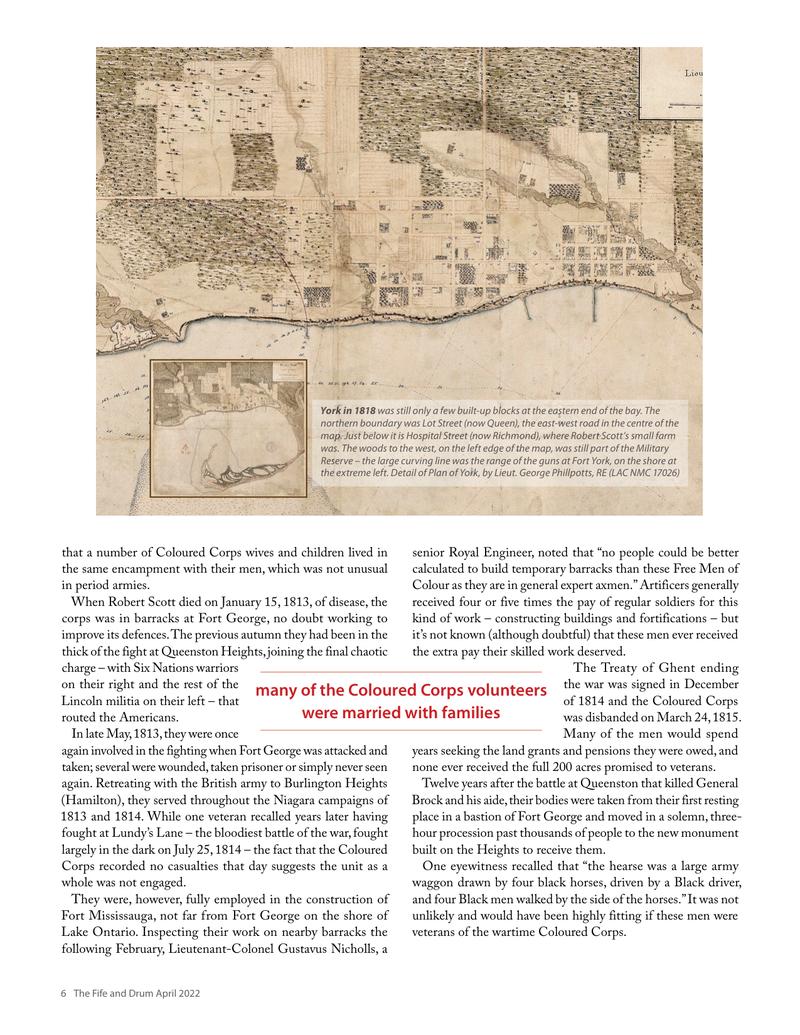
When Robert Scott died on January 15, 1813, of disease, the corps was in barracks at Fort George, no doubt working to improve its defences, the previous autumn having shed up the thick of the fight at Queenston Heights, joining the final chaotic charge – with Six Nations warriors on their right and the rest of the Lincoln militia on their left – that routed the Americans.
many of the Coloured Corps volunteers were married with families
In late May, 1813, they were once again involved in the fighting at Fort George was attacked and taken; several were wounded, taken prisoner or simply never seen again. Retreating with the British army to Burlington Heights (Hamilton), they served throughout the Niagara campaign of 1813 and 1814. While one veteran recalled years later having fought at Lundy’s Lane – the bloodiest of battles – they fought largely in the dark on July 25, 1814 – the fact that the Coloured Corps recorded no casualties that day suggests the unit as a whole was not engaged.
They were, however, fully employed in the construction of Fort Mississauga, not far from Fort George on the shore of Lake Ontario. Inspecting their work on nearby barracks the following February, Lieutenant-Colonel Gustavus Nicholls, a senior Royal Engineer, noted that “no people could be better calculated to build temporary barracks than these Free Men of Colour as they are in general expert axmen.” Artificers generally received three or five times the pay of regular soldiers for this kind of work – constructing buildings and fortifications – but it’s not known (although perhaps suspected) that these men ever received the extra pay their skilled work deserved.
The Treaty of Ghent ending the war was signed in December of 1814 and the Coloured Corps was disbanded on March 24, 1815.
Many of the men would spend years seeking the land grants and pensions they were owed, and none ever received the full 200 acres promised to veterans.
Twelve years after the battle at Queenston that killed General Brock and his aide, their bodies were taken from their first resting place in a bastion of Fort George and moved in a solemn, three-hour procession past thousands of people to the new monument built on the Heights to receive them.
One eyewitness recalled that “the hearse was a large army waggon drawn by four black horses, driven by a Black driver, and four Black men walked by the side of the horses.” It was not unlikely and would have been highly fitting if these men were veterans of the wartime Coloured Corps.
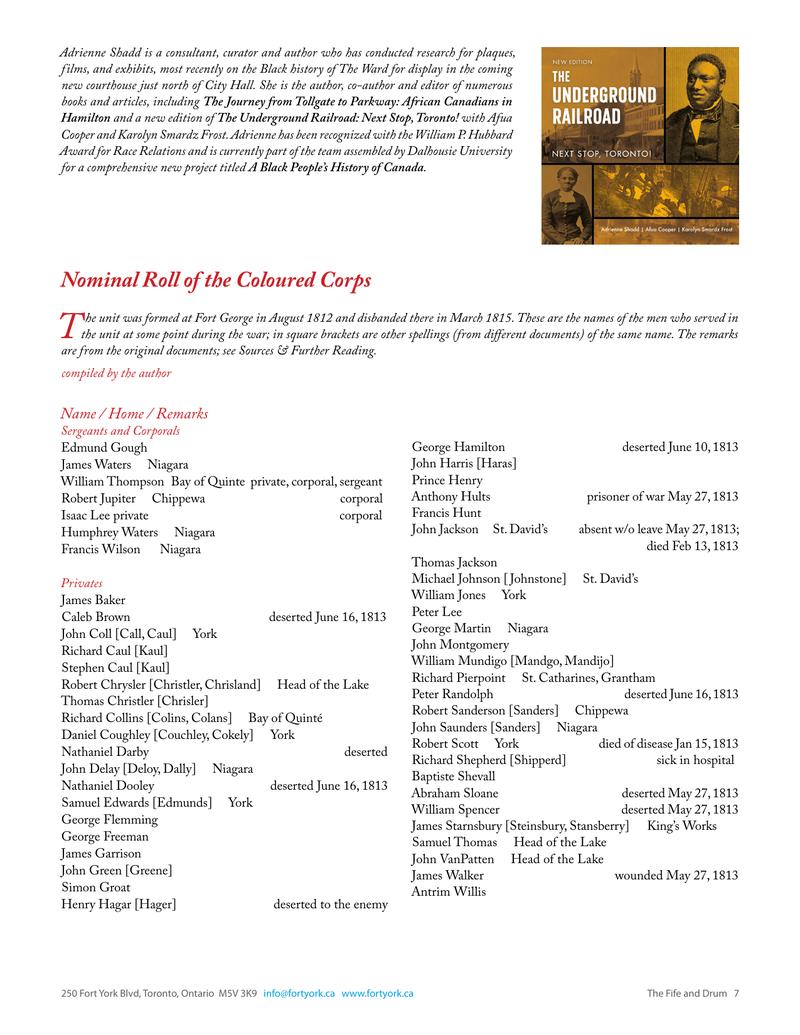
Nominal Roll of the Coloured Corps
The unit was formed at Fort George in August 1812 and disbanded there in March 1815. These are the names of the men who served in the unit at some point during the war; in square brackets are other spellings (from different documents) of the same name. The remarks are from the original documents; see Sources & Further Reading.
compiled by the author

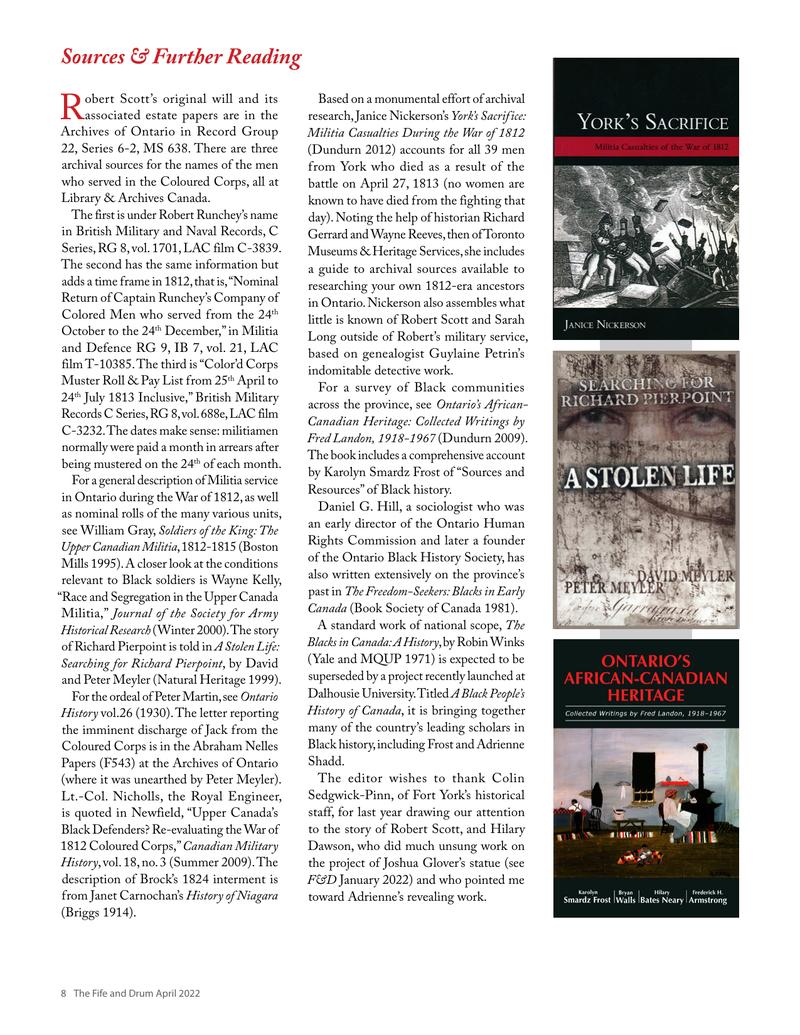
Sources & Further Reading
Robert Scott’s original will and its associated estate papers are in the Archives of Ontario in Record Group 22, Series 6-2, MS 638. There are three archival sources for the names of the men who served in the Coloured Corps at Library & Archives Canada.
The first is under Robert Runchey’s name in British Military and Naval Records, C Series, RG 8, vol. 1701, LAC film C-3839. The second has the same information but adds a time frame in 1812, that is, “Nominal Return of Captain Robert Runchey’s Company of Colored Men who served from the 24th October to the 24th December 1812” Militia and Defence RG 9, IB 7, vol. 21, LAC film T-10385. The third is “Color’d Corps Muster Roll for Pay Listed 25th April 24th July 1813 Inclusive,” British Military Records C Series, RG 8, vol. 686, LAC file C-3232. The dates make sense: militiamen normally were paid a month in arrears after being mustered on the 1st of each month.
For a general description of Militia service in Ontario during the War of 1812, as well as nominal rolls of the many various units, see William Gray, Soldiers of the King: The Upper Canadian Militia, 1812-1815 (Boston Mills 1995). A closer look at the conditions relevant to Black soldiers is in the article “Race and Segregation in the Upper Canada Militia,” Journal of the Society for Army Historical Research (Winter 2000). The story of Richard Pierpoint is told in A Stolen Life: Searching for Richard Pierpoint, by David Meyler and Peter Meyler (Natural Heritage 1999). The story of Peter Martin, see Ontario History vol.26 (1930). The letter reporting the imminent discharge of Jack from the Coloured Corps is in the Abraham Nelles Papers (F543) at the Archives of Ontario (where it was unearthed at LAC by author Lt.-Col. Nicholls, the Royal Engineer, is quoted in Newfield, “Upper Canada’s Black Defenders? Re-evaluating the War of 1812 Coloured Corps,” Canadian Military History, vol. 18, no. 3 (Summer 2009). The description of Brock’s 1824 interment is from Janet Carnochan’s History of Niagara (Briggs 1914).
Based on a monumental effort of archival research, Janice Nickerson’s York’s Sacrifice: Militia Casualties During the War of 1812 (Dundurn 2012) accounts for all 39 men from York who died as a result of the battle on April 27, 1813 (no women are known to have died from the fighting that day). Noting is in the help of historian Richard Gerrard and Wayne Reeves, then of Toronto Museums & Heritage Services, she includes a guide to many primary sources available to researching your own 1812-era ancestors in Ontario. Dickason also assembles what little is known of Robert Scott and Sarah Long outside of Robert’s military service, based on genealogist Guylaine Bennett’s indomitable detective work.
For a survey of Black communities across the province, see Ontario’s African-Canadian Heritage: Collected Writings by Fred Landon, 1918-1967 (Dundurn 2009). The book includes a comprehensive account by Karolyn Smardz Frost of “Sources and Resources” of Black history.
Daniel G. Hill, a sociologist who was an early director of the Ontario Human Rights Commission and later a founder of the Ontario Black History Society, has much written extensively on the subject past in The Freedom-Seekers: Blacks in Early Canada (Book Society of Canada 1981).
A standard work of national scope, The Blacks in Canada: A History, by Robin Winks (Yale and McGill 1971) is expected to be superseded by a project recently launched at Dalhousie University. Titled A Black People’s History of Canada, it is bringing together many of the country’s leading scholars in Black history, including Frost and Adrienne Shadd.
The editor wishes to thank Colin Sedgwick-Pinn, of Fort York’s historical staff, for last year drawing our attention to the story of Robert Scott; and Hilary Dawson, who did much unsung work on the project of Joshua Glover’s statue (see F&D January 2022) and who pointed me toward Adrienne’s revealing work.
Original printed pages