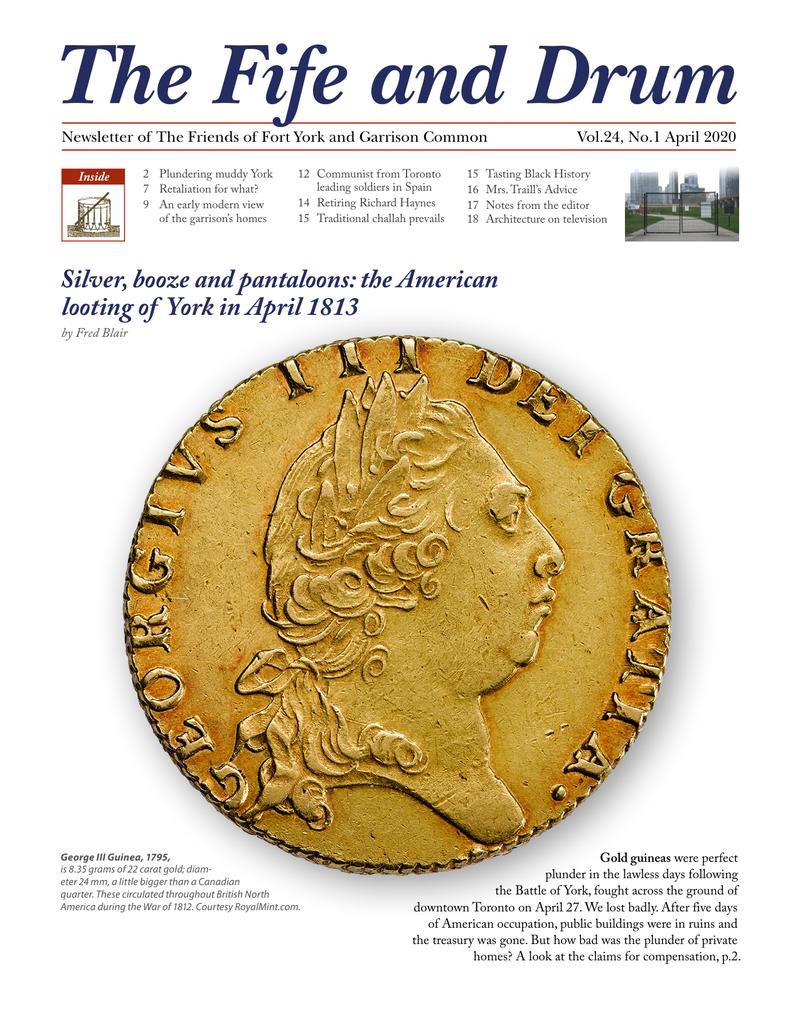
Gold guineas were perfect plunder in the lawless days following the Battle of York, fought across the ground of downtown Toronto on April 27. We lost badly. After five days of American occupation, public buildings were in ruins and the treasury was gone. But how bad was the plunder of private homes? A look at the claims for compensation, p.2.
Lieutenant Ely Playter, a farmer in the 3rd York Militia, wrote in his diary that he was just leaving the eastern gate of the fort when the great magazine “Blew up.” Although it killed more U.S. soldiers than the fighting itself, ending the Battle of York, the vast explosion left Ely stunned but otherwise unharmed. He watched Major-General Sheaffe march off toward Kingston and quickly helped set fire to the dockyard, where the unfinished 30-gun frigate Sir Isaac Brock was one of the reasons York was attacked. Then Ely and a few other militiamen, with their frightened families, made their way to his father’s farm a mile or so up the Don River.
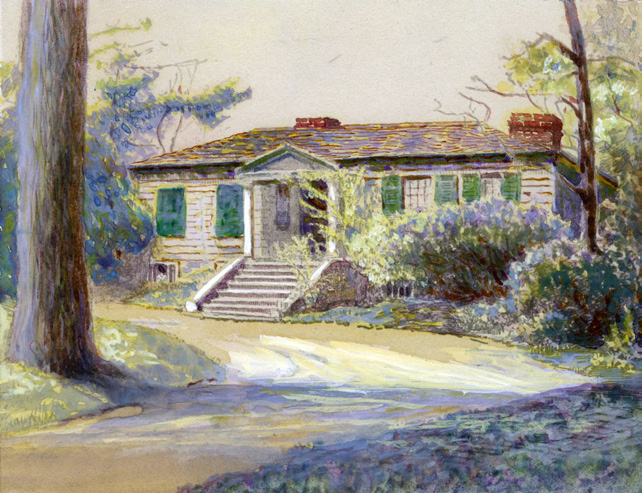
The next day a friend appeared at Ely’s nearby farm with a waggon (“hearing I was killed”) so he sent his wife and children with his friend north to safety in Newmarket.
It was two days after the battle that an American looting party “came to my House, Broke the door and took many things.” According to Ely’s later claim for losses, they made off with some cash and jewellery, his sword, clothing, and other items – including his regimental head-dress. He and his brother George watched from the woods until dark.
In the morning he finally went down to the ruined fort to surrender and, after visiting some wounded friends, went back to find the American commander. “I spoke to Genl. Dearborn of his Men Plundering my House,” recorded Ely. “He said it was contrary to his orders and he had station’d an officer in Town to prevent it.” They both knew that private property was given explicit protection in the terms of the town’s surrender. The general assured the aggrieved lieutenant that he’d look into the matter and have the miscreants punished.
there is no record of anyone being gravely assaulted
Major-General Dearborn, who issued few orders of any kind, had in fact done little to discourage the pillaging. Although the town of York was virtually lawless in those cool, rainy days at the end of April, there is no record of anyone being gravely assaulted. A few American officers took it upon themselves to prevent or discourage the pillaging. The buildings of the old garrison had been ruined by cannon fire and the explosion while the legislative building, the town blockhouse and several government warehouses – after they’d been emptied of trophies and useful stores – were soon reduced to ashes, by accident or design. But these were public buildings. How severe was the looting of private homes in the wake of the battle?
This is an examination of the claims filed by individuals for losses resulting from the capture of York. The claims are focused on goods that were “taken and Plundered by the enemy,” as many of them say. They reveal some interesting aspects of the American looting during the occupation and about the households of the town at the time. These claims for compensation open a small window into Upper Canadian social history.
During the War of 1812 and immediately after it, local military boards ruled on claims submitted for losses sustained as a result of the war. In 1815, Lieutenant Governor Gore appointed for this purpose an overarching commission which submitted a report the following year. No claims were actually paid out then, and it was estimated that the cost of covering them all would have been three times the provincial income. A new commission was appointed in 1823, with more satisfactory results.
In 2012 Library & Archives Canada published digital microfilm records that included 23 reels from the War Loss Claims commissions. The documents recorded on microfilm include the original claims, records of the board’s proceedings, various schedules and registers, and vouchers for the eventual payments.
Claims were categorized according to the cause of the loss. The boards recognized four causes: damage or loss caused by His Majesty’s troops, allied warriors, or the enemy; and damage or loss sustained while providing transport or supplies to the forces. A total of 2,055 claims were presented for compensation. There was a board for each type of claim and some people had to make two or more claims to different boards.
Included in this total were 130 claims that were paid in March, 1813, only a month before the battle. There were problems with the army’s accounting system at the beginning of the war and a number of Upper Canadians were not initially paid for their service in the militia, for providing accommodations or transport,
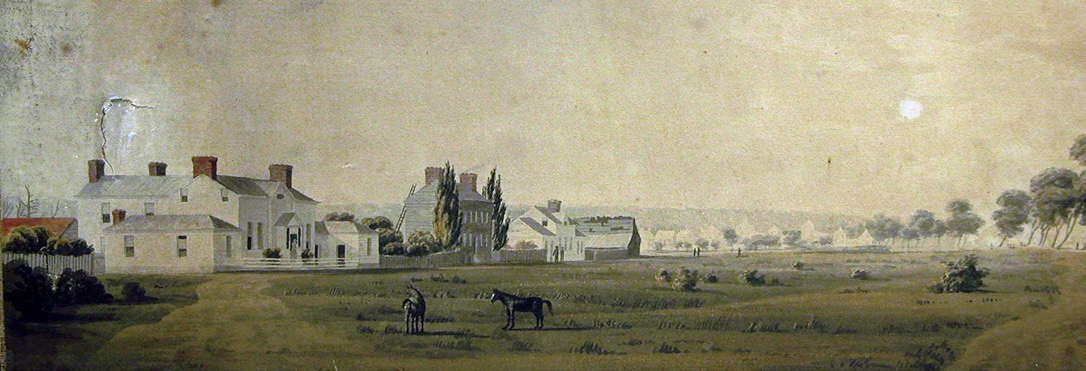
for wood cutting, and for deliveries of food, firewood, candles and other supplies.
One important cause of loss was not considered by the commission: looting by the residents themselves. Some of these thieves were the “disaffected” – residents who were highly critical of the local government and openly supportive of the republican cause. Others were merely criminal opportunists (the victors had emptied the jail). Still others were happy to cart home supplies distributed by American officials at the wharves, where more public stores had piled up than the already crowded fleet could carry. There was so much that the Reverend John Strachan, the young Anglican who seemed to be everywhere that day, was given 50 barrels of flour to distribute to the poor. While he went to find a waggon, most of these barrels disappeared.
every house they found deserted was completely sacked
Many of the criminals and the disaffected were dealt with harshly by the justice system in subsequent months. York being a small town of some 700 souls, a few of these people were well known to their neighbours.
Claimants had to report the date and place of their loss, who was responsible, a description of the stolen items and their value (with proof when available) and a certification that the claim was “just and true,” preferably by a witness to the event. They did not have to give a detailed account of their experience with the looters.
But we have enough stories from a handful of claims, letters, diaries and other sources to construct a good sense of what went on in the days after the battle. “It appears that as soon as the last responsible American officer left the town,” writes historian Robert Malcolmson, “the prowlers went to work.” According to one such observer – the sheriff’s wife – “every house they found deserted was completely sacked.”
I looked at 24 claims for compensation related to the occupation of York from the day of the battle (Tuesday the 27th) until the following Sunday (May 2nd) when the Americans were all back aboard their ships. This is most, if not all, of the claims filed by citizens whose property at York was pillaged; a few other claims with absent or ambiguous dates or locations might have been included, but these 24 well represent the Upper Canadians.
The only other individual losses not counted here are the possessions of the officers of British regiments that retreated on April 27. Each was compensated (by the army, not the treasury of Upper Canada) typically for “three fourths of his personal baggage.” Sheaffe’s own valuable personal effects – including a dress coatee with gold embroidery and a splendid musical snuff box – were seized and taken to Dearborn. They were later auctioned off at an American port.
Of the 24 claims examined, four were rejected. Patrick Strange, an assistant barrack master at the York garrison, claimed for a list of items including all his lost clothing. Strange was also, however, a sergeant on the rolls of the Glengarry Regiment of Light Infantry Fencibles – a British regiment, not militia – so his claim was rejected as inadmissible. Jacob Clock of York Township claimed he had lost five cows and two calves to allied warriors. The board’s investigation found instead that “he had sold his cattle to the enemy.”
Joshua Leach, a carpenter working for the navy, claimed for the loss of a chest of tools. Evidence was presented that he was known to have had those tools in his possession after the occupation and that “he had amply remunerated himself by the share he took of the supplies plundered of public stores left by the enemy.” Joseph Kendrick lost his schooner, the Governor Hunter, that was aground near the shore and burnt by the Americans. He claimed it was worth £650. It was noted, however, that he had received £300 compensation (in stolen British army bills) from General Dearborn, which the commissioners deemed a fair value.
The remaining 20 claims were almost all the result of looting by ill-disciplined American soldiers. Thomas James Plucknett, the superintendent of the dockyard that was building the Brock, was the one exception. The fire that Ely Playter had helped to set also consumed Plucknett’s own clothing and household items, a claim initially rejected as unsupported (widely regarded as officious and none-too-bright, Plucknett had few friends).
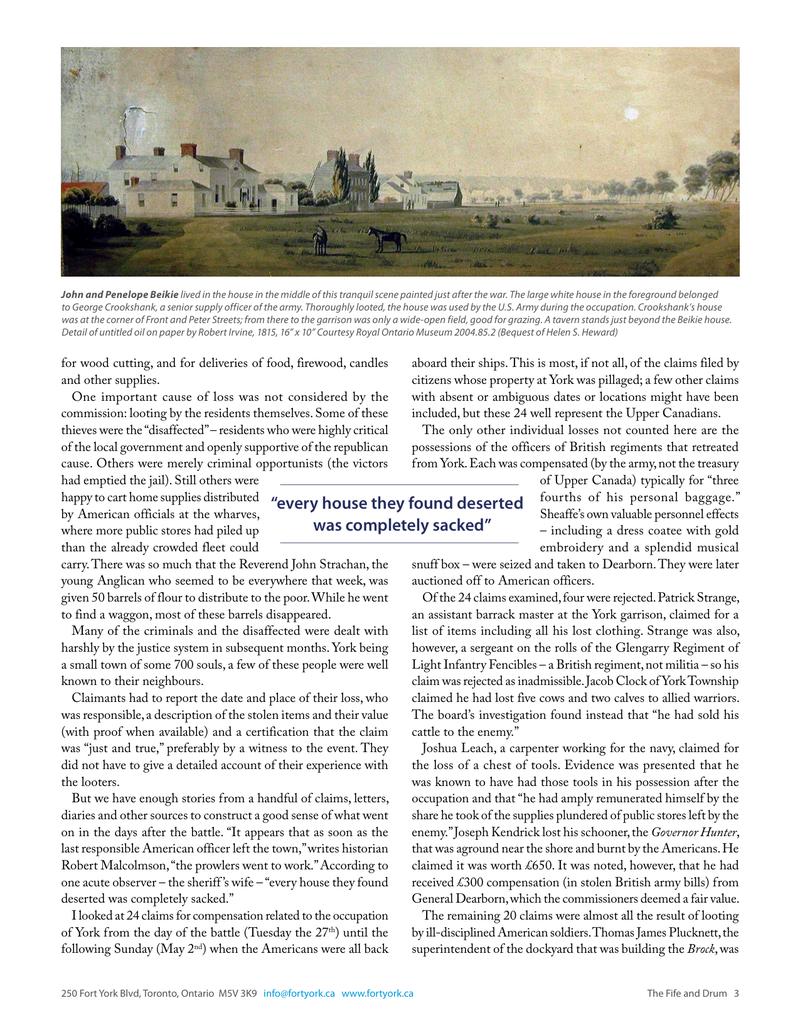
Sheriff John Beikie, like many other men in the town, was briefly a prisoner on the afternoon of the battle. His wife, Penelope, searched for her husband and son and made sure they were safe before returning to their home, which was within sight of the ruined garrison. She managed to preserve most of the family’s possessions by standing guard in the doorway with a broom. “Will you believe it?” she wrote to her brother, “I had the temerity to frighten, and even to threaten, some of the enemy.”
Some American soldiers later helped guard the Beikie house and Major William Swan, a senior member of Dearborn’s staff, stayed with the family one night to ensure their safety. He was among the various Americans commended by citizens of York (including Sheriff Beikie) for helping to guard their private property. And some U.S. troops gave supplies to the destitute families left behind when the British regiments left for Kingston.
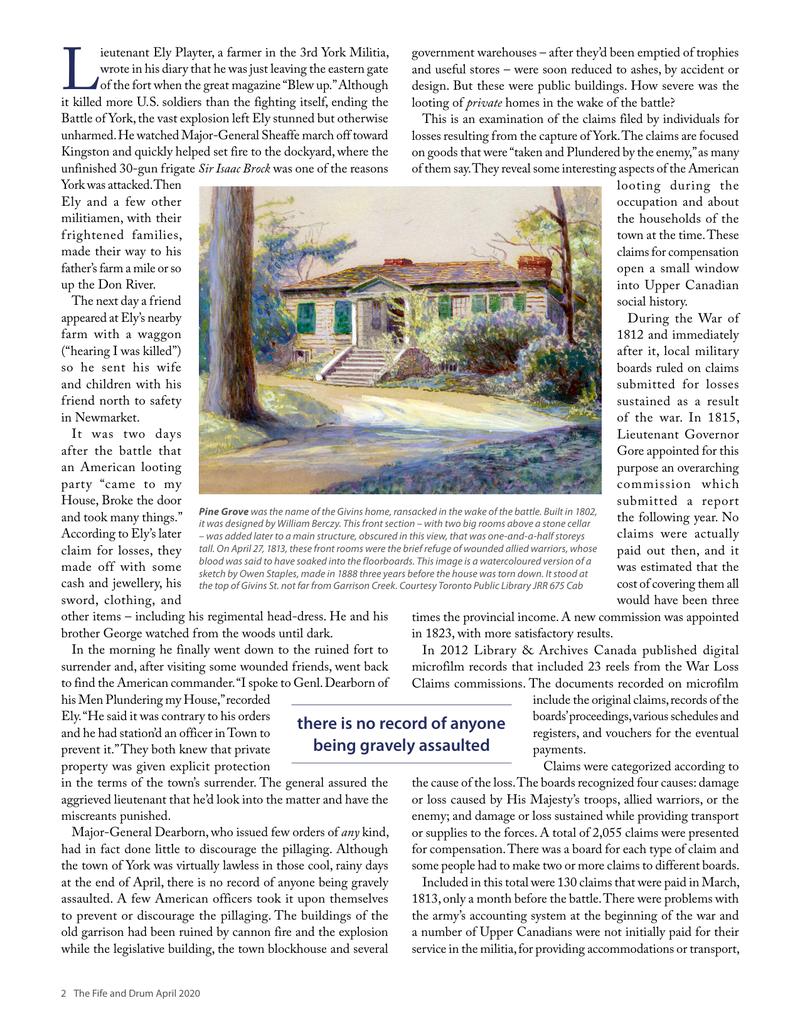
Major James Givins, who was Sheaffe’s liaison officer to the warriors, was far away from his home when the looting began. A party of Americans drove his wife from the house and ransacked her life. Angelique was found “in great Distress” by William Dummer Powell, a prominent citizen and friend of Sheaffe’s. They soon encountered the guilty Americans.
“One of them was apprehended in my Presence who had returned loaded with Plunder,” he wrote in support of the Givins claim, “& from whom a Silver Cup & Mirror was taken by the Guard.” He accompanied Angelique to report the incident to Dearborn. The general told her (according to Powell) “that it was not in his Power to protect her in her own House” on the edge of the woods, and that she should take shelter with someone in town.
Reverend Strachan also saw the Americans with some of the Givins’s possessions and, the following Saturday, he and Angelique went to Dearborn. The American commander said there was little he could do for anyone associated with the warriors, and Strachan later suggested – in his endorsement of the Givins claim – that “Major Givins as belonging to the Indian department was particularly exposed to the ‘depredations of the Enemy.'” The family’s two claims amounted to more than £388, including £50 for repairs to the house. Among the articles lost were carpets, curtains, tablecloths, silverware, books, wine, furniture, all their clothes (they had seven children), an English saddle and one “Childs Coat with Dimity Curtains.”

Grant Powell (William’s son) was a local surgeon with the Provincial Marine who also left with Sheaffe’s column. His wife, Elizabeth, had fled north with their servant and young daughter and did not return home until the following year. His home, at the corner of Front and George, was also in the sights of the pantry, an American soldier eating pieces of sugar. Bessy Walters, the family’s servant, berated the man – but it soon transpired that he was from a farm owned by Elizabeth’s own father, a prominent citizen of New York City!
They set about exchanging the news of mutual acquaintances and, although it had already been pillaged, the Powell home was secure for the rest of the occupation. After the Americans left, Sheriff Beikie rescued a few of the family’s possessions from Upper Canadian looters, but the Powells still claimed for the loss of household goods, clothing, food, and liquor.
The 20 legitimate claims for compensation that were examined were submitted by a variety of people:
Major William Allan, 3rd York Militia, leading merchant, deputy commander of the regiment;
Elizabeth Andrews, of York;
John S. Baldwin, a merchant of Niagara with goods in York;
Private Henry Brown, 3rd York Militia, a messenger for the government;
Private Thomas Deary, 3rd York Militia, a merchant in York;
Major James Givins, Superintendent, Indian Department;
Joseph Grenette, a naval artificer;
Patrick Hartney, Barrack Master at fort, badly wounded;
James Hinton, a carpenter in York;
John Hunter, messenger for the Legislative Assembly who lived in an adjacent house;
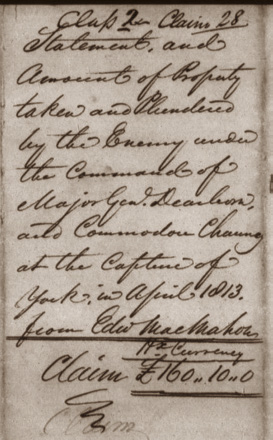
Lieutenant Edward MacMahon, 3rd York Militia, military secretary to Major-General Sheaffe;
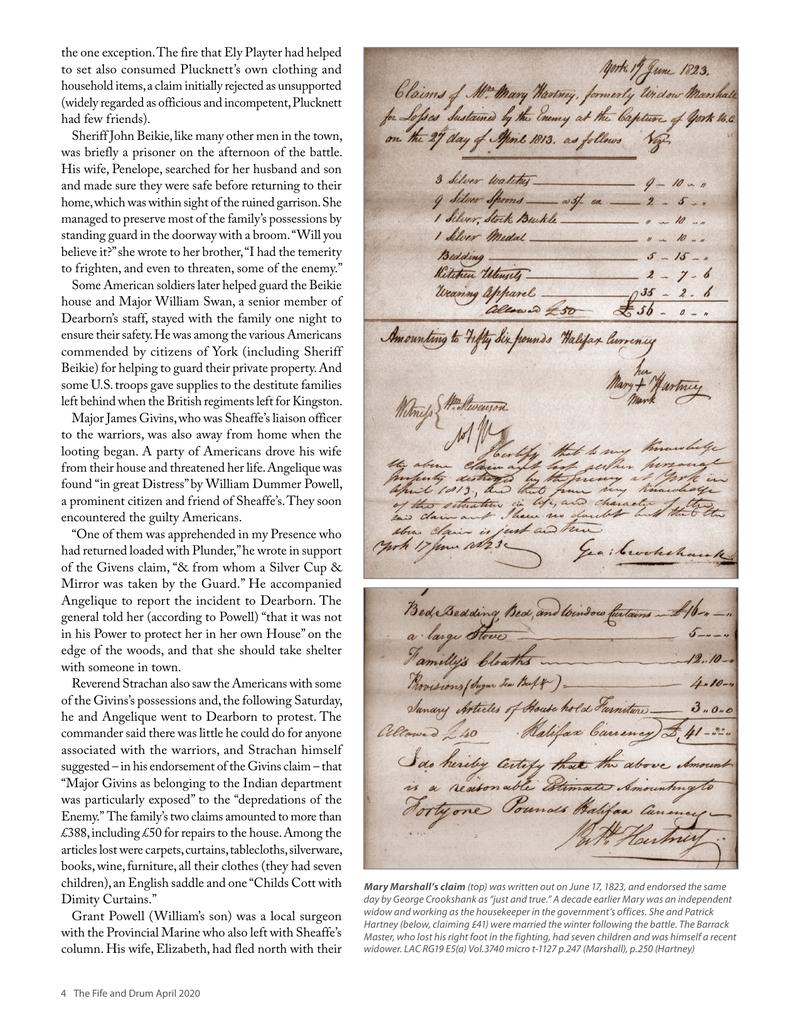
Mary Marshall, a housekeeper in Elmsley House;
Ensign Edward McArthur, 3rd York Militia, a merchant in York;
Joseph Nadeaux, of Lower Canada with baggage in York;
Lieutenant Ely Playter, 3rd York Militia, a farmer;
Thomas James Plucknett, the Superintendent of Artificers for the Quarter Master General’s Office and the Provincial Marine;
Surgeon Grant Powell, Provincial Marine;
Quetton St. George, a leading merchant of York;
Private William Shaw, 3rd York Militia (son of Major-General Shaws);
John Small, of York.
Of the two women who claimed for losses on their own, one – Mary Marshall – was well known at Elmsley House, rented as office space by the provincial government. Her claim was endorsed by no less than George Crookshank, a senior supply officer for the army and one of the claims commissioners.
The other woman – Elizabeth Andrews – may have been the mother of Angelique Givins (whose maiden name was Andrews). An Elizabeth Andrews was the widow of Captain James Andrews, a senior sailor on the Great Lakes when his new command HMS Ontario was lost in a storm in 1780. Elizabeth and her daughters, including one Angelique, later made successful land claims in Newark (that is, in Niagara-on-the-Lake). Elizabeth claimed for her “entire wearing apparel and some heirloom silver,” all modestly valued at £25.
Comparing these claims to one another can be a problem. Like Joseph Kendrick’s claim for his schooner, the values cited were sometimes inflated. Other claims, like those from Patrick Strange and Thomas Plucknett, included little detail of individual items. As a basis of comparison, then, the items listed were sorted into ten categories of goods. The ten categories, with the number of claims made for each category, are:
Clothing 13
Money & valuables 12
Household items 11
Beds & bedding 9
Food 8
Wine & spirits 6
Books 4
Arms & munitions 3
Damages to a house 1
Bulk tobacco 1
The end of April that year was cool and rainy and no doubt some of the stolen men’s clothing went into immediate use. Women’s and children’s clothing was presumably taken home by the soldiers for their own families or for sale. Clothing was not only the most common category claimed, it also represents the largest number of individual items stolen. Some claimants lost entire chests full of wearing apparel.
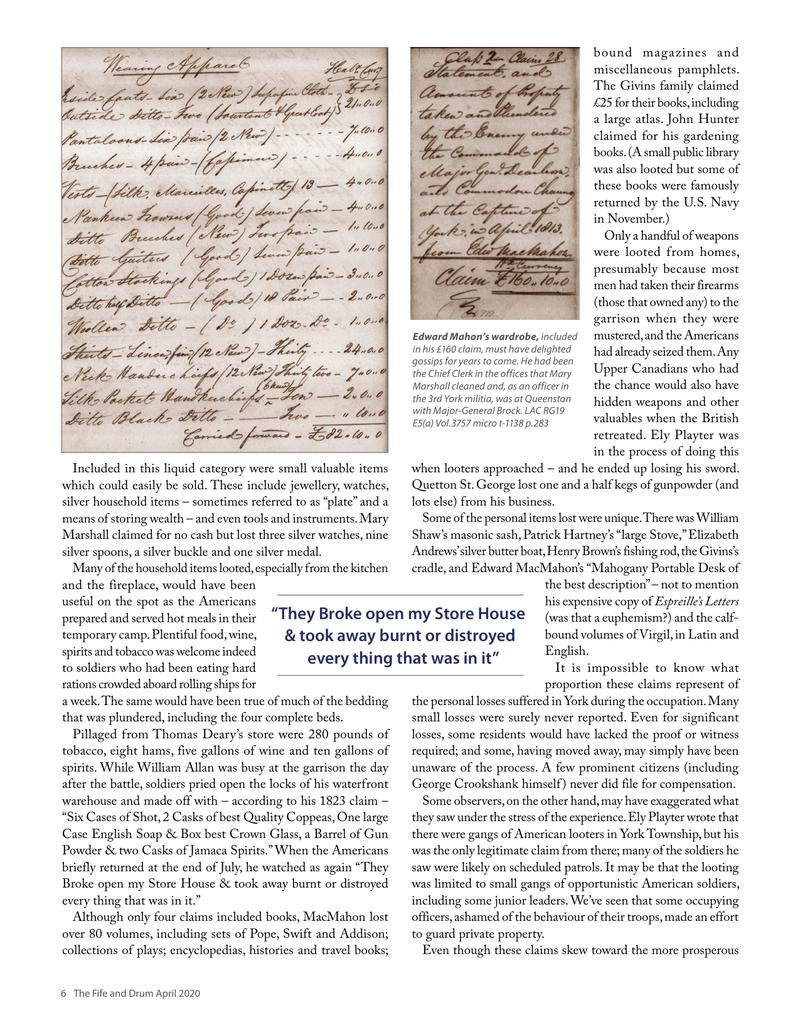
Edward McMahon – who had been the Chief Clerk of the government’s offices and was living at Government House as Sheaffe’s military secretary – presented an itemized list of more than 180 articles of clothing, including 44 handkerchiefs, 30 fine linen shirts and six “pantaloons.” Mary Marshall and James Givins, on Angelique’s behalf, more modestly claimed undefined “wearing apparel.” Mary wanted a little over £35 for hers; for the wardrobe of Angelique and her seven children, an even £100 was sought.
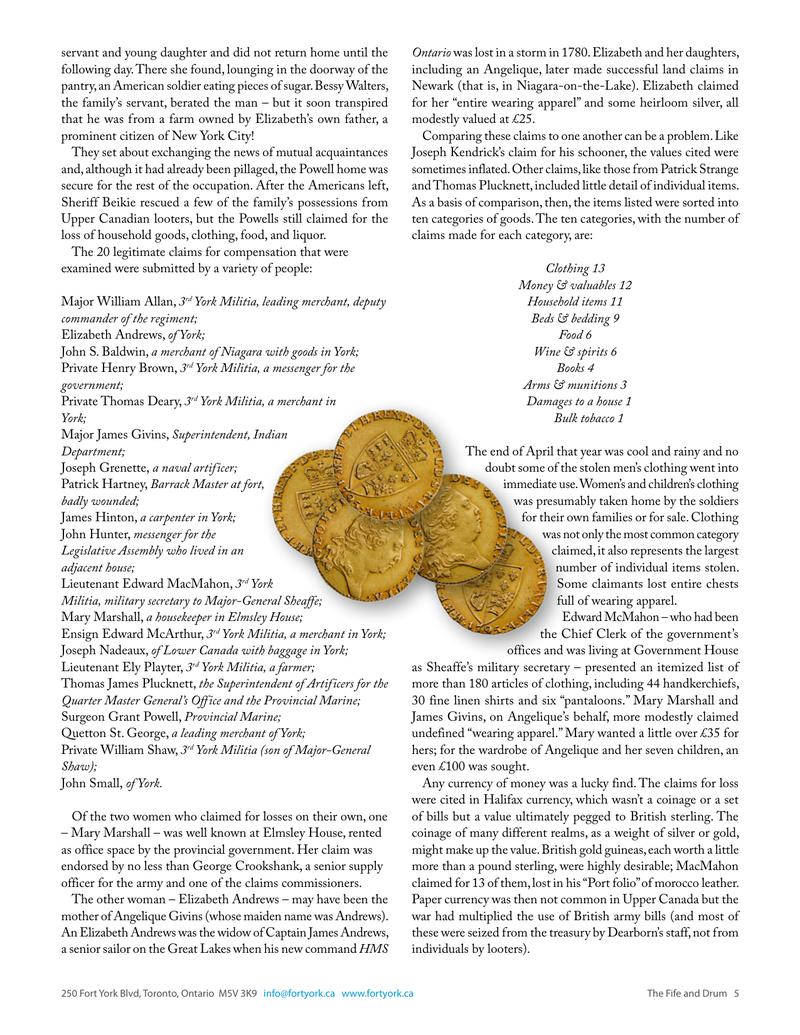
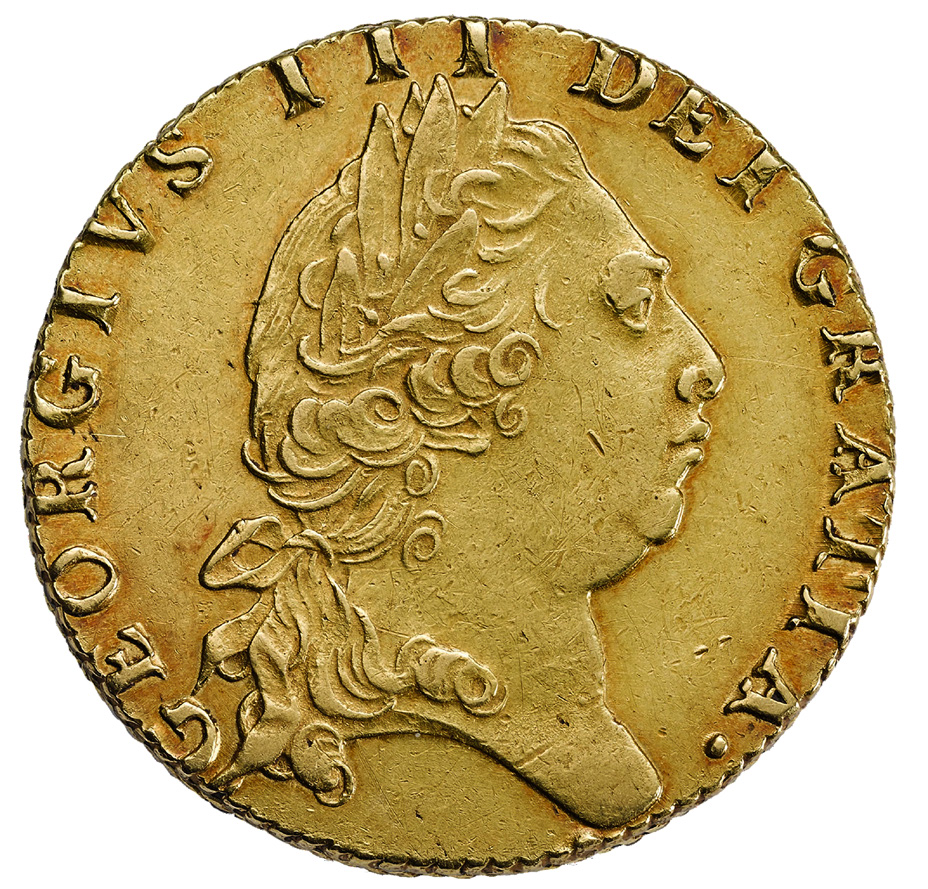
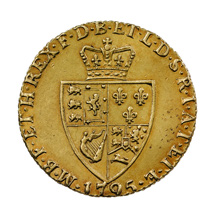
Any currency of money was a lucky find. The claims for loss were cited in Halifax currency, which wasn’t a coinage or a set of bills but a value ultimately pegged to British sterling. The coinage of many different colonies, as a weight of silver or gold, might make up the value. British gold guineas, each worth a little more than a pound sterling, were highly desirable; MacMahon claimed for 13 of them, lost in his “Port Folio” of morocco leather. Paper currency was then not common in Upper Canada but the war had multiplied the use of British army bills (and most of these were seized from the treasury by Dearborn’s staff, not from individuals by looters).

Included in this liquid category were small valuable items which could easily be sold. These include jewellery, watches, silver household items – sometimes referred to as “plate” and a means of storing wealth – and cash and instruments. Mary Marshall claimed for no cash but lost three silver watches, nine silver spoons, a silver buckle and one metal cup.
Many of the household items looted, especially from the kitchen and the fireplace, would have been useful on the army and one of the claims commissioners.
“They Broke open my Store House & took away burnt or distroyed every thing that was in it”
Included in this liquid category were small valuable items which could easily be sold. These include jewellery, watches, silver household items – sometimes referred to as “plate” and a means of storing wealth – and cash and instruments. Mary Marshall claimed for no cash but lost three silver watches, nine silver spoons, a silver buckle and one metal.
Many of the household items looted, especially from the kitchen and the fireplace, would have been useful on the army and one of the claimants remembered they were “prepared and served hot meals in their temporary camp. Plentiful food, wine, spirits and tobacco was welcome indeed to soldiers who had been eating hard rations crowded aboard rolling ships for a week. The same would have been true of much of the bedding that was plundered, including the four complete beds.
Pillaged from Thomas Deary’s store were 280 pounds of tobacco, eight hams, five gallons of wine and ten gallons of spirits. While William Allan was busy at the garrison the day after the battle, soldiers pried open the locks of his waterfront warehouse and made off with – according to his 1823 claim – “Six Cases of Shot, 2 Casks of best Quality Coppeas, One large Case English Soap & Box best Crown Glass, a Barrel of Gun Powder & two Casks of Jamaica Spirits.” When the Americans briefly returned at the end of July, he watched as again “They Broke open my Store House & took away burnt or distroyed every thing that was in it.”
Although only four claims included books, MacMahon lost over 80 volumes, including sets of Pope, Swift and Addison; collections of plays, encyclopedias, histories and travel books; bound magazines and miscellaneous pamphlets. The Givins family claimed £25 for their books, including a large atlas. John Hunter claimed for his gardening books. (A small public library was also looted but some of these books were famously returned by the U.S. Navy in November.)
Only a handful of weapons were looted from homes, presumably because most men had taken their firearms (those that owned any) to the garrison when they were mustered, and the Americans had already seized them. Any Upper Canadians who had the chance would also have hidden weapons and other valuables when the British retreated. Ely Playter was in the process of doing this when looters approached – and he ended up losing his sword. Quetton St. George lost one and a half kegs of gunpowder (and lots else) from his business.
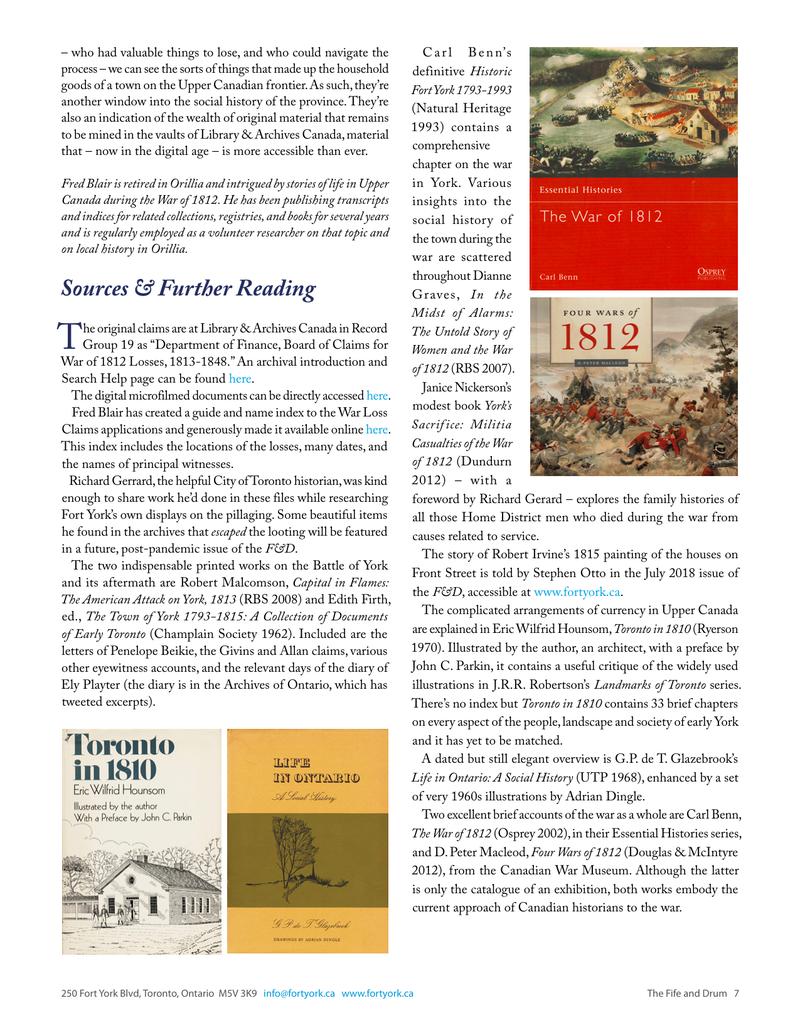
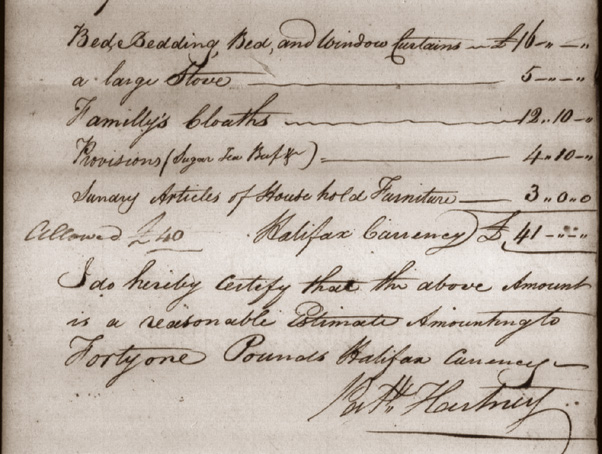
Some of the personal items lost were unique. There was William Shaw’s masonic sash, Patrick Hartney’s “large Stove,” Elizabeth Andrew’s silver teapot, Henry Brown’s fishing rod, the Givins’s cradle, and Edward MacMahon’s “Mahogany Portable Desk of the best description” – not to mention his expensive copy of Espriella’s Letters (was that a euphemism?) and the calf-bound volumes of Virgil, in Latin and English.
It is impossible to know what proportion these claims represent of the personal losses suffered in York during the occupation. Many small losses were surely never reported. Even for significant losses, some residents would have lacked the proof or witness required; and some, having moved away, may simply have been unaware of the process. A few prominent citizens (including George Crookshank himself) never did file for compensation.
Some observers, on the other hand, may have exaggerated what they saw under the stress of the experience. Ely Playter wrote that there were gangs of American looters in York Township, but his was the only legitimate claim from there; many of the soldiers he saw were likely on scheduled patrols. It may be that the looting was limited to small gangs of opportunistic American soldiers, including some junior leaders. We’ve seen that some occupying officers, ashamed of the behaviour of their troops, made an effort to guard private property.
Even though these claims skew toward the more prosperous
Original printed pages