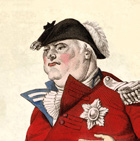
The Garrison Reserve, known also as the Garrison Common, was set aside in 1793 for defensive purposes by Governor John Graves Simcoe. It included everything south of Queen Street from Jarvis Street in the east to midway between Jameson and Dowling avenues in the west. Soon it was obvious that too much land had been reserved, and Simcoe’s successors released some of it for private development. In 1797 and 1799 Hon. Peter Russell approved enlargements to the town plot for York that moved its limits west from Jarvis to Peter Street. Then, just before war broke out in 1812, Major General Isaac Brock, acting as Administrator of the Province, granted almost 350 acres at the west end of the Reserve (the part beyond present-day Dufferin Street) to James Brock, his Secretary and first cousin. In 1821 the latter sold from his holdings a 50-acre parcel flanked by present day Jameson Avenue; later that decade Joseph Spragge built a home there he called “Springhurst.” Following Brock’s death, his widow sold the rest of his holdings south of Queen in 1833 to John Henry Dunn and Dr. William C. Gwynne who also built villas. These estates remained relatively intact until the 1870s, when much subdivision took place west of Dufferin, incorporated in 1878 as the village of Parkdale. In 1889 the City annexed Parkdale.
Here is how the streets in the area got their names.
Close Alexander J. Close, a Toronto real estate and insurance broker, and Patrick G. Close, a wholesale grocer and sometime alderman for the St. Lawrence Ward, were major real estate developers in the Parkdale area in the latter 1870s.
Cowan This street formed the east side of the Dunn Estate when it was subdivided in 1875 and 1877 by P. G. and A. J. Close respectively. This street may have been named by the Closes after a relative or friend.
Dufferin The west boundary of the City before the annexation of Parkdale. About 1877-78 it was named for Frederick Temple Blackwood, the first Marquess of Dufferin and Ava, governor-general of Canada from 1872-78.
Dunn See Cowan above. Dunn Avenue ran down the centre of the subdivision of the Dunn Estate. It recalled both Col. Alexander Roberts Dunn (1833-1868), who won Canada’s first Victoria Cross for valour in the charge of the Light Brigade at Balaclava, and his father, Hon. John Henry Dunn (1792-1854), at one time Receiver General for Upper Canada.
Elm Grove Originally Greig. Renamed ‘Elm Grove’ for the house of Dr. William Charles Gwynne (1806-1875) built in 1836 facing Queen St. to designs by J. G. Howard. After Gwynne’s demise his daughter, Eliza Anne Gwynne, made it her home until she died in 1910. It was demolished in 1917.
Fort Rouillé In the 1750s the French built a trading fort on Lake Ontario and named it for Antoine-Louis Rouillé, minister of Marine and Colonies. In the 1880s a three-block long street named for the fort was opened from near where it had stood on the lake north to Huxley, now Springhurst. This stub of a street is all that remains of it after the CNE spread west of Dufferin, and the Gardiner was built.
Gwynne Dr. William C. Gwynne owned 200 acres on the west side of Dufferin St., south of Queen.
Jameson Robert Sympson Jameson (1796-1854) came here in 1833 as attorney-general for Upper Canada but was later appointed vice-chancellor of the Court of Chancery and a Legislative Councillor. In 1845 he purchased part of ‘Springhurst,’ Joseph Spragge’s estate south of Queen St., and had John G. Howard prepare a plan of subdivision for it.
King Laid out by Gov. Simcoe in 1793 as one of Toronto’s first streets and named in honour of the sovereign, George III
Melbourne Probably for William Lamb, second Viscount Melbourne (1779-1848), who was in and out of office as Prime Minister of Great Britain several times between 1834-41 and was a favourite of Queen Victoria
Spencer Named in honour of Herbert Spencer (1820-1903), the great social philosopher, by Eliza Anne Gwynne and Patrick Close when they subdivided a part of the Gwynne Estate in 1877.
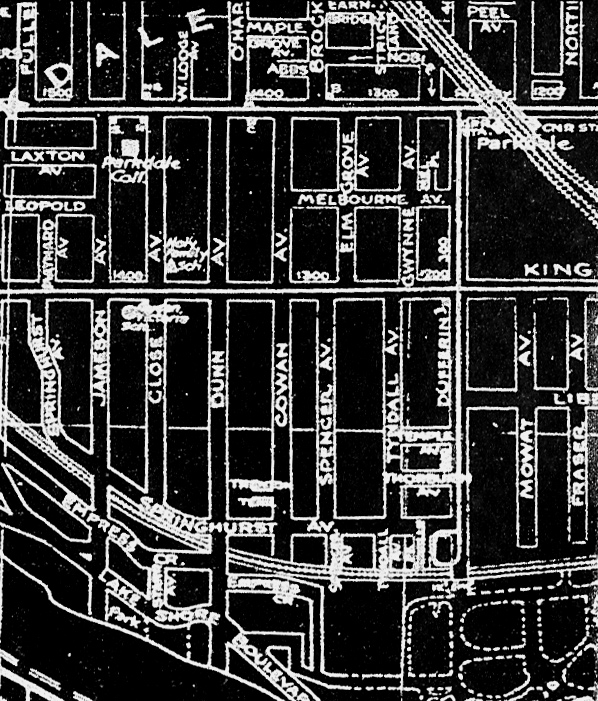
Springhurst Originally called Huxley by Eliza Anne Gwynne and Patrick Close to honour the natural scientist, Thomas Huxley (1825-95), it ran only two blocks from Dufferin to Spencer. In 1889, when Huxley was extended west to join up with William, the first street west of Jameson, both names were changed to ‘Springhurst’ after the former Spragge estate, named in recognition of the area’s numerous springs.
Temple After Eliza Anne Gwynne died in 1910, her executors, Dr. Algernon Temple and David Symons, K.C., subdivided the rest of the lands surrounding ‘Elm Grove,’ her family home. Each executor got to pick a name for one street created thus: Dr. Temple chose his family name, while Mr. Symons saw fit to honour his mother, Isabel Thorburn.
Thorburn See Temple above.
Trenton Terr Changed from Coatsworth Avenue in 1889, following Parkdale’s annexation by the City of Toronto, because a Coatsworth Avenue already existed elsewhere. But why the name Trenton was chosen is not known.
Tyndall Named in honour of John Tyndall (1820-93), the natural philosopher, by Eliza Anne Gwynne and Patrick Close when they subdivided a part of the Gwynne Estate in 1877.
Until circa 1904 in the area south of the rail corridor where the lakeshore park, CNE buildings, parking lots and the Gardiner are found now, streets with the following names existed: Iroquois St. (later Dominion Ave.), Lorne Ave., Lorne Court, Mississauga St., Rose Ave. and Victoria Crescent. They are now distant memories.
Original printed pages