From 1794 until 1863 today’s Victoria Memorial Square, just east of Fort York, was the cemetery for the garrison. In the latter year it was deemed full and new burials were begun at a location closer to Strachan Avenue.
The original site was effectively abandoned, suffering some twenty years of neglect until 1884 when its scandalous condition caused the city to establish a Military Burial Ground Commission to record the surviving monuments and restore the dignity of the place. The headstones were arranged in a “terrace” along the western edge of the area and the cemetery thereafter functioned as a public park. John Ross Robertson commissioned a local artist to prepare a sketch of the scene for his series of articles on Toronto history that became the six-volume Landmarks of Toronto.
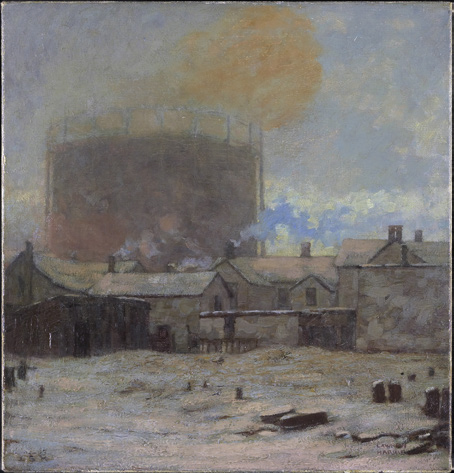
Harris’s painting shows a corner of Victoria Square looking west to Bathurst Street. A gas holder looms in the background. For a century until Toronto was supplied with natural gas from western Canada, gas for industrial use, heating, and light was manufactured from Ohio coal. The problem of storing it ahead of customers’ needs was solved by gas holders: ingenious steel structures within frames that rose and fell as gas was pumped into them and drawn off.
The square remained in the public consciousness and in 1907 the sculpture of The Old Soldier by Walter Allward (later famous for his Vimy Memorial) was installed in the centre of the park. It had been commissioned by the Army and Navy Veterans’ Association as a tribute to the War of 1812 dead.
The condition of Victoria Square, however, can be imagined from Katharine Hale’s 1919 description of how to find the sculpture, namely in “a slum of Toronto, a shabby little park or baseball ground called Portland Park.”
This is how it appears as a previously unidentified image in a painting of 1911-1912 by Lawren Harris entitled The Gas Works. The view is looking southwest from the edge of the monument fence towards the gas holders that stood on the west side of Bathurst Street where Front Street ends, the same structures that are seen from the south in J.E.H. MacDonald’s contemporaneous painting Tracks and Traffic, 1911-12. A close examination of the Goad’s Fire Insurance Atlas of the period led me to conclude that only one open space in the vicinity of any gas holders in the inner city would present this view: Victoria Memorial Square. I found further evidence in the painting to confirm that Victoria Square was its setting by spotting what all others had missed–the “terrace” of surviving headstones lined up against the fence in the middle distance.
Today the square is the central feature of a thriving new neighbourhood named Wellington Place which has emerged over the past twenty years as a result of the city opening up the King-Spadina area to mixed use development.
Original printed pages