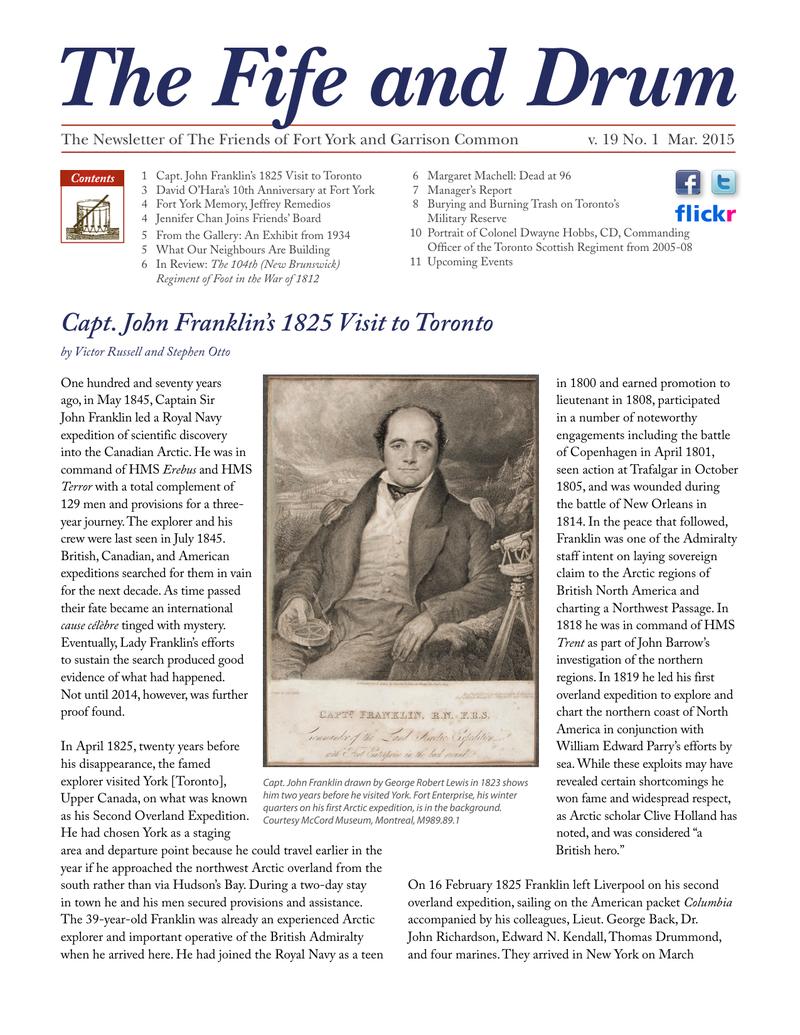
One hundred and seventy years ago, in May 1845, Captain Sir John Franklin led a Royal Navy expedition of scientific discovery into the Canadian Arctic. He was in command of HMS Erebus and HMS Terror with a total complement of 129 men and provisions for a three-year journey. The explorer and his crew were last seen in July 1845. British, Canadian, and American expeditions searched for them in vain for the next decade. As time passed their fate became an international cause célèbre tinged with mystery. Eventually, Lady Franklin’s efforts to sustain the search produced good evidence of what had happened. Not until 2014, however, was further proof found.

In April 1825, twenty years before his disappearance, the famed explorer visited York [Toronto], Upper Canada, on what was known as his Second Overland Expedition. He had chosen York as a staging area and departure point because he could travel earlier in the year if he approached the northwest Arctic overland from the south rather than via Hudson’s Bay. During a two-day stay in town he and his men secured provisions and assistance. The 39-year-old Franklin was already an experienced Arctic explorer and important operative of the British Admiralty when he arrived here. He had joined the Royal Navy as a teen in 1800 and earned promotion to lieutenant in 1808, participated in a number of noteworthy engagements including the battle of Copenhagen in April 1801, seen action at Trafalgar in October 1805, and was wounded during the battle of New Orleans in 1814. In the peace that followed, Franklin was one of the Admiralty staff intent on laying sovereign claim to the Arctic regions of British North America and charting a Northwest Passage. In 1818 he was in command of HMS Trent as part of John Barrow’s investigation of the northern regions. In 1819 he led his first overland expedition to explore and chart the northern coast of North America in conjunction with William Edward Parry’s efforts by sea. While these exploits may have revealed certain shortcomings he won fame and widespread respect, as Arctic scholar Clive Holland has noted, and was considered “a British hero.”
On 16 February 1825 Franklin left Liverpool on his second overland expedition, sailing on the American packet Columbia accompanied by his colleagues, Lieut. George Back, Dr. John Richardson, Edward N. Kendall, Thomas Drummond, and four marines. They arrived in New York on March 15 and remained there for eight days. Continuing on to Albany they were wined and dined by New York Governor De Witt Clinton and, interestingly, by the Hon. Stephen Van Rensselaer, a former lieutenant governor of New York and sitting US congressman. Van Rensselaer commanded American forces that had invaded Canada in 1812 but were defeated at the battle of Queenston Heights by Major General Sir Isaac Brock.
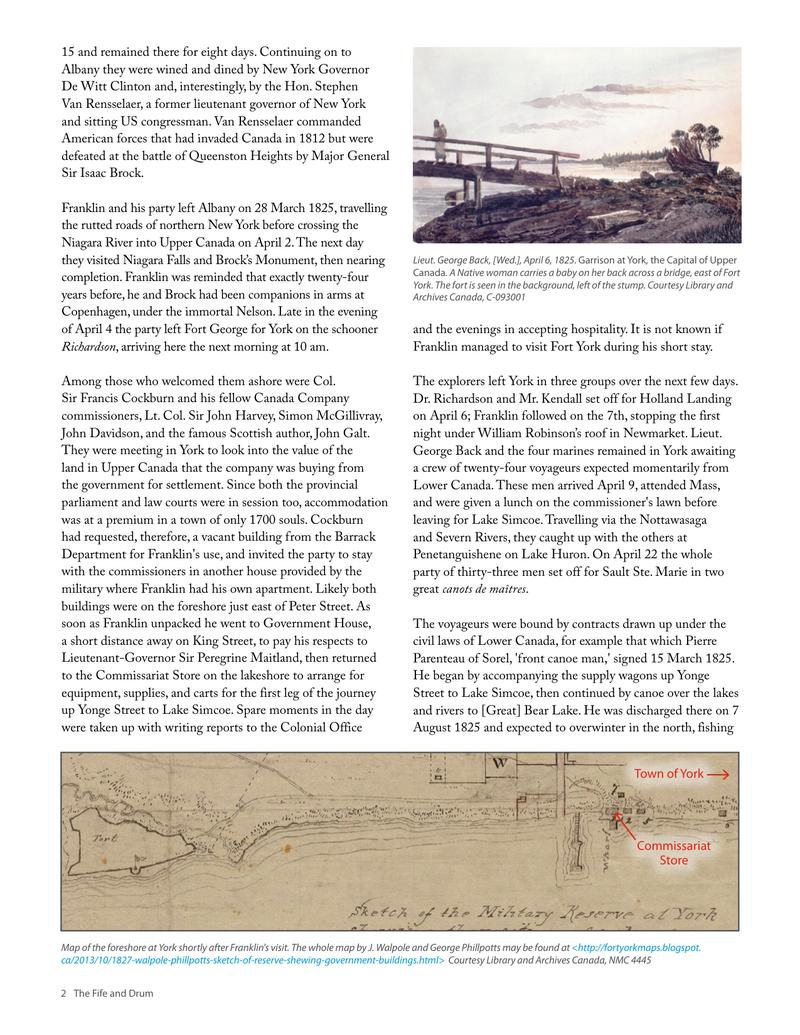
Franklin and his party left Albany on 28 March 1825, travelling the rutted roads of northern New York before crossing the Niagara River into Upper Canada on April 2. The next day they visited Niagara Falls and Brock’s Monument, then nearing completion. Franklin was reminded that exactly twenty-four years before, he and Brock had been companions in arms at Copenhagen, under the immortal Nelson. Late in the evening of April 4 the party left Fort George for York on the schooner Richardson, arriving here the next morning at 10 am.

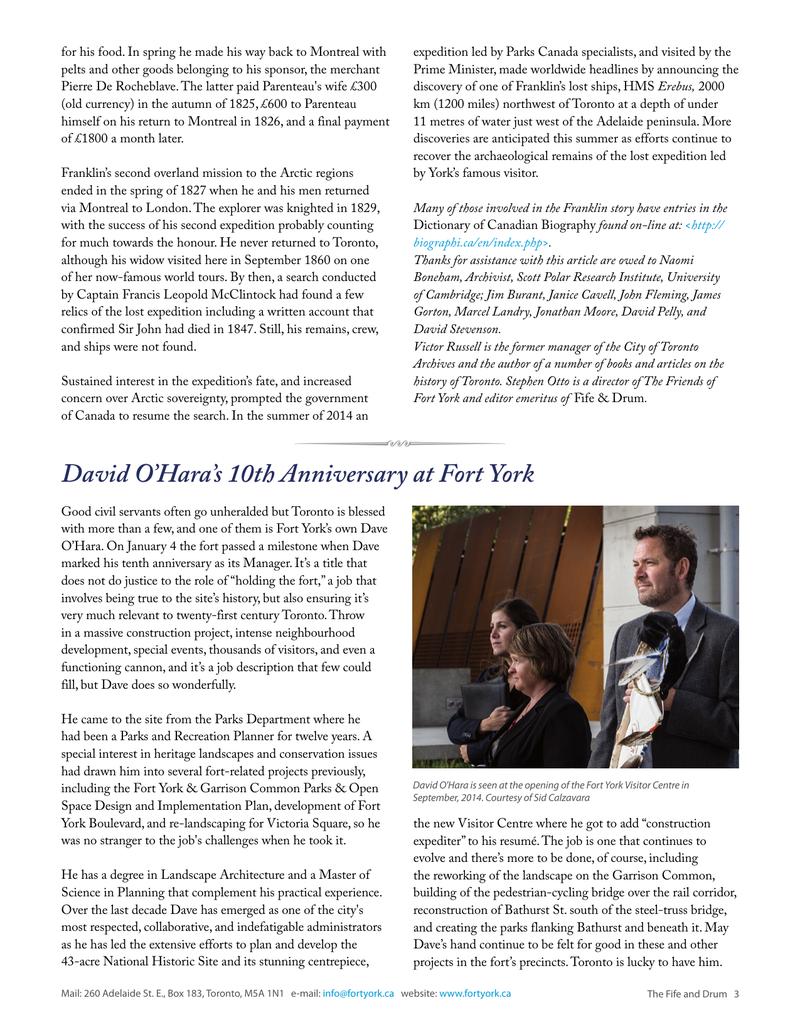
Among those who welcomed them ashore were Col. Sir Francis Cockburn and his fellow Canada Company commissioners, Lt. Col. Sir John Harvey, Simon McGillivray, John Davidson, and the famous Scottish author, John Galt. They were meeting in York to look into the value of the land in Upper Canada that the company was buying from the government for settlement. Since both the provincial parliament and law courts were in session too, accommodation was at a premium in a town of only 1700 souls. Cockburn had requested, therefore, a vacant building from the Barrack Department for Franklin’s use, and invited the party to stay with the commissioners in another house provided by the military where Franklin had his own apartment. Likely both buildings were on the foreshore just east of Peter Street. As soon as Franklin unpacked he went to Government House, a short distance away on King Street, to pay his respects to Lieutenant-Governor Sir Peregrine Maitland, then returned to the Commissariat Store on the lakeshore to arrange for equipment, supplies, and carts for the first leg of the journey up Yonge Street to Lake Simcoe. Spare moments in the day were taken up with writing reports to the Colonial Office and the evenings in accepting hospitality. It is not known if Franklin managed to visit Fort York during his short stay.
The explorers left York in three groups over the next few days. Dr. Richardson and Mr. Kendall set off for Holland Landing on April 6; Franklin followed on the 7th, stopping the first night under William Robinson’s roof in Newmarket. Lieut. George Back and the four marines remained in York awaiting a crew of twenty-four voyageurs expected momentarily from Lower Canada. These men arrived April 9, attended Mass, and were given a lunch on the commissioner’s lawn before leaving for Lake Simcoe. Travelling via the Nottawasaga and Severn Rivers, they caught up with the others at Penetanguishene on Lake Huron. On April 22 the whole party of thirty-three men set off for Sault Ste. Marie in two great canots de maîtres.

The voyageurs were bound by contracts drawn up under the civil laws of Lower Canada, for example that which Pierre Parenteau of Sorel, ‘front canoe man,’ signed 15 March 1825. He began by accompanying the supply wagons up Yonge Street to Lake Simcoe, then continued by canoe over the lakes and rivers to [Great] Bear Lake. He was discharged there on 7 August 1825 and expected to overwinter in the north, fishing for his food. In spring he made his way back to Montreal with pelts and other goods belonging to his sponsor, the merchant Pierre De Rocheblave. The latter paid Parenteau’s wife £300 (old currency) in the autumn of 1825, £600 to Parenteau himself on his return to Montreal in 1826, and a final payment of £1800 a month later.
Franklin’s second overland mission to the Arctic regions ended in the spring of 1827 when he and his men returned via Montreal to London. The explorer was knighted in 1829, with the success of his second expedition probably counting for much towards the honour. He never returned to Toronto, although his widow visited here in September 1860 on one of her now-famous world tours. By then, a search conducted by Captain Francis Leopold McClintock had found a few relics of the lost expedition including a written account that confirmed Sir John had died in 1847. Still, his remains, crew, and ships were not found.
Sustained interest in the expedition’s fate, and increased concern over Arctic sovereignty, prompted the government of Canada to resume the search. In the summer of 2014 an expedition led by Parks Canada specialists, and visited by the Prime Minister, made worldwide headlines by announcing the discovery of one of Franklin’s lost ships, HMS Erebus, 2000 km (1200 miles) northwest of Toronto at a depth of under 11 metres of water just west of the Adelaide peninsula. More discoveries are anticipated this summer as efforts continue to recover the archaeological remains of the lost expedition led by York’s famous visitor.
Many of those involved in the Franklin story have entries in the Dictionary of Canadian Biography found on-line at: <http://biographi.ca/en/index.php>.
Thanks for assistance with this article are owed to Naomi Beauchêne, Archivist, Scott Polar Research Institute, University of Cambridge; Jim Burant, Janice Cavell, John Fleming, James Gorton, Marcel Landry, Jonathan Moore, David Pelfy, and David Stevenson.
Original printed pages