Reconstruction of the garrison well house, in the summer of 2007, required the dismantling of the 1957 stone well head, which had for so long been a lamentably anachronistic feature of Historic Fort York. Minor excavation of the soil around the well was required for the installation of the floor structure in order to allow the finished floor to be set at ground level. No more than ten inches of soil needed to be removed below existing grade, all of which was presumed to have already been disturbed during the excavation of the well when it was discovered and excavated in 1956 – and also during construction of the stone well head the following year. However, in the course of the 2007 excavation, the tops of flat stones were unexpectedly encountered, just at the limit of its lowest depth. These appeared to have been deliberately laid there.
After careful investigation, these stones proved to be to the distinct upper surface of a partial foundation wall. An expanded search soon revealed the presence of four mortared rubble-stone corner footings surrounding the well, which had once supported at least one historic well house. The top surface of the stone footings occurs at the top level of a stratigraphic layer clearly identified as dating to the 1830s period. The fact that the footings had been laid of coarse rubble-stone suggests an earlier, rather than later date of construction. In the earliest days of York, such stones were frequently collected for building construction from the beach along Lake Ontario. The footings were documented and left undisturbed for future investigation.
The finding presents some intriguing possibilities as to the construction of this well, the date of which has yet to be conclusively determined. The fact that the well house footings are not oriented in parallel with the south face of the 1815 Stone Magazine – and bear no apparent relationship to any of the surviving buildings – raises interesting interpretive questions. Is it possible that the footings had been laid relative to far earlier structures?
Unfortunately, minor outbuildings and structures such as Privies, Root Houses, and wells, etc., rarely appeared on Royal Engineer garrison plans, most surveyors being chiefly interested in illustrating the primary buildings, and features directly related to defence. Even today such structures remain overlooked by architectural historians, which is unfortunate because – as it’s sometimes said – “Small doors often lead into large rooms.” This metaphor seems particularly apt in respect to the well at Fort York, and especially so in consideration of several surviving military documents. These offer strong circumstantial evidence to suggest that the well had been sunk far earlier than anyone has yet considered. In fact, the documents imply that this humble stone-lined hole in the ground today not only represents one of the earliest features at Fort York, but arguably one of the oldest surviving structures in Toronto, and can be counted amongst the earliest surviving British military structures in Ontario. (Second only, perhaps, to the 1796 Magazine at Fort George.)
Approximately 60 feet to the east of the well once stood the rear walls of the two wings of Government House, built between 1800 and 1802 as the vice-regal residence of the second lieutenant governor of Upper Canada, Lieutenant-General Peter Hunter. The building also served as the residence of Hunter’s civil successor, Sir Francis Gore, and provincial administrators Sir Isaac Brock and Sir Roger Hale Sheaffe. Government House was substantially damaged as a result of the explosion of the Grand Magazine on 27 April 1813, and was subsequently looted by the occupying American troops. It was one of the public buildings ordered burned by General Henry Dearborn upon the departure of the U.S. Army on May 1. Remains of the building were discovered by archaeologists Donald Brown, Catherine Webb, and David Spittal during monitoring for various service line installations across the central Parade Ground in the late 1980s/early 1990s. Remains of the charred wooden floor and stone foundations were discovered and, amongst the many early small finds, were several pewter Queen’s Rangers soldiers’ buttons. Unfortunately, excavations on this important structure were limited due to the usual fiscal constraints, and no further investigation has since been carried out.
The wood-frame vice-regal residence was erected upon the Military Reserve, just west of the garrison, amid the crumbling remnants of Simcoe’s 1793 garrison, and on the site of the modern Fort York Parade Ground. It was built to present an imposing presence near the edge of the embankment of the Lake and must have commanded impressive views of it. From the outset, however, the project was plagued with difficulty. Heavy and prolonged spring rains had delayed the excavation of the cellars and the laying of the stone foundation. This had forced Captain Robert Pilkington, of the Royal Engineer Department, to procure extra tradesmen. Pilkington kept Lt. General Hunter apprised of his progress – and the mounting cost overruns – through regular correspondence with Major James Green, Hunter’s military secretary. Through Major Green, Hunter had evidently made his desire for “every convenience” clear to Pilkington. One of these conveniences had been a large fenced garden – located on the site of the 1815 Brick Officers’ Barrack – and, evidently, a rather substantial stone well behind his residence.
Several years ago, David Spittal located the first documentary evidence of a well having been sunk at Government House by July 1802. In the Archives of Ontario he found the pay lists for the civil and military artificers and labourers employed on the various Public Works at the garrison. One of the works on which some had been engaged was “Sinking and Walling up a Well and Erecting a Shade over it.” This well was later mentioned in two surviving letters by Captain Æneas Shaw of the Queen’s Rangers, and CO of the Garrison at York. With Hunter away at Quebec, Shaw had been posting letters to the Lt. General via Green. In the first letter, dated at York on 2 August 1802, Shaw mentions difficulties with the newly-completed well:
There are still doubts respecting the Quality of the Water in the Well at the General’s Quarters. Lime and Salt have been put in it and after remaining a due time to disolve [sic] the Water has been emptied out, but enough has not yet made in it, to say what has been the effect. If the Water is still found unpalatable I shall direct it to be emptied once or twice more, before the General returns.
Sunk to the underlying bedrock – at a depth of 24 feet – the water it produced was quite brackish. The following month, Shaw’s letter to Green, dated 1 September, included an update on the well: “I am happy to be able to say that the Quality of the Water in the General’s Well is greatly improved since last emptied.”
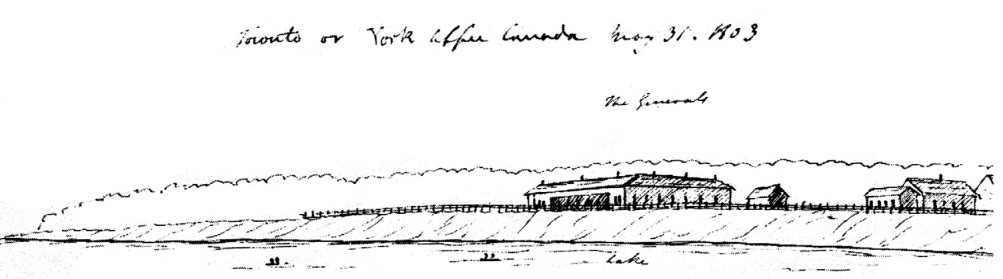
The Fort York well is certainly exceptional amongst those found at any other British military site in Ontario, due to its sheer size – indeed it is described in later correspondence as “the Great Well at the Garrison.” Having an external diameter of ten feet, with limestone “steining” two feet thick, it represents a significant engineering effort when one considers that it was excavated and walled up entirely by hand. The sinking of wells was simply not a priority at British military posts, most of which were built on the shores of some body of fresh water or other. At the expense of fire safety, the army seemed quite content to keep its men occupied in hauling water from nearby lakes and rivers. Fort George, for example, did not have its first well sunk until 1807, eight years after the establishment of that garrison.
Having been below ground, and of such substantial construction, the “General’s Well” could easily have survived the concussion from the explosion of the nearby Grand Magazine. Built into important structural abutment of the lakeshore, the principal force of the blast from the Magazine would have been directed upward and outward into the lake. When the garrison was reconstructed on the site of Government House, beginning in the wake of 1813, it would simply have made sense to incorporate this useful, extant feature into the new works, especially given the dire shortage of both civil and military artificers and the fact that, by necessity, the new defences were built in great haste, in anticipation of further attack.
Though definitive proof remains elusive, in all probability the Fort York well is indeed “the General’s.” If so, one of the earliest surviving structures in Toronto, one of the few surviving features dating to the Battle of York, and the only visible reminder of one of the most important public buildings of early Upper Canada, has remained hidden in plain sight for over 50 years.

Original printed pages