The following is a severe compression of a longer article, entitled “Why the White House Was Burned: An Investigation into the British Destruction of Public Buildings at Washington in August 1814,” published in the Journal of Military History, vol. 76, no. 4 (October 2012). Readers interested in the subject are advised to consult that source.
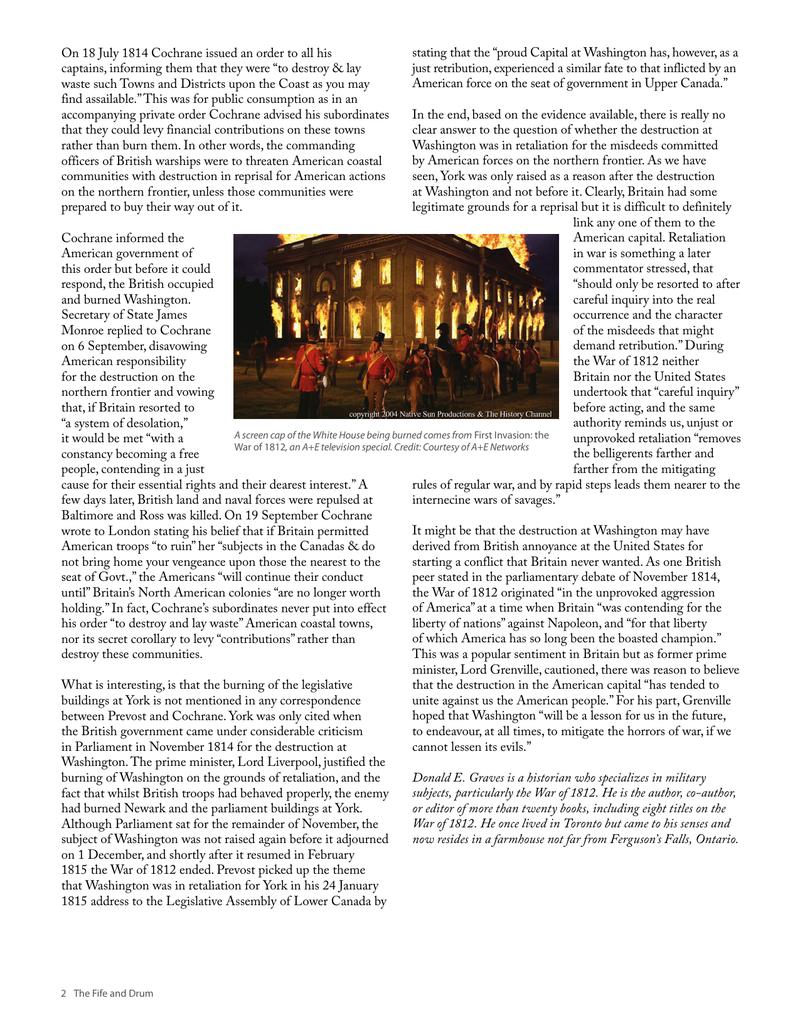
In the evening of Wednesday, 24 August 1814, a British army under Major General Robert Ross entered Washington. During the next 24 hours it burned the Capitol, White House, Treasury, War and State Departments, and completed the destruction of the Navy Yard already begun by the defenders.

Ross apparently believed that he was retaliating for the American “burning of the British capital in Canada”—a reference to the destruction of the legislative buildings at York in 1813. At the time York was under American occupation and the torching of these structures was an unofficial, lawless act by an individual or individuals. Interestingly enough, in the months that followed, this act is not mentioned in the official correspondence of Sir George Prevost, the governor general, nor is retribution mentioned in any official document relating to the occupation of York. Many historians feel that the destruction at Washington was an act of retaliation but are split on the reason: Americans tend to believe it was retribution for York, while Canadians feel it was done to avenge American destruction of other localities in Canada.
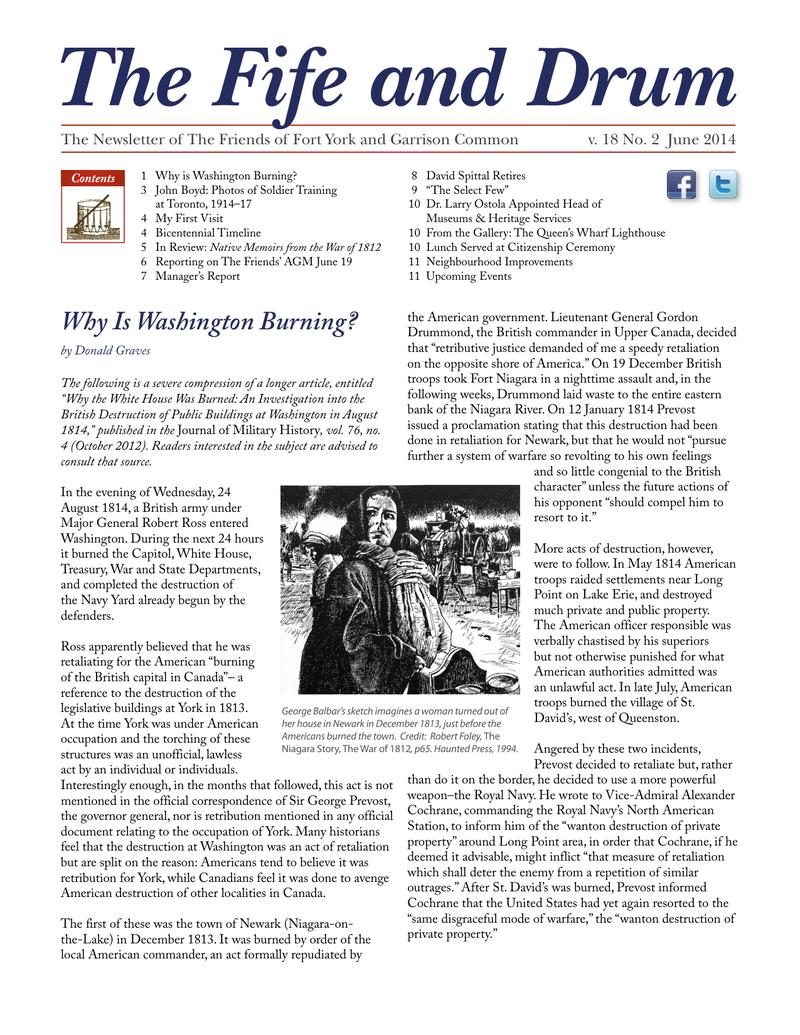
The first of these was the town of Newark (Niagara-on-the-Lake) in December 1813. It was burned by order of the local American commander, an act formally repudiated by the American government. Lieutenant General Gordon Drummond, the British commander in Upper Canada, decided that “retributive justice demanded of me a speedy retaliation on the opposite shore of America.” On 19 December British troops took Fort Niagara in a nighttime assault and, in the following weeks, Drummond laid waste to the entire eastern bank of the Niagara River. On 12 January 1814 Prevost issued a proclamation stating that this destruction had been done in retaliation for Newark, but that he would not “pursue further a system of warfare so revolting to his own feelings and so little congenial to the British character” unless the future actions of his opponent “should compel him to resort to it.”
More acts of destruction, however, were to follow. In May 1814 American troops raided settlements near Long Point on Lake Erie, and destroyed much private and public property. The American officer responsible was verbally chastised by his superiors but not otherwise punished for what American authorities admitted was an unlawful act. In late July, American troops burned the village of St. David’s, west of Queenston.
Angered by these two incidents, Prevost decided to retaliate but, rather than do it on the border, he decided to use a more powerful weapon—the Royal Navy. He wrote to Vice-Admiral Alexander Cochrane, commanding the Royal Navy’s North American Station, to inform him of the “wanton destruction of private property” around Long Point area, in order that Cochrane, if he deemed it advisable, might inflict “that measure of retaliation which shall deter the enemy from a repetition of similar outrages.” After St. David’s was burned, Prevost informed Cochrane that the United States had yet again resorted to the “same disgraceful mode of warfare,” the “wanton destruction of private property.”
On 18 July 1814 Cochrane issued an order to all his captains, informing them that they were “to destroy & lay waste such Towns and Districts upon the Coast as you may find assailable.” This was for public consumption as in an accompanying private order Cochrane advised his subordinates that they could levy financial contributions on these towns rather than burn them. In other words, the commanding officers of British warships were to threaten American coastal communities with destruction in reprisal for American actions on the northern frontier, unless those communities were prepared to buy their way out of it.
Cochrane informed the American government of this order but before it could respond, the British occupied and burned Washington. Secretary of State James Monroe replied to Cochrane on 6 September, disavowing American responsibility for the destruction on the northern frontier and vowing that, if Britain resorted to “a system of desolation,” it would be met “with a constancy becoming a free people, contending in a just cause for their essential rights and their dearest interest.” A few days later, British land and naval forces were repulsed at Baltimore and Ross was killed. On 19 September Cochrane wrote to London stating his belief that if Britain permitted American troops “to ruin” her “subjects in the Canadas & do not bring home your vengeance upon those the nearest to the seat of Govt.,” the Americans “will continue their conduct until” Britain’s North American colonies “are no longer worth holding.” In fact, Cochrane’s subordinates never put into effect his order “to destroy and lay waste” American coastal towns, nor its secret corollary to levy “contributions” rather than destroy these communities.

What is interesting, is that the burning of the legislative buildings at York is not mentioned in any correspondence between Prevost and Cochrane. York was only cited when the British government came under considerable criticism in Parliament in November 1814 for the destruction at Washington. The prime minister, Lord Liverpool, justified the burning of Washington on the grounds of retaliation, and the fact that whilst British troops had behaved properly, the enemy had burned Newark and the parliament buildings at York. Although Parliament sat for the remainder of November, the subject of Washington was not raised again before it adjourned on 1 December, and shortly after it resumed in February 1815 the War of 1812 ended. Prevost picked up the theme that Washington was in retaliation for York in his 24 January 1815 address to the Legislative Assembly of Lower Canada by stating that the “proud Capital at Washington has, however, as a just retribution, experienced a similar fate to that inflicted by an American force on the seat of government in Upper Canada.”
Retaliation in war is something a later commentator stressed, that “should only be resorted to after careful inquiry into the real occurrence and the character of the misdeeds that might demand retribution.”
In the end, based on the evidence available, there is really no clear answer to the question of whether the destruction at Washington was in retaliation for the misdeeds committed by American forces on the northern frontier. As we have seen, York was only raised as a reason after the destruction at Washington and not before it. Clearly, Britain had some legitimate grounds for a reprisal but it is difficult to definitively link any one of them to the American capital. Retaliation in war is something a later commentator stressed, that “should only be resorted to after careful inquiry into the real occurrence and the character of the misdeeds that might demand retribution.” During the War of 1812 neither Britain nor the United States undertook that “careful inquiry” before acting, and the same authority reminds us, unjust or unprovoked retaliation “removes the belligerents farther and farther from the mitigating rules of regular war, and by rapid steps leads them nearer to the internecine wars of savages.”
It might be that the destruction at Washington may have derived from British annoyance at the United States for starting a conflict that Britain never wanted. As one British peer stated in the parliamentary debate of November 1814, the War of 1812 originated “in the unprovoked aggression of America” at a time when Britain “was contending for the liberty of nations” against Napoleon, and “for that liberty of which America has so long been the boasted champion.” This was a popular sentiment in Britain but as former prime minister, Lord Grenville, cautioned, there was reason to believe that the destruction in the American capital “has tended to unite against us the American people.” For his part, Grenville hoped that Washington “will be a lesson for us in the future, to endeavour, at all times, to mitigate the horrors of war, if we cannot lessen its evils.”
Original printed pages