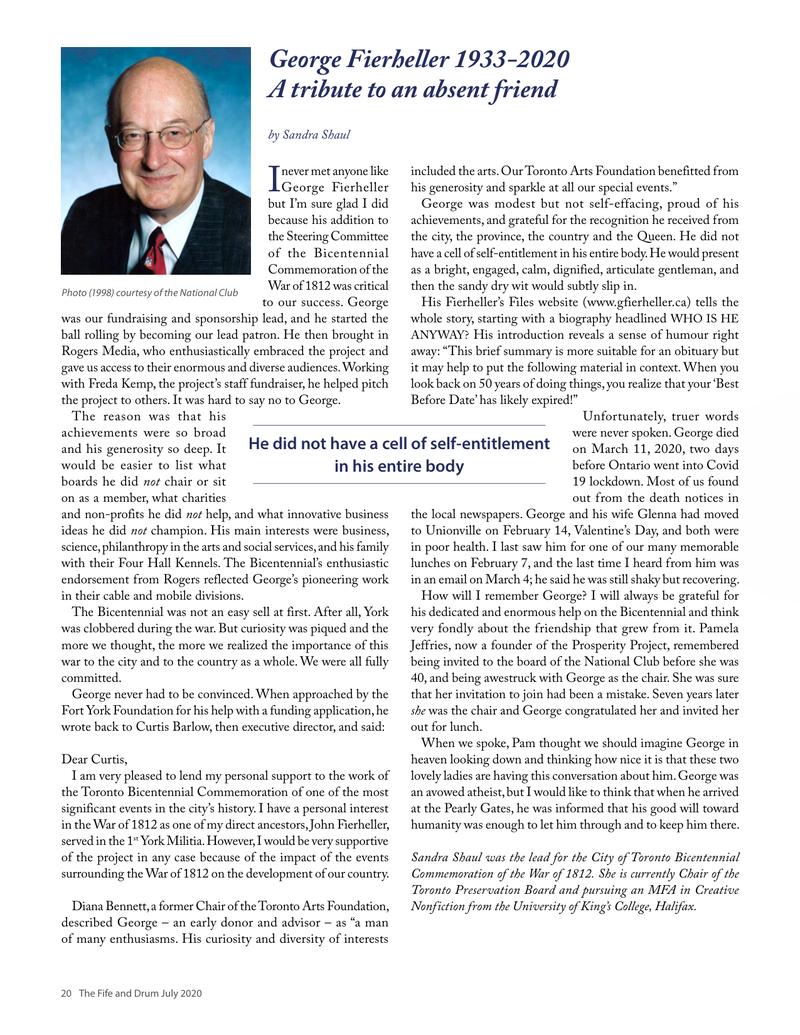
I never met anyone like George Fierheller but I’m sure glad I did because his addition to the Steering Committee of the Bicentennial Commemoration of the War of 1812 was critical to our success. George was our fundraising and sponsorship lead, and he started the ball rolling by becoming our lead patron. He then brought in Rogers Media, who enthusiastically embraced the project and gave us access to their enormous and diverse audiences. Working with Freda Kemp, the project’s staff fundraiser, he helped pitch the project to others. It was hard to say no to George.
The reason was that his achievements were so broad and his generosity so deep. It would be easier to list what boards he did not chair or sit on as a member, what charities and non-profits he did not help, and what innovative business ideas he did not champion. His main interests were business, science, philanthropy in the arts and social services, and his family with their Four Hall Kennels. The Bicentennial’s enthusiastic endorsement from Rogers reflected George’s pioneering work in their cable and mobile divisions.
The Bicentennial was not an easy sell at first. After all, York was clobbered during the war. But curiosity was piqued and the more we thought, the more we realized the importance of this war to the city and to the country as a whole. We were all fully committed.
George never had to be convinced. When approached by the Fort York Foundation for his help with a funding application, he wrote back to Curtis Barlow, then executive director, and said:
Dear Curtis,
I am very pleased to lend my personal support to the work of the Toronto Bicentennial Commemoration of one of the most significant events in the city’s history. I have a personal interest in the War of 1812 as one of my direct ancestors, John Fierheller, served in the 1st York Militia. However, I would be very supportive of the project in any case because of the impact of the events surrounding the War of 1812 on the development of our country.
Diana Bennett, a former Chair of the Toronto Arts Foundation, described George – an early donor and advisor – as “a man of many enthusiasms. His curiosity and diversity of interests included the arts. Our Toronto Arts Foundation benefitted from his generosity and sparkle at all our special events.”
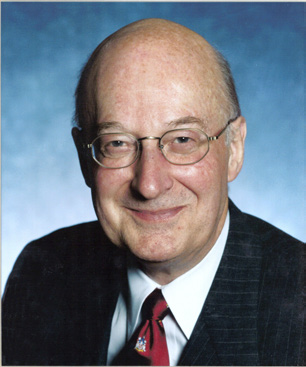
George was modest but not self-effacing, proud of his achievements, and grateful for the recognition he received from the city, the province, the country and the Queen. He did not have a cell of self-entitlement in his entire body. He would present as a bright, engaged, calm, dignified, articulate gentleman, and then the sandy dry wit would subtly slip in.
He did not have a cell of self-entitlement in his entire body
His Fierheller’s Files website (www.gfierheller.ca) tells the whole story, starting with a biography headlined WHO IS HE ANYWAY? His introduction reveals a sense of humour right away: “This brief summary is more suitable for an obituary but it may help to put the following material in context. When you look back on 50 years of doing things, you realize that your ‘Best Before Date’ has likely expired!”
Unfortunately, truer words were never spoken. George died on March 11, 2020, two days before Ontario went into Covid 19 lockdown. Most of us found out from the death notices in the local newspapers. George and his wife Glenna had moved to Unionville on February 14, Valentine’s Day, and both were in poor health. I last saw him for one of our many memorable lunches on February 7, and the last time I heard from him was in an email on March 4; he said he was still shaky but recovering.
How will I remember George? I will always be grateful for his dedicated and enormous help on the Bicentennial and think very fondly about the friendship that grew from it. Pamela Jeffries, now a founder of the Prosperity Project, remembered being invited to the board of the National Club before she was 40, and being awestruck with George as the chair. She was sure that her invitation to join had been a mistake. Seven years later she was the chair and George congratulated her and invited her out for lunch.
When we spoke, Pam thought we should imagine George in heaven looking down and thinking how nice it is that these two lovely ladies are having this conversation about him. George was an avowed atheist, but I would like to think that when he arrived at the Pearly Gates, he was informed that his good will toward humanity was enough to let him through and to keep him there.
Original printed pages