

The earliest view of the capital of Upper Canada following the War of 1812 is Robert Irvine’s grand oil painting “View of York,” of about 1816, now at the Art Gallery of Ontario. Masterfully impressive in scope and accurately detailed, it depicts Fort York, then recently rebuilt, as part of a broad panorama of the town and its harbour.
It is to the everlasting benefit of Toronto historians that he passed the time by sketching and painting
Irvine, an Orkneyman, was born Andrew Cruikshank in 1792. He changed his name in 1810 when he arrived in Canada and entered the service of the North West Company on one of its supply ships on the Great Lakes. By 1812 he was captain of the Caledonia owned by Angus Mackintosh of Moy, near Windsor, freighting trade goods and furs between Sault Ste. Marie and Fort Erie. When war broke out he placed his ship at the disposal of Captain Charles Roberts at Fort St. Joseph, who used it to great advantage in staging a surprise assault on the American fort at Mackinac. The result was a stunning victory for the British.
Later that season the Caledonia and its cargo of furs was seized at Fort Erie by an American party from Black Rock (Buffalo) who attacked under the cover of darkness. Irvine was captured but released a few days later in an exchange of prisoners following the Battle of Queenston Heights. The authorities in charge of the Provincial Marine, however, were not about to let his valuable experience go to waste. He was soon made a Second Lieutenant and posted to Amherstburg.
In January 1813 he fought on land at Frenchtown (now Munroe, Michigan), where he distinguished himself and was wounded. Promoted then to First Lieutenant, he was given charge of the brig General Hunter and saw action in May at Fort Meigs (now Perrysburg, Ohio). By September 1813 he was serving aboard the Queen Charlotte. After its captain was killed during the Battle of Lake Erie and the next in line knocked unconscious by a splintering timber, Irvine assumed command. Unfortunately, his lack of fighting experience was telling and he was forced to surrender his ship to the Americans.
Taken first to Sandusky with 300 other prisoners, and then to Ohio, in the early spring of 1814 he and 77 others were marched to Frankfort, Kentucky, and locked up in the state prison there. Because the jail was overcrowded, the terms of their confinement were liberal, but this respite did not last long. The Americans and British agreed in April 1814 on an exchange of prisoners which saw Irvine set out on a forced march northward to York. The march lasted three and a half months and was attended by fever and starvation. When Irvine finally arrived during the summer of 1814 he was able to recuperate at the home of his cousin, George Crookshank (as he spelled it), the Assistant Commissary-General. It is to the everlasting benefit of Toronto historians that he passed the time by sketching and painting. The whereabouts of all but about 15 of his works are unknown. Recently come to light is his small painting of the Garrison Common looking east from in front of Crookshank’s house toward the town of York, whose house-gables appear in the distance.
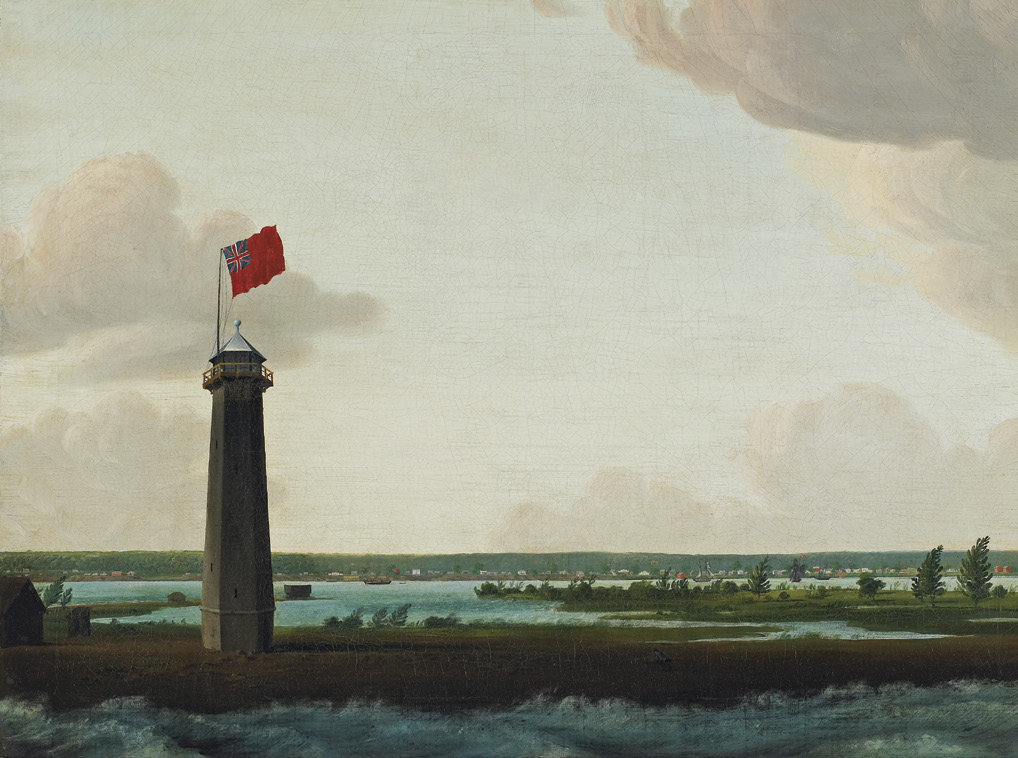
His grand oil-on-canvas view of York from across the harbour was clearly one of his major paintings, judging by its size and medium. It shows in some detail the buildings at the west end of the fort, including the Central Blockhouse, the Commandant’s House, completed in late 1815, the roofs of the Splinterproof Barracks, and of the Brick Soldiers’ Barracks, begun in the autumn of 1815. Clear also is the line of boulders and the shingle beach of Lake Ontario below the ramparts – just in front of where the Visitor Centre sits today. HMS Montreal sits at anchor on the right of the Gibraltar Point lighthouse (built in 1809) in its configuration as a troopship undertaken in early 1815. Because the deciduous trees in the painting are in full leaf, it seems likely that Irvine made the view in the early summer of 1816, about the time he was given command of the provincial government schooner Toronto on Lake Ontario. Although this appointment lasted less than a year before the Toronto was scrapped, it gave Irvine the opportunity to execute important documentary paintings at Queenston and Kingston.
Having assumed his sinecure to be more or less permanent, Irvine sought other recognition for his wartime service and was granted 1200 acres in three widely separated townships, though he never developed his lands. By December 1817 he was captaining a merchant vessel sailing between Saint John, N.B., and the West Indies carrying lumber, rum, sugar and coffee. His last recorded voyage was in September 1821. He died in Bridgetown, Barbados, in March 1823, of unknown causes, aged only thirty-one.

Front Street, just after the war
The big white house on the left, built in 1801, belongs to George Crookshank, then the senior supply officer of the army in Upper Canada and cousin of the artist. Dismissed as “a colonial cottage building” by John Ross Robertson, it was the scene of much drama two years earlier on the day of the Battle of York.
Crookshank, who was not married, fled on April 27, 1813, with General Shaeffe toward Kingston. His house that afternoon became the scene of the acrimonious negotiations for York’s surrender and was thoroughly looted. Two years later, Irvine painted a woman standing in the front doorway.
Next along Front, at Windsor St., is the home of John Beikie, who was then the Sheriff. He and his son Donald were in the thick of the fighting west of the fort but were back in time to see the departure of the general, who “left us all standing in the street like a parcel of sheep” (as he later wrote). His wife Penelope famously shooed away some hopeful looters but her husband complained that soldiers stole his chickens.
Further east on Front, two men stand outside the Half-Way House, “a resort for soldiers from the garrison,” as Robertson described the tavern. Sadly, it did not earn an entry in Guillet’s encyclopedic directory of such establishments. The barn-like structure beyond was a military storehouse, its jagged roofline suggesting, perhaps, that attempts to burn it down failed in the steady rain that drenched York in the days after the battle.

Original printed pages


