St. John the Evangelist Church was for many years an important spiritual and military establishment in Toronto. First established in 1858 and serving as the main religious base for the British garrisons of Fort York, the church continued after 1870 to be affiliated with various military units active in the neighbourhood. Located on Stewart Street inside the original boundaries of the fort’s first cemetery – Victoria Square – the church became known colloquially as “the Garrison Church.” But St. John’s was also the hub of an active Anglican parish that through much of the 20th century would be known city-wide for its charitable works. In the early 1920s they began, and then ran for more than 40 years, what became the largest free clinic in the city.
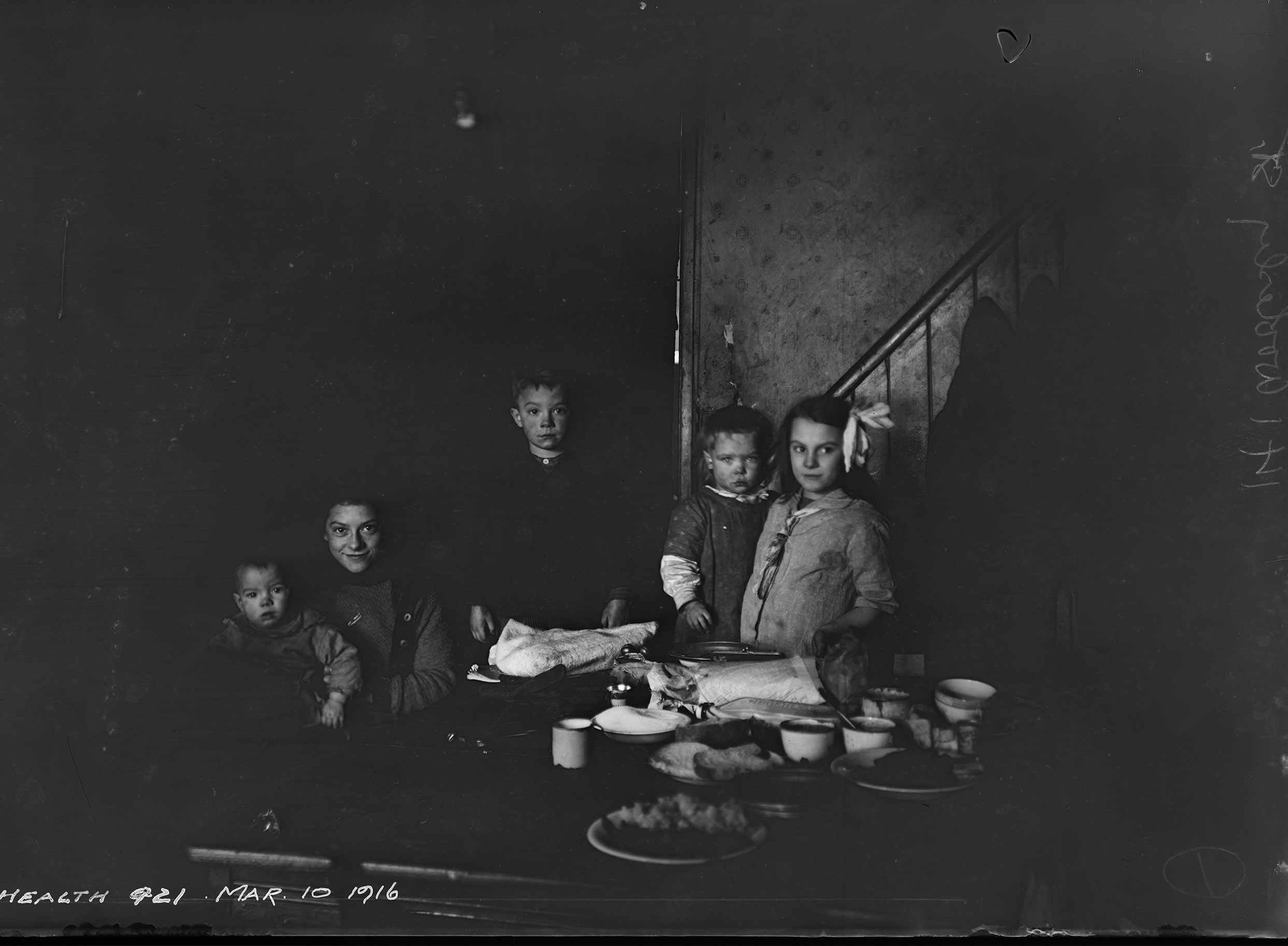
By the end of the 19th century, Toronto’s public persona was one of a successful, business-oriented city. This often self-aggrandizing view was the product of massive growth combined with dramatic change driven by industrialization and immigration. From 1880 through to the First World War, Toronto would more than double in area through the annexation of its surrounding suburbs. It would also undergo a population explosion, growing from 180,000 in 1880 to 376,000 in 1911. While prosperity was enjoyed by many, some were less fortunate. The working class, the poor, and a growing immigrant population were artfully ignored by this somewhat smug view of a bustling city.
St. John’s parish adjacent to the Old Fort (as it was called then) experienced these changes first hand. Many of the private homes built north and east of the church were disappearing, giving way to factories cheek to jowl with the remaining houses (the results can still be seen along Portland). At the same time, the original middle-class residents of the 19th century parish were being replaced by large numbers of the working poor, living in less-than-ideal conditions and including many from overseas whose first language was not English.
By the 1930s, the afternoon and evening clinics were seeing more than 12,000 patients a year
The proliferation of inner-city poverty prompted the city’s Medical Officer of Health, Dr. Charles Hastings, to launch an enquiry in the spring of 1911. For the purposes of his study, Dr. Hastings identified six areas of the city that he felt were the worst of the worst. One of the target neighbourhoods, called the Niagara District, was the area immediately north of the Old Fort – now crowded by industry and the railways – and within the boundaries of St. John’s parish. In July 1911, Hastings released a shocking report on the “slum conditions” of these neighbourhoods and began a long crusade to improve the public health of the city. Many others, including clergymen, were inspired to help.
The Rev. Robert J. Moore of St. George the Martyr church in the autumn of 1912 proposed a meeting of the downtown parishes to see what they could do as a common effort. The Rev. Alex Williams and the Rev. J. Russell MacLean of St. John the Evangelist readily agreed to attend. The result was the organization of the Downtown Church Workers Association (DCWA) to help parishes create their own social assistance programs and to coordinate and train parish volunteers.
By the early summer of 1913 charitable work in St. John’s parish included regular clothing and food drives. Later that summer, parish volunteers erected a large tent in what they called the Memorial Park (Victoria Square) to shelter a ‘well baby clinic’ attended by a City of Toronto Public Health Nurse. Also that year some 700 mothers and 1,300 children were taken into the country for a one-day picnic.

Summer outings for those who couldn’t afford their own trip to the country became an important part of the DCWA’s social work. The parish itself in 1922 opened St. John’s Rest Home and Fresh Air Camp at Corbett’s Point on Lake Ontario near Whitby. The camp was a popular program and by 1928 some 550 people from the parish – which now included the city’s new garbage incinerator and a very busy abattoir – were escaping to a week or two in the country each summer.
The social welfare programs of St. John’s continued throughout the First World War. The enlistment, and then loss, of so many men had left many families with little support. Then, right after the war, new health-care issues were added to the social worries of the community, indeed of the whole country. Through all of 1919 and 1920 Canadian soldiers were returning home from Europe, leaving behind nearly 60,000 of their comrades, and preceded by more than 170,000 wounded.

Repatriated soldiers faced growing unemployment, low hourly rates, and – if all that wasn’t enough – the city was still suffering the effects of the Spanish Flu. The world-wide pandemic had killed some 50,000 Canadians, including 1,700 in Toronto, leaving still more families destitute. Given that health-care services then were strictly pay-as-you-go, basic medical care was beyond the means of many, and especially of many in the Niagara District.
In November 1921, “The Incessant Battle with Want” – as a Globe headline put it – led the Rev. MacLean and his more prosperous parishioners to plan a new initiative: St. John’s Medical Mission and Dispensary. The mission, held four times a week in the basement of the church, was opened the following March. MacLean dedicated the effort to “the Gallant dead of the parish and congregation, who made the supreme sacrifice in the Great War.”
In organizing the medical mission, MacLean worked closely with two prominent Toronto doctors: John Taylor Fotheringham and Herbert Ernest Clutterbuck. Dr. Fotheringham was the post-war commander, as a major general, of the Militia component of the Canadian Army Medical Corps and, in the civilian world, on the faculty of the University of Toronto. He had joined the Militia as a student at the university and served as Surgeon Lieutenant of the 12th York Rangers and later the Queen’s Own Rifles. Fotheringham went overseas with the 2nd Canadian Division and was appointed the formation’s senior medical officer in 1915. The official history of the medical service declared him John Fotheringham was trusted as a man of fair mind and generous spirit.
free medical services to anyone who attended, regardless of race, religion or denomination
Dr. Herbert Ernest Clutterbuck, a friend and colleague, was chief surgeon at St. John’s Hospital, on Major Street just north of College, and later chief surgeon of Toronto Western Hospital, at Bathurst and Dundas. Clutterbuck was a graduate of the University of Toronto and had served as a medical officer with the British army during the war. He also taught at the university. Dr. Alex D. McKelvy, another experienced physician, volunteered to be the ear, nose and throat specialist.
The clinic was attended by the Sisterhood of St. John the Divine and served as an outpatient clinic for their hospital three blocks to the north. Operating expenses were largely covered by the Toronto Garrison Business Men’s Association, led by local entrepreneurs such as Edmund Collett and Bartholomew Sproulc, principals of their packaging company at 127 Portland, and C.S. Smith, of the Dominion Paper Box Company at 469 King St. West. The hospital itself spent $2,500 on the initial renovation and equipment of the church basement.
From the day the medical mission opened on Saturday, March 4, 1922, it offered free medical services to anyone who attended, regardless of race, religion or denomination. Available were medical consultations and treatments; pre- and postnatal care; ear, nose and throat treatments; and eye clinics for children. The dispensary provided free prescriptions. Surgical referrals were dealt with by volunteers at St. John’s Hospital after normal hours. By the 1930s, the afternoon and evening clinics were seeing more than 12,000 patients a year.
For the next three decades the clinic endured continuing challenges. In November 1931 the church’s leadership changed when the Rev. Joseph T. Robbins became Rector of St. John’s after the death of the beloved J. Russell MacLean. The Depression put a severe strain on the mission’s resources, forcing parishioners to increase their fundraising and to apply for more financial support from the City. The Fresh Air Camp near Whitby had been scaled down by 1933 and soon after was closed. Robbins also reorganized the clinic’s staff in 1937 when the Sisters of St. John the Divine moved to their new convalescent hospital in far-away North York. He soon secured a new affiliation with Toronto Western.
Long the destination of church parades (meaning organized, mandatory attendance) from the nearby garrisons, St. John’s broadened its relationship with the armed forces during the Second World War. Robbins commissioned as a captain (later major) in the army’s Chaplain Service – becoming a “padre” to the units – and St. John’s received the colours of the Royal Canadian Dragoons, who had long been stationed at the Stanley Barracks. The soldiers and aircrews of the wartime Little Norway camp at the foot of Bathurst declared St. John’s their official church and attended services there in strength.


The Medical Mission and Dispensary sustained itself throughout the war as the local industrial workforce grew sharply. During the 1950s the basement clinics were being attended by some 18 volunteer doctors and a comparable number of Registered Nurses. By the end of the decade the mission was advertising a psychiatric department. Even as church-service attendance declined after the war, St. John’s medical mission was reporting 15,000 patients per year, many from outside the parish.


Joseph Robbins passed away in 1957 – after serving the parish as rector for 26 years – and the hard decision was made in 1962 to demolish the aging church (its 1892 cornerstone survives in Victoria Square). Anticipating the loss, the wardens of the church had a modern secular building put up next door. St. John’s House included worship space; a gymnasium, a kitchen and a rector’s apartment, serving a dwindling parish until 1985. But the ambitious clinic could not be kept up and it closed soon after being re-established. The final service at St. John the Evangelist Anglican Church was held on November 11, 1963, with the pipes of the Irish Regiment of Canada, of Fort York Armoury, playing the lament.
When medical care and hospital stays are only available to those who can afford them, a lot of needs will go unmet. These needs were among those, for housing and sanitation as well as for medical care, so dramatically revealed by the Medical Officer of Health in 1911. St. John’s Medical Mission and Dispensary, begun in 1922, was part of the answer. By the time it expired there were new winds of change in the air.
In the 1960s, governments were no longer discussing whether Canadians should have open access to health care; rather, they were talking about how to build a national health-care system. The introduction to Parliament of the Medical Care Act in 1966 was a harbinger that we should indeed have universal care. At last, the medical care provided by so many by local charities like St. John’s church was no longer needed.
A note on sources
The author appreciates the generous help of Barbara Putnam, niece of Major Rev. Robbins, and especially of Molly Robbins, his daughter, who provided valuable insights and photographs.
The original report on the slums of Toronto is available as Dr. Charles Hastings, Report of the Medical Officer of Health, dealing with the recent investigation of ‘slum conditions’ in Toronto 1911 (City of Toronto Archives, Fonds 200, Series 365, File 14). Paul Bator’s unpublished PhD thesis on public health in Toronto up to 1930 is also available in the archives as Fonds 92, Item 13. For a history of the Downtown Church Workers Association, see John F. Hayes, The Challenge of Change 1912-1962. For more on J.T. Fotheringham, see Sir Andrew Macphail, Official History of the Canadian Forces in the Great War 1914-1919: The Medical Services, published in 1925.
The web site of the Canadian Museum of History has an excellent short account of health care in Canada since 1914, while a charming story of the 1892 cornerstone’s trowel, by historian Richard Gerrard, can be found in Vol.22, No.1 of The Fife and Drum. The definitive story of St. John the Evangelist (Garrison) Church remains Stephen Otto’s account for the Wellington Place Neighbourhood Association, at www.wellingtonplace.org/history/church.php.
Original printed pages