The new Visitor Centre is bound to give Fort York a higher profile within the city. Prominent signage and easier access from Fleet and Bathurst streets will boost visitation, while the new pedestrian and cycling bridge over the rail corridors east of Strachan Avenue will connect the fort with neighbourhoods to the north. In this second of a series of articles on the Visitor Centre and its setting, Kevin Plummer takes us on a walkabout of the building and explains its impressive features as visitors will experience them.
The main vehicular access to the site will be the same as now, off Fort York Boulevard, but parking will be moved from its present location on the Common to under the Gardiner Expressway, close to the Visitor Centre. Overflow and bus parking may be west of the Armoury.
Along the south side of the Visitor Centre where the Gardiner forms an arcade over the entrance plaza, the landscaping mimics the old wooden wharves and grassy shallows once found along Toronto’s lakefront, recalling the original lakeshore. Guests will enter the Visitor Centre by passing under one of the massive rusting-steel slabs—each weighing one ton—some of which are flipped up—that form an escarpment-like wall along the facade.
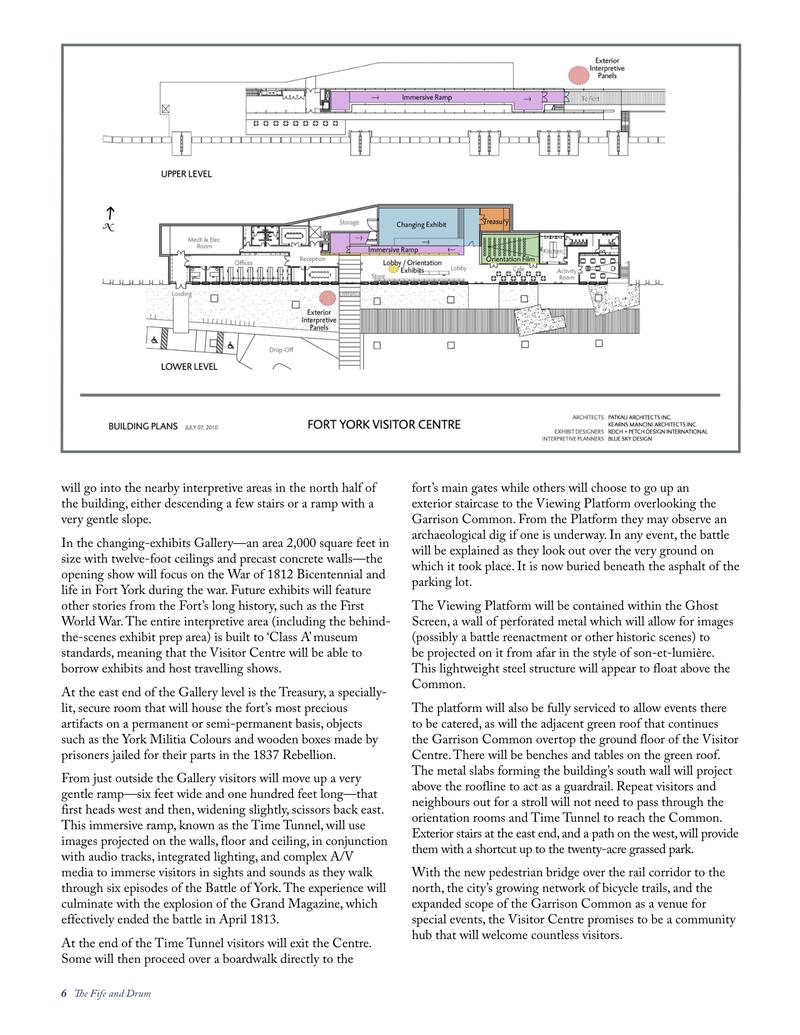
The challenges of building on the edge of an important archaeological site have led to the creation of a linear building, stretching along a roughly east-west axis. Its main public entry—on the south near the approximate centre—acts as a de facto demarcation between the public areas and the administrative offices within.
Inside on the left is the Volunteer Office, a space for the use of groups like the Evergreen gardeners, Friends of Fort York, and Fort York Management Board. Next, there is a Meeting Room which can be used by staff, site-based volunteers, and community groups. Across the way the Resource Centre will house the fort’s substantial library. Behind closed doors at the west end of the entry hall will be site offices and work spaces for curatorial staff and special events coordinators.
Most visitors, however, will not be concerned with the fort’s administration. They will turn right into the reception area to be greeted there by staff at the desk beside the retail store. The entire north wall of this lobby area will be used for interpretation or displays orienting visitors to the site in its greater context.
Almost every square foot of the main floor has been designed to function as both a museum and community centre. And so, while the lobby and common areas occupying roughly the southern half of the building may appear narrow on a plan, in reality they will be quite open to ensure the greatest ease of movement and flexibility for after-hours usage. The cafe, with seating indoors and out, promises to be a hub of activity both during the fort’s regular operations as well as after hours, while the kitchen will allow on-site catering for special events.
Next to the cafe, at the building’s extreme east end, is a room designed to accommodate a variety of activities. This Multifunction Space will be the first stop for school groups where teachers can orientate classes or lead activities. In the evenings, it can serve as a second meeting room for community groups. To the north of the Multifunction Space is one set of public washrooms. Another, nearer the front entrance, is located on the north side of the lobby.
Visitors will begin their tour of the fort in the sixty-person Orientation Theatre. After an audio-visual presentation they will go into the nearby interpretive areas in the north half of the building, either descending a few stairs or a ramp with a very gentle slope.
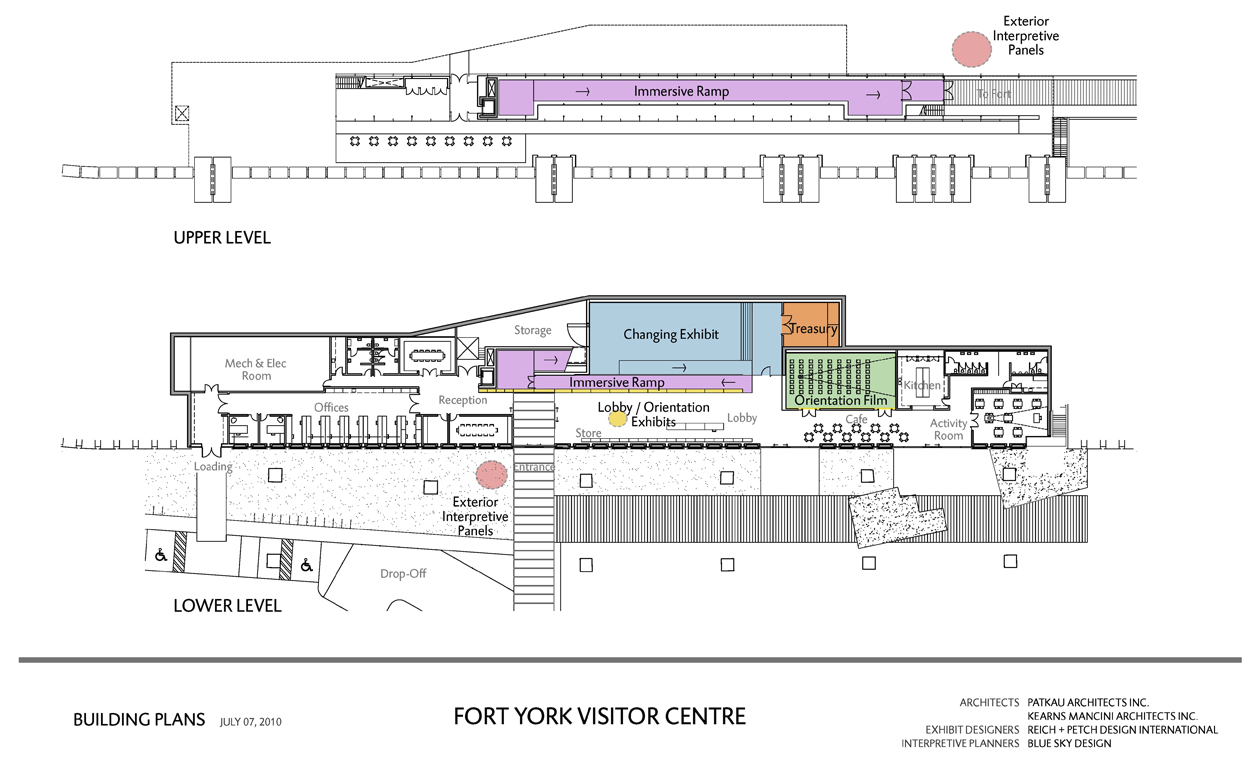
In the changing-exhibits Gallery—an area 2,000 square feet in size with twelve-foot ceilings and precast concrete walls—the opening show will focus on the War of 1812 Bicentennial and life in Fort York during the war. Future exhibits will feature other stories from the Fort’s long history, such as the First World War. The entire interpretive area (including the behind-the-scenes exhibit prep area) is built to ‘Class A’ museum standards, meaning that the Visitor Centre will be able to borrow exhibits and host travelling shows.
At the east end of the Gallery level is the Treasury, a specially-lit, secure room that will house the fort’s most precious artifacts on a permanent or semi-permanent basis, objects such as the York Militia Colours and wooden boxes made by prisoners jailed for their parts in the 1837 Rebellion.
From just outside the Gallery visitors will move up a very gentle ramp—six feet wide and one hundred feet long—that first heads west and then, widening slightly, scissors back east. This immersive ramp, known as the Time Tunnel, will use images projected on the walls, floor and ceiling, in conjunction with audio tracks, integrated lighting, and complex A/V media to immerse visitors in sights and sounds as they walk through six episodes of the Battle of York. The experience will culminate with the explosion of the Grand Magazine, which effectively ended the battle in April 1813.
At the end of the Time Tunnel visitors will exit the Centre. Some will then proceed over a boardwalk directly to the fort’s main gates while others will choose to go up an exterior staircase to the Viewing Platform overlooking the Garrison Common. From the Platform they may observe an archaeological dig if one is underway. In any event, the battle will be explained as they look out over the very ground on which it took place. It is now buried beneath the asphalt of the parking lot.
The Viewing Platform will be contained within the Ghost Screen, a wall of perforated metal which will allow for images (possibly a battle reenactment or other historic scenes) to be projected on it from afar in the style of son-et-lumière. This lightweight steel structure will appear to float above the Common.
The platform will also be fully serviced to allow events there to be catered, as will the adjacent green roof that continues the Garrison Common overtop the ground floor of the Visitor Centre. There will be benches and tables on the green roof. The metal slabs forming the building’s south wall will project above the roofline to act as a guardrail. Repeat visitors and neighbours out for a stroll will not need to pass through the orientation rooms and Time Tunnel to reach the Common. Exterior stairs at the east end, and a path on the west, will provide them with a shortcut up to the twenty-acre grassed park.
With the new pedestrian bridge over the rail corridor to the north, the city’s growing network of bicycle trails, and the expanded scope of the Garrison Common as a venue for special events, the Visitor Centre promises to be a community hub that will welcome countless visitors.
Original printed pages