

By 1 pm on Tuesday, 27 April 1813, the American force attacking York had victory within its grasp. And then an explosion ripped the earth and rained death upon the advancing column as the grand magazine near the British garrison blew up. A stone block ended Brigadier General Zebulon Pike’s career with a fatal blow. Thirty-eight others were killed and 224 were wounded, some of whom survived for only days.
Descriptions of the debris that fell on the American column provided the first information about the actual construction of the magazine. ‘At first the air was darkened with stones, rafters and clay,’ wrote artillery officer Major Abraham Eustis. Aide-de-camp to Major General Henry Dearborn, Lieutenant Colonel Samuel Conner, referred to ‘Cart loads of stone, and an immense quantity of iron, shell and shot.’ Some of the Americans thought the British had laid a mine beneath the approach to the garrison for the purpose of destroying a marching column. General Dearborn’s opinion was that his enemy had built an ‘immense magazine… so contrived as to discharge much of the greatest portion of stones in the direction our columns were advancing.’ Dearborn was closer to the mark, although there is no proof that British engineers designed a magazine with the destruction of an enemy in mind. In fact, very little is actually known about the construction of the building that blew up that afternoon.
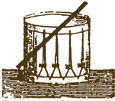
Every military garrison and any warship needed to have a secure storage space for the types of black powder used in cannon and small arms. The record shows that ‘A Powder Magazine of square Hemlock Logs was built in 1795’ at York and in 1811 Major General Isaac Brock referred to it as the ‘small wooden shed not sixty yards from the King’s house which had served as a magazine for some years.’ The ‘King’s house’ was the residence of the lieutenant governor situated on the west side of Garrison Creek opposite the stockaded garrison, blockhouse, and barracks. If it had survived time, the building would have stood about the centre of Historic Fort York today, where the location near the magazine has been marked since May 1968 by a memorial maple tree.
After the declaration of war in June 1812 work began to improve the fortifications at York and continued through to the following spring. It resulted in the construction of four batteries west of Garrison Creek, initial work on the rampart on the west side of the modern site, and a new magazine. But engineering plans for each of these structures have yet to come to light.
There is only one detailed description of the magazine, located in the Amasa Trowbridge Papers
There is only one detailed description of the magazine, located in the Amasa Trowbridge Papers held by the U. S. Library of Congress. Trowbridge was an American surgeon who helped treat the wounded after the battle. He must have viewed the nearby vast crater where the magazine had been and then discussed its structure with local men. In the mid-1850s he wrote a full description as part of the account that he sent to Benson Lossing who was collecting recollections from veterans for his Pictorial Field-book of the War of 1812 (published in 1868). With some minor clarifications, Trowbridge’s description follows:
[A] little farther west [from the Government House Battery] stood their principal magazine, being about Thirty feet [in size] with solid mason work and stone, 30 feet deep in the earth and [with] an entrance at the bottom from the lake. Over this stood a large stone building with apparatus for elevating military stores from the bottoms, different apartments were formed and arranged for the reception of military and naval stores. It was admitted that there were five hundred barrels of powder on the first floor and the other rooms filled with fixed ammunition and the stone Arsenal above well-filled with the same material. All of an explosive character.
This sort of structure was typical of designs used during the period to erect storage buildings with magazines securely protected in their lower portions. Colonel Cromwell Pearce, who held command briefly after Pike fell, must have talked to someone who knew about the structure because he wrote that it was ‘considerably below the surface of the ground… and lined to keep the powder dry and arched with large stones.’
Ordnance reports for March 1813 show that a very large amount of ordnance was in storage at York, much of which must have still been in the magazine on 27 April. These included over 300 barrels of powder, 10,000 round shot, 600 grape shot, 700 common case, 750 shells, and 40,000 prepared musket cartridges.
There were very few British or Canadians wounded by the detonation, but nearly all of them were well out of range when the detonation took place. Casualty reports for the regiments located further back in the American column and remarks by the survivors suggest that the debris field extended about 500 yards from the magazine. Another explosion of black powder that took place on 12 January 1807 in the town of Leiden, Holland, supports this contention. A transport vessel carrying 369 barrels of black powder was docked alongside the canal in the centre of Leiden when it accidentally blew up, resulting in the death of more than 150 people and the injury of 2000 others. It destroyed 220 homes, flattening structures within 185 yards, damaging others up to 530 yards away, and breaking windows at a distance of nearly 1700 yards. Most of the debris from the ship fell within 500 yards of the canal although an anchor landed nearly 1000 yards away. It is estimated that the fireball achieved a temperature of 1650 degrees Celsius and that the explosive force was equal to that produced by about 9 tons of TNT.

No participant at York ever referred to debris that damaged the town, which is not surprising since its western edge was more than 1000 yards in the distance. Only rare comments like that of Ely Players’ indicated the sad state of the garrison. In his diary he noted that the place was ‘shattered and rent even by the [artillery] balls and the explosion of the magazine, not a building but shewed some marks of it and some all torn to pieces.’
Late in 1813 work began to remove the ruins of the garrison, the lieutenant governor’s residence, and other buildings. Construction included a magazine inside the new fort while the crater where the old magazine had been was eventually filled in and the description of the building more or less forgotten.
Perhaps someday a researcher will uncover the British engineering plan for the lethal magazine that ruined Pike’s victory and another question about the battle of York will be answered.
Original printed pages


