

“Who shall say what Toronto may not yet be?” asked one of the city’s newspapers in 1844 as it admired the many local improvements rising on all sides, somewhat unexpectedly, after the seat of government had been moved to Kingston and predictions proved wrong that grass would grow in the streets of Toronto. Another journal, noting the evident signs of progress, remarked, “One great work remains [unrealized]… The Toronto and Lake Huron Railroad.” While railway-building had been in the air since the mid-1830s when a line to Lake Huron was surveyed, all plans had been put on hold by political and economic uncertainty following the 1837 Rebellion.
Responding to the political unrest, British authorities asked Lord Durham to look into matters. His impressive report gave rise to legislation at Westminster in 1840 to combine Upper and Lower Canada into the Province of Canada. In tidying up some loose ends a few years later, the Imperial Parliament passed the Canada Vesting Act empowering the Parliament of Canada to authorize the construction of canals or railways over lands set apart for military purposes.
Thus, the stage was set for untrammeled railway expansion near Fort York. The plot to make railway-building a matter of public business was advanced by the Canadian Parliament when it passed general railway legislation, specific company charters and acts of incorporation. As the mania for railways climaxed in the 1850s the stream of loan guarantees, municipal subsidies, bond purchases and pieces of facilitating legislation seemed endless. In this frenzied environment the sacrifice of Ordnance lands to facilitate construction was small potatoes, made easier because until 1856 the Province of Canada had no responsibility for the lands, including Toronto’s Garrison Common; they were managed by the British Board of Ordnance.
Initially three railway companies were chartered to serve Toronto. They all pursued their own interests with vigor and hardly a side glance for the common good. The Board of Ordnance was powerless to resist. So long as any of its land taken was paid for, few people seemed worried about good land planning or compromising Fort York. Toronto mayor John George Bowes was an exception. In an effort to preserve the City’s lease on 287 acres of the Garrison Common for a Western Park, he wrote the Officers of H.M. Ordnance in March, 1852, proposing the Northern, Western and Eastern Railroad companies be induced to unite and enter the City by the Garrison Ravine. (See Fife & Drum, August 2005) Presumably his far-sighted suggestion carried extra weight because he was also President of the as-yet-unbuilt Toronto & Guelph Railway. But nothing came of it.
The Ontario, Simcoe & Huron (OS&H) was the first to start construction in October, 1851, when Lady Elgin officiated at a sod-turning ceremony. Service from Toronto to Aurora began in May, 1853, and to Allandale, near Barrie, six months later. The OS&H’s operations occupied 34 acres of Ordnance land at Toronto. Most of it was used for a depot south of Front Street between Bathurst and Spadina. The balance lay in a rail corridor that carried the tracks west from the depot, along the north side of Garrison Creek and then in a long arc across the Common to Queen Street. A spur line south to the Queen’s Wharf wrapped tightly around the fort’s east end. These works required the leveling of the site of the original Fort York on the east bank of Garrison Creek, filling much of the adjacent ravine, and diverting the Creek itself into a sluiceway.
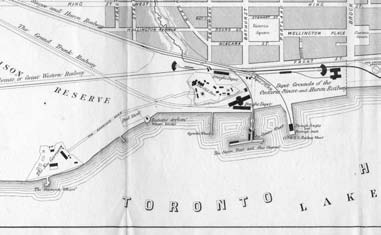
The second railway to serve Toronto was the Great Western (GWR) which, for technical reasons, was organized as the Hamilton & Toronto. Its construction started at the Hamilton end in April, 1853. By the time it secured “eleven acres of the Ordnance land at the west end of the Queen’s Wharf adjoining the Old Fort” for its Toronto terminus, the area had become crowded. The GWR was forced to fill even more of the Garrison Creek ravine in order to slip its tracks, locomotive roundhouse and passenger station between the OS&H right-of-way and the north ramparts of Fort York. Service between Toronto and Hamilton opened in December, 1855.
By then Toronto’s third railway, the Grand Trunk was well along in building its line from a staging area south of Fort York. Of 20 acres of land it had there, almost ten were reclaimed from the lake by its enterprising contractors, C. S. Gzowski & Co. The rest was acquired from the Board of Ordnance. When trains began running to Guelph, Berlin [Kitchener] and Stratford in June, 1856, there was no connection between this part of the GTR and the main line joining Toronto with Montreal. Only in 1857 were tracks laid along the city’s esplanade. Accordingly, the GTR’s western section required, besides the usual freight house and passenger station, a huge locomotive house some 585 feet long for maintaining the engines, particularly in the punishing Canadian winter. These buildings, located on fill south and east of Fort York, closed the noose to within a few feet of the ramparts on all sides but the west.
What had been put in place within five short years proved very long-lasting. Although the names of the railways and who controlled them changed, their marks on the landscape have endured for more than 150 years. The OS&H was renamed the Northern Railway in 1858 and taken over by the GTR in 1888, which in turn was combined with the Canadian National system in 1920. Today its right-of-way survives as the CN Georgetown line. The GWR was merged with the GTR in 1882, and its corridor continues to serve as the CN main line between Toronto and Hamilton. About 1871 the GTR leased running rights on its Garrison Common tracks to the Toronto, Grey & Bruce Railway, in which it had a minority interest. In 1883 the TG&B came to be controlled by the Canadian Pacific Railway, and CP bought the former GTR right-of-way and yards. The engine house came down in 1888/90, but its foundations still turn up whenever there is an archaeological excavation in the area.
Only recently has Fort York got some of its own back. In the 1990s nearly 9 acres were added to the south edge of the site under development agreements with Wittington Properties and Molson Breweries, and a further 3.5 acres acquired from CN along the northern ramparts. The Fort York National Historic Site now takes in 41 acres around the fort, and another two acres in Victoria Memorial Square.
Original printed pages


